Author: Jinfiniti Science

Image of a senescent 'zombie cell'

‘Zombie Cells’ Are Quietly Aging You Faster

What You Should Know

  • Zombie cells are aging cells that stop dividing but don’t die, continuously releasing inflammatory compounds that damage the tissue around them.
  • They accumulate naturally with age because the immune system becomes less efficient at clearing them over time.
  • Not all zombie cells are harmful; some serve short-term repair roles, but chronic buildup is linked to a range of age-related conditions.
  • Fisetin and quercetin are the best-studied natural compounds for targeting zombie cells, with early human trial data supporting their use.

Right now, somewhere in your body, there are cells that have stopped working but haven’t died. They’ve dropped out of the cell cycle completely, sitting inert in your tissues while continuously leaking toxic signals into everything around them.

Scientists call them senescent cells. Most people call them zombie cells. And the older you get, the more of them you collect.

What makes this worth understanding is that the process runs silently, with no obvious symptoms, for years before it shows up as something recognizable. The good news is that this mechanism is well understood, and the science of addressing it has moved faster than most people realize.

Fisetin + Quercetin Complex

Target senescent cells naturally.
Jinfiniti SenoAid mockup with gradient background

What Are Zombie Cells?

In a healthy cell cycle, cells divide, wear out, and eventually self-destruct through a process called apoptosis, the body’s built-in cleanup mechanism. Old cells die. New cells replace them. The system works.

Zombie cells skip the last step. They stop dividing, but they don’t die. Instead, they enter a kind of permanent standby mode and start releasing a steady stream of inflammatory proteins and enzymes. Researchers call this the senescence-associated secretory phenotype, or SASP. Think of it as a slow chemical leak that doesn’t stop.

One or two zombie cells aren’t a serious problem. The issue is accumulation: thousands or millions of them building up across your tissues over years, generating chronic low-grade inflammation that gradually impairs the cells and organs around them.

Healthy Aging CellZombie (Senescent) Cell
Divides normally?Yes, until worn outNo
Dies via apoptosis?YesNo, resists death
Releases inflammatory signals?MinimalYes, continuously
Cleared by immune system?Generally yesLess so, especially with age

Why They Pile Up With Age

When you’re young, your immune system is reasonably good at identifying and clearing senescent cells before they cause lasting problems. Short-term senescence actually serves a purpose — it plays a role in wound healing and in suppressing abnormal cell growth. The cells form, do their job, and get cleared out.

With age, that clearance becomes less efficient. Zombie cells start accumulating faster than your body removes them. Several things accelerate this process:

  • DNA damage from UV exposure, environmental toxins, or replication errors over time
  • Chronic oxidative stress from poor diet, inactivity, or prolonged illness
  • Ongoing low-grade inflammation, which itself triggers more cellular senescence, creating a feedback loop that compounds over time
  • Past illness or injury that left unresolved cellular damage behind

The result is a gradual accumulation that builds over decades, not weeks. By the time most people notice something is wrong — persistent fatigue, joint pain, slower recovery from illness — the buildup has been underway for years.

What Zombie Cells Are Linked To

Senescent cell accumulation doesn’t cause one specific disease. It appears to accelerate whatever your biology is already predisposed to. That’s part of what makes it hard to study and easy to miss.

The conditions consistently linked to high zombie cell burden include:

  • Alzheimer’s disease and cognitive decline
  • Osteoarthritis and chronic joint inflammation
  • Cardiovascular disease and arterial stiffness
  • Type 2 diabetes and insulin resistance
  • Pulmonary fibrosis (progressive lung tissue scarring)
  • Osteoporosis and bone loss
  • Muscle loss with aging (sarcopenia)
  • Chronic inflammatory conditions across multiple organ systems

The pattern is consistent across both animal models and early human research: zombie cells don’t cause disease from scratch. They speed up the diseases you were already heading toward.

Some Zombie Cells Actually Help Your Body Heal

The “destroy all zombie cells” narrative is an oversimplification — and a fairly important one to get right.

A 2022 study published in Science from UC San Francisco found that some senescent cells are embedded in healthy young tissue, particularly in the lungs, intestines, and skin, where they function as repair sentinels. When researchers used senolytic drugs to eliminate all senescent cells in these tissues, healing from injury actually slowed down.

This finding actually sharpens the case for addressing zombie cells. The research community’s approach is increasingly focused on intermittent, targeted interventions that reduce chronic accumulation rather than aggressively wiping out every senescent cell in the body. This is sometimes called “hit-and-run” dosing: brief senolytic treatment with rest periods in between.

The goal is burden reduction, not total elimination. That distinction matters if you’re considering any senolytic supplement or protocol.

Can You Measure Your Zombie Cell Burden?

There’s no simple test that directly counts your senescent cells. But that doesn’t mean you’re flying blind.

Senescence markers, the proteins zombie cells produce at elevated levels, can be measured as reliable indicators of cellular aging. One of the most established is beta-galactosidase (β-gal), an enzyme that accumulates in senescent cells and is used in research settings as a standard marker of cellular senescence. These markers are included in Jinfiniti’s AgingSOS Advanced Panel, alongside other biological aging biomarkers.

This is where biological age testing becomes practically useful. Chronological age tells you how many years you’ve lived. Biological age, tracked through markers like these, tells you more about how your cells are actually holding up. That gap is often where the clearest opportunities for intervention are.

The Natural Senolytics With the Most Evidence

A senolytic is any compound that selectively targets and promotes the death of senescent cells, by disabling the survival pathways those cells rely on to persist. Several pharmaceutical senolytics exist, including dasatinib, a cancer drug used in research settings. For most people exploring natural approaches, two compounds have the most evidence behind them.

They’re both plant-derived flavonoids, each studied specifically for senolytic activity. They work on different mechanisms, which is why research supports using them together rather than choosing one.

Fisetin

Among 10 flavonoids screened in a major study at the Mayo Clinic, fisetin ranked as the most potent natural senolytic. In aged mice, intermittent fisetin treatment reduced senescence markers across multiple tissues, restored tissue homeostasis, and extended both median and maximum lifespan. The effects persisted after fisetin cleared the body, consistent with how a hit-and-run mechanism works, rather than a drug effect that requires continuous presence.

Human tissue studies, using adipose (fat) tissue samples, showed fisetin reduced senescent cell burden in a cell-type-specific way, meaning it didn’t indiscriminately eliminate every senescent cell, only certain populations. That selectivity matters clinically.

Fisetin is found in small amounts in strawberries, apples, and onions. The doses used in research are significantly higher than what diet alone provides.

Quercetin

Quercetin was the first flavonoid identified as senolytic, and it has more human data behind it than any other natural compound in this category.

In a first-in-human pilot study published in EBioMedicine, three days of dasatinib plus quercetin (1000mg daily) significantly reduced senescent cell burden in fat tissue and skin within 11 days, with measurable drops in circulating SASP inflammatory markers. This was the first peer-reviewed evidence that senolytics can directly clear senescent cells in humans, not just in animal models.

Quercetin and fisetin target different types of senescent cells through different pathways. Combined, they cover a broader range than either one alone.

“Targeting cellular senescence is one of the eight root causes of biological aging we look at clinically,” says Dr. Jin-Xiong She, founder of Jinfiniti Precision Medicine. “Quercetin and fisetin have the strongest evidence among natural senolytic compounds, which is why combining them made sense as a formulation approach.”

What the Evidence Actually Says

The animal data is strong and has been replicated across multiple independent labs. The early human data, particularly from the dasatinib and quercetin trials, is genuinely promising. But most human trials are still small and pilot-stage, and large randomized controlled trials are ongoing. This is a young field.

A few practical things to understand:

  • Bioavailability varies. Fisetin has relatively low bioavailability in standard form. Compounds like bromelain and piperine can improve absorption, which is a real consideration in any senolytic formulation.
  • Dosing approach matters. The hit-and-run method appears more consistent with the research than continuous daily use. Most protocols use short dosing windows with periods off.
  • The safety profile is favorable. For the natural flavonoids, there is little evidence of adverse effects at the doses studied. This is distinct from pharmaceutical senolytics like dasatinib, which have well-documented side effects from their primary clinical use.

To summarize where the science stands: solid mechanism, encouraging early human evidence, good safety profile for natural senolytics, and an evidence base that’s still being built out. If you have underlying health conditions or take medications, talk with your clinician before starting any senolytic protocol.

Chronic low-grade inflammation and cellular senescence reinforce each other, so looking at both together gives a more complete picture of what’s driving cellular aging.

Frequently Asked Questions

What are zombie cells?

Zombie cells — or senescent cells — are aging cells that have stopped dividing and resist normal cell death. Instead of clearing out of the body, they stay in your tissues and continuously release inflammatory compounds that can impair surrounding healthy cells over time.

What causes zombie cells to accumulate?

They accumulate naturally with age as the immune system becomes less efficient at clearing them. DNA damage, chronic oxidative stress, ongoing low-grade inflammation, and past illness can all accelerate the process.

Can you get rid of zombie cells naturally?

Fisetin and quercetin are the best-studied natural compounds for reducing zombie cell burden. They are senolytics — compounds that selectively promote the death of senescent cells by disabling the survival pathways those cells depend on. Early human data and extensive animal research support their use. Large-scale human trials are ongoing.

What are senolytics?

Senolytics are compounds that selectively eliminate senescent cells. Unlike general anti-inflammatory agents, which suppress symptoms, senolytics target the cells themselves by exploiting their dependence on specific pro-survival pathways. Both pharmaceutical and natural senolytics exist.

Is fisetin or quercetin better for senescent cells?

Both are backed by solid evidence. Fisetin is the more potent natural senolytic in head-to-head flavonoid comparisons. Quercetin has more human trial data. Because they work on different mechanisms and target different types of senescent cells, the research supports using them together rather than choosing one over the other.

How do I know if zombie cells are a problem for me?

There is no direct consumer test that counts senescent cells. However, senescence markers like beta-galactosidase can be measured as part of a comprehensive biological aging panel. Jinfiniti’s AgingSOS Advanced Panel includes these markers alongside other cellular health indicators, giving a more complete picture of how your biology is actually aging.

  • Reyes, N. S., Krasilnikov, M., Allen, N. C., Lee, J. Y., Hyams, B., Zhou, M., Ravishankar, S., Cassandras, M., Wang, C., Khan, I., Matatia, P., Johmura, Y., Molofsky, A., Matthay, M., Nakanishi, M., Sheppard, D., Campisi, J., & Peng, T. (2022). Sentinel p16INK4a+ cells in the basement membrane form a reparative niche in the lung. Science, 378(6616), 192–201. https://doi.org/10.1126/science.abf3326
  • Yousefzadeh, M. J., Zhu, Y., McGowan, S. J., Angelini, L., Fuhrmann-Stroissnigg, H., Xu, M., Ling, Y. Y., Melos, K. I., Pirtskhalava, T., Inman, C. L., McGuckian, C., Wade, E. A., Kato, J. I., Grassi, D., Wentworth, M., Burd, C. E., Arriaga, E. A., Ladiges, W. L., Tchkonia, T., Kirkland, J. L., Robbins, P. D., & Niedernhofer, L. J. (2018). Fisetin is a senotherapeutic that extends health and lifespan. EBioMedicine, 36, 18–28. https://doi.org/10.1016/j.ebiom.2018.09.015
  • Hickson, L. J., Langhi Prata, L. G. P., Bobart, S. A., Evans, T. K., Giorgadze, N., Hashmi, S. K., Herrmann, S. M., Jensen, M. D., Jia, Q., Jordan, K. L., Kellogg, T. A., Khosla, S., Koerber, D. M., Lagnado, A. B., Lawson, D. K., LeBrasseur, N. K., Lerman, L. O., McDonald, K. M., McKenzie, T. J., Passos, J. F., Tchkonia, T., & Kirkland, J. L. (2019). Senolytics decrease senescent cells in humans: Preliminary report from a clinical trial of Dasatinib plus Quercetin in individuals with diabetic kidney disease. EBioMedicine, 47, 446–456. https://doi.org/10.1016/j.ebiom.2019.08.069
NAD vs peptides featured image showing peptide vials on a counter in dramatic lighting

NAD+ vs Peptides: The Differences, Explained

What You Should Know

  • NAD+ is not a peptide. They work through completely different mechanisms in the body.
  • Most longevity peptides (BPC-157, MOTS-c, GHK-Cu) have been studied mainly in animals, not humans. NAD+ has multiple human clinical studies behind it.
  • Some compounds frequently compared to NAD+ (MOTS-c, 5-amino-1MQ) actually depend on NAD+ to do their job, making them complementary rather than competing options.
  • You can measure your NAD+ levels with a blood test and confirm whether they change after treatment. You cannot do that with most peptides.

Walk into any longevity clinic or scroll through enough biohacking content, and you’ll find NAD+ and peptides listed in the same breath. Sermorelin. BPC-157. GHK-Cu. MOTS-c. NAD+ injections. They appear together on clinic menus, in wellness stacks, on podcasts. The implication is that they’re roughly the same kind of thing and you’re choosing between them.

They’re not the same kind of thing. NAD+ is a molecule your cells use to make energy. It’s inside every cell in your body right now. Peptides are short chains of amino acids that act like biological text messages, sending specific instructions to specific parts of the body. These two things work differently, have different amounts of research behind them, and solve different problems.

Grouping them together causes real confusion about what each does and when, or whether, either is worth pursuing. This article untangles the distinction and walks through six specific comparisons to help you think clearly about each one.

CLIA-Certified NAD Blood Test

Find out if your NAD+ is in the healthy range.

Jinfiniti Intracellular NAD Test on purple background

NAD+ Is Not a Peptide

The confusion makes sense. Both NAD+ and peptides come up constantly in anti-aging and longevity conversations, and some clinics sell them side by side. But they are chemically different things that do different jobs.

NAD+ (nicotinamide adenine dinucleotide) is a helper molecule your cells rely on to convert food into usable energy. Think of it as the fuel gauge for your cells. Every cell in your body needs it, all the time, to repair DNA, produce energy, and keep basic functions running. It is not built from amino acids and is not a peptide.

Peptides are different. They’re short chains of amino acids (the same building blocks that make up proteins) that carry targeted instructions. A peptide might tell your pituitary gland to release more growth hormone, or signal skin cells to produce more collagen. The scope is narrow by design. That is both their strength and their limitation.

As Eric Verdin documented in a 2015 review, NAD+ is involved in energy production, DNA repair, and activating proteins called sirtuins (which help regulate how cells age) in virtually every cell in the body. No single peptide does that. Each peptide has one job. NAD+ has hundreds.[1]

NAD+ also declines with age. By midlife, many adults have 40 to 50% less NAD+ than they did in their 20s. That drop tracks closely with the kind of fatigue, brain fog, and slower recovery that most people write off as just getting older. The good news is that NAD+ levels can be tested and raised.

How Peptides Work and Why the Evidence Varies

The word “peptide” just describes a molecular structure: a short chain of amino acids. It does not tell you what the peptide does. Your body makes thousands of them, and they serve completely different purposes. Insulin is a peptide. So are endorphins. The GLP-1 medications used for weight loss, like Ozempic, are also peptides, and they have some of the most rigorous human research of any drug in recent memory.

The peptides that come up in longevity clinics are a different category. Most of them are experimental. Many are sold as research compounds rather than regulated supplements, and their evidence comes almost entirely from animal studies, not human trials. That does not mean they do nothing. It means we do not yet know what they do in people, at what dose, or over what time frame.

The Regulatory Picture

Not all peptides have the same legal status, and that matters when you’re deciding what to put in your body.

Regulatory CategoryExamples
FDA-approved medicationsSemaglutide (Wegovy), tirzepatide (Zepbound)
Prescription-only compounded drugsSermorelin, ipamorelin, CJC-1295
FDA-flagged substances (safety concerns raised)BPC-157, MOTS-c
Unregulated research compounds5-amino-1MQ

BPC-157 and MOTS-c have both been flagged by the FDA for potential safety concerns, and both appear on WADA’s list of banned substances (the organization that oversees drug testing in competitive sports). This does not automatically make them dangerous. But it is information that most influencers leave out entirely.

NAD+ vs. Specific Peptides: A Side-by-Side Breakdown

Each peptide targets something different. The right question is not which one wins against NAD, but what problem you are actually trying to solve.

Here is an overview before the detailed comparisons:

CompoundWhat It IsWhat It TargetsHuman ResearchCan You Test It?
NAD+Energy molecule found in all cellsEnergy, cell repair, metabolism, cognitionMultiple controlled human trialsYes, via blood test
BPC-157Synthetic peptideTissue repair, gut healing, injury recoveryAlmost none (mainly animal studies)No
SermorelinSynthetic peptideGrowth hormone productionModerate (growth hormone studies)Yes, via IGF-1 blood test
GHK-CuNaturally occurring copper peptideSkin, collagen, wound healingModerate (mostly topical studies)No
MOTS-cPeptide from mitochondrial DNABlood sugar regulation, metabolismEarly stage (mainly animal studies)No
5-amino-1MQSmall synthetic moleculeSlowing NAD+ breakdown, fat metabolismAnimal studies onlyNo

BPC-157 vs. NAD+

BPC-157 is a synthetic peptide originally derived from a protein found in stomach juice. In animal studies, it has shown the ability to speed up healing in tendons, ligaments, and the gut lining, likely by encouraging the growth of new blood vessels and stimulating the cells that build connective tissue.[2]

The problem is that those results are almost entirely from animals. There are a handful of small human case reports, but no proper clinical trials. The FDA does not recognize BPC-157 as a legal supplement, and it cannot be sold as one.[3]

NAD+ does not repair a torn tendon the way BPC-157 is supposed to. What it does is keep the energy supply running in the cells doing the repair work. These are different tools:

  • BPC-157 may be worth a conversation with a doctor if you are dealing with a specific injury or chronic gut issues, with realistic expectations about the limited evidence
  • NAD+ is the stronger choice for energy, mental clarity, metabolic health, and overall cellular function, with human data to back it up

Sermorelin vs. NAD+

Sermorelin is a synthetic peptide that tells your pituitary gland (a small gland at the base of your brain) to release more growth hormone. Growth hormone naturally declines with age, which can contribute to muscle loss, fat gain, poor sleep, and slower recovery. Sermorelin works by mimicking the body’s own signal for growth hormone release rather than replacing the hormone directly.

The evidence for sermorelin is stronger than for most longevity peptides. Studies on growth hormone restoration in older adults have shown real improvements in muscle mass, body fat, and sleep quality. It requires a prescription and is administered through a compounding pharmacy.[4]

NAD+ and sermorelin work at different levels of the body:

  • Sermorelin works in the hormonal system, addressing growth hormone decline
  • NAD+ works inside individual cells, maintaining the energy supply that all hormones and repair processes depend on

Someone with both low and declining growth hormone might benefit from addressing both, but in the right order. They are not alternatives to each other.

GHK-Cu vs. NAD+

GHK-Cu is a small copper-containing peptide that naturally exists in your blood, saliva, and urine. Levels drop significantly as you age, and research has found that this decline is connected to things like thinning skin, slower wound healing, and hair loss. GHK-Cu works by activating the cells that produce collagen and elastin (the proteins that keep skin firm and elastic) and by helping regulate genes involved in tissue repair.

One analysis identified more than 4,000 human genes that GHK-Cu appears to influence. Among the peptides in this article, it has some of the more credible evidence, particularly for skin health.[5]

GHK-Cu and NAD+ are not competitors:

  • GHK-Cu targets structural repair in the skin and connective tissue
  • NAD+ targets energy production and cell maintenance across the entire body

Using both makes sense if both goals are relevant. They address different things.

MOTS-c vs. NAD+

MOTS-c is a small peptide produced inside your mitochondria (the parts of your cells that generate energy). Most peptides are encoded in the DNA inside your cell’s nucleus. MOTS-c is unusual because it comes from the DNA inside the mitochondria itself.

A 2015 study in Cell Metabolism found that it plays a role in regulating blood sugar and metabolism, and that it can mimic some of the metabolic benefits of exercise in animal models.[6]

MOTS-c works inside mitochondria. Mitochondria need NAD+ to function. The two are not alternatives. MOTS-c depends on adequate NAD+ to do its job. Low NAD+ undermines the very system MOTS-c is trying to support.

MOTS-c is also banned by WADA, has no published human clinical trials, and is sold as an unregulated research compound. For anyone interested in metabolic health, building a foundation with NAD+ first is the more sensible and evidence-backed approach.

For more context on how NAD+ compares to other mitochondrial health compounds, see Urolithin A vs. NAD+.

5-Amino-1MQ vs. NAD+

One clarification upfront: 5-amino-1MQ is not a peptide. It is a small synthetic molecule, and it shows up in longevity content because of its relationship to NAD+, not because it belongs in the same category as BPC-157 or sermorelin.

Here is what it does. Your body has an enzyme called NNMT that breaks down a building block your cells use to make NAD+. When NNMT is overactive, your NAD+ gets depleted faster than your body can replenish it. 5-amino-1MQ blocks that enzyme, slowing the breakdown.

In fat cell studies published on PubMed, it raised intracellular NAD+ levels by 1.2 to 1.6 times. Most interest has focused on fat loss and blood sugar regulation.[7]

There are no published human trials. It is sold as a research compound.

The relationship with NAD+ is synergistic:

  • 5-amino-1MQ slows how fast NAD+ gets used up
  • NAD+ precursors like NMN and NR increase how much NAD+ your body produces

These two approaches work on the same problem from different angles. Direct NAD+ supplementation has considerably more human research behind it.

Peptide Therapy vs. NAD Injections

Someone comparing peptide therapy to NAD+ injections is usually weighing two clinical options: a full peptide protocol from a longevity or regenerative medicine clinic, versus NAD+ delivered by injection (either directly into a vein or under the skin).

Peptide therapy protocols at clinics typically combine several different peptides at once. A common stack might include one peptide to raise growth hormone, another to help with injury recovery, and another to support skin or collagen. Each peptide delivers a targeted message to one specific system. That specificity is the appeal. But it also means that the protocol as a whole has almost never been studied, and the evidence for each individual component varies from moderate to essentially nonexistent.

NAD+ injections deliver one molecule that every cell in your body uses. The effect is broad rather than targeted. When your NAD+ levels are low, cells across multiple systems are running below capacity. An injection addresses that deficit everywhere at once, not just in one tissue or organ.

Peptide TherapyNAD+ Injections
How it worksEach peptide sends a signal to one specific systemRestores a molecule that all cells need to function
ScopeNarrow and targeted per peptideBroad effect across the whole body
ProtocolMultiple compounds, each with a different purposeOne molecule, one mechanism
Research qualityVaries widely; many compounds have no human trialsGrowing body of human clinical data
Can you test outcomes?Rarely, for most peptidesYes, via intracellular NAD+ blood test
Legal statusRanges from prescription to FDA-flaggedAdministered clinically; not FDA-approved as a drug

Peptide therapy protocols can run several hundred to over a thousand dollars a month depending on what is included. NAD+ injections carry their own clinic-dependent cost. Before committing to either, knowing your baseline NAD+ level tells you whether NAD+ deficiency is part of what you’re dealing with, which changes how any protocol should be sequenced.

For a closer look at what NAD+ injections involve clinically, see NAD injection side effects and what they mean.

How to Choose What to Address First

There is no single right answer, but starting with your goal, then looking at what the evidence actually supports, gets you further than starting with whichever treatment sounds most interesting.

Your GoalWhere to StartWhat to Know
Recovering from an injury, tendon damage, or gut issuesBPC-157 (with a doctor)Human evidence is very limited; manage expectations
Improving growth hormone, body composition, or sleepSermorelin (prescription required)Better evidence than most longevity peptides
Skin health, collagen production, wound healingGHK-CuModerate evidence, particularly for topical use
Energy, mental clarity, metabolic healthNAD+Strongest human evidence; results can be verified with a test
Not sure what is causing your symptomsTest your NAD+ firstEstablishes a baseline before spending money on any protocol

As Dr. Jin-Xiong She, founder of Jinfiniti Precision Medicine, explains: “Most people assume their NAD+ is fine until they test it. The data tells a different story. Intracellular NAD+ is deficient in the majority of adults we see, and that deficiency is affecting energy, recovery, and cellular function in ways they’ve learned to accept as normal aging.”

One thing that separates NAD+ from every peptide on this list: you can measure it. A simple NAD blood test shows your intracellular NAD+ level before you start and again after treatment, so you know whether anything actually changed.

There is no equivalent test for most peptides. You cannot measure whether BPC-157 rebuilt your tendon or whether MOTS-c improved your blood sugar at the cellular level. That difference matters when you are deciding where to put your money and your trust.

Frequently Asked Questions

Is NAD a Peptide?

No. NAD+ is a molecule your cells use to make energy and repair themselves. Peptides are short chains of amino acids that carry targeted signals to specific parts of the body. These are different structures that work in completely different ways. The confusion comes from both being discussed in longevity medicine, not from any real similarity between them.

Can You Take NAD+ and Peptides at the Same Time?

In most cases, yes. NAD+ and the compounds discussed in this article target different systems, so they generally do not interfere with each other. Some of them (MOTS-c, 5-amino-1MQ) actually depend on NAD+ to work properly. That said, any protocol that combines multiple compounds should be supervised by a clinician who can look at your full health picture and flag anything that might interact.

Which Has More Clinical Evidence: NAD+ or Peptide Therapy?

NAD+ has meaningfully more human clinical evidence. Multiple controlled trials in people have looked at NAD+ supplementation, including studies that measured actual intracellular levels before and after. BPC-157 and MOTS-c have almost no human trial data. Sermorelin has more than most, because growth hormone research is more developed. GHK-Cu has moderate evidence, primarily from topical skin studies.

Is 5-Amino-1MQ a Peptide?

No. Despite often being grouped with peptides in longevity content, 5-amino-1MQ is a small synthetic molecule that works by blocking an enzyme that breaks down a building block of NAD+. It is not made of amino acids and does not work the way peptides do.

Do I Need a Prescription for NAD+ Supplementation?

No. NAD+ boosters like NMN and NR are available as supplements without a prescription. NAD+ therapy by injection requires a clinical setting. Most people start with supplements, which have strong clinical trial support and can be taken at home.

  1. Verdin E. NAD+ in aging, metabolism, and neurodegeneration. American Association for the Advancement of Science (AAAS); 2015. https://doi.org/10.1126/science.aac4854
  2. McGuire FP, Martinez R, Lenz A, Skinner L, Cushman DM. Regeneration or Risk? A Narrative Review of BPC-157 for Musculoskeletal Healing. Springer Science and Business Media LLC; 2025. https://doi.org/10.1007/s12178-025-09990-7
  3. Lee E, Burgess K. Safety of Intravenous Infusion of BPC157 in Humans: A Pilot Study. Alternative Therapies in Health and Medicine. 2025.
  4. Sinha DK, Balasubramanian A, Tatem AJ, Rivera-Mirabal J, Yu J, Kovac J, et al. Beyond the androgen receptor: the role of growth hormone secretagogues in the modern management of body composition in hypogonadal males. AME Publishing Company; 2020. https://doi.org/10.21037/tau.2019.11.30
  5. Pickart L, Margolina A. Regenerative and Protective Actions of the GHK-Cu Peptide in the Light of the New Gene Data. MDPI AG; 2018. https://doi.org/10.3390/ijms19071987
  6. Lee C, Zeng J, Drew BG, Sallam T, Martin-Montalvo A, Wan J, et al. The Mitochondrial-Derived Peptide MOTS-c Promotes Metabolic Homeostasis and Reduces Obesity and Insulin Resistance. Elsevier BV; 2015. https://doi.org/10.1016/j.cmet.2015.02.009
  7. Neelakantan H, Vance V, Wetzel MD, Wang HYL, McHardy SF, Finnerty CC, et al. Selective and membrane-permeable small molecule inhibitors of nicotinamide N-methyltransferase reverse high fat diet-induced obesity in mice. Elsevier BV; 2018. https://doi.org/10.1016/j.bcp.2017.11.007
A woman pours magnesium powder into her water bottle

Magnesium Malate vs. Glycinate: Which Form Is Right for You?

Vital Minerals Complex

Dual-form magnesium for sleep and cellular energy.

Jinfiniti Vital Minerals Small CTA

Spend five minutes in any supplement aisle and you’ll find a dozen forms of magnesium, each with a label implying it’s the one you should be taking. Most of us eventually narrow it down to two: malate and glycinate. Both are well-absorbed and widely recommended. And both claim to help with fatigue — so which one actually works for you?

The answer isn’t about which form is “better.” It’s about what your health goals actually are.

What You Should Know

  • Magnesium malate is bonded with malic acid, a compound involved in ATP production; it’s typically better suited for energy and muscle recovery
  • Magnesium bisglycinate is bonded with two glycine molecules that help calm the nervous system; it’s better suited for sleep and stress
  • Both forms are well-absorbed; the meaningful difference is what the bonded compound adds beyond the magnesium itself
  • Using both forms at different times of day is a valid approach, and some supplements are formulated to include both

Magnesium Malate and Glycinate: The Differences

Both malate and glycinate (often appearing on labels as bisglycinate) are organic, chelated forms of magnesium — meaning the mineral is bonded to another compound to improve absorption and reduce digestive side effects. That’s where the similarity ends. What they’re bonded to shapes how they work.

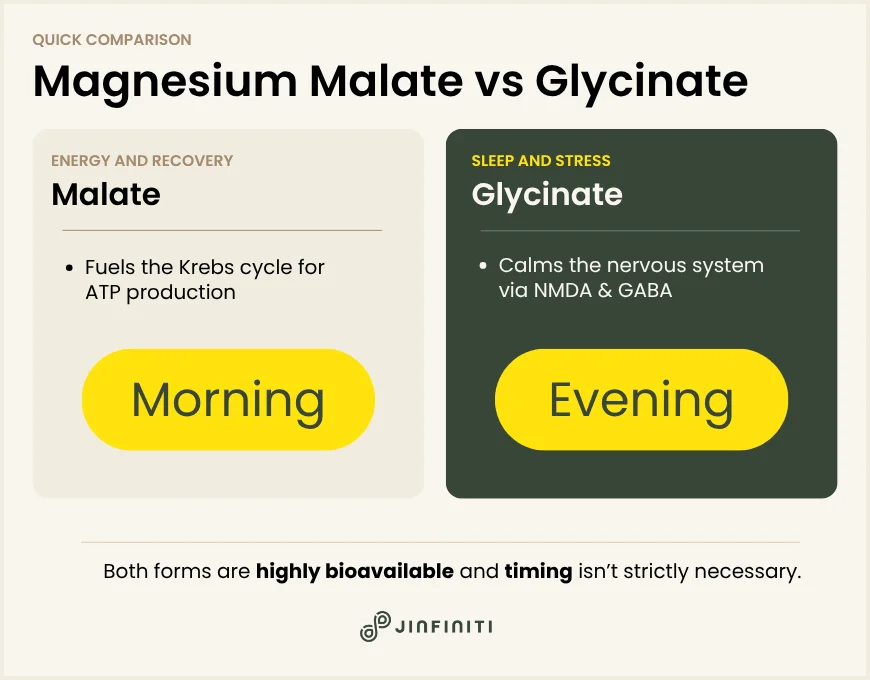
Infographic showing the difference between magnesium malate and glyicnate

Magnesium Malate: The Energy Form

Magnesium malate pairs magnesium with malic acid, a naturally occurring compound found in apples and most fruits. Malic acid is a substrate in the Krebs cycle — the chain of reactions your mitochondria use to generate ATP, the form of energy your cells actually run on. When malate is absorbed alongside magnesium, both compounds become available to support energy production from different angles simultaneously.

That mechanism is part of why magnesium malate has been studied in the context of fibromyalgia, a condition linked to impaired cellular energy and muscle pain. A 1992 study by Abraham and Flechas treated 15 fibromyalgia patients with combined magnesium malate supplementation for 8 weeks and saw meaningful reductions in tender point scores, with some participants reporting improvement within 48 hours. A subsequent double-blind crossover trial by Russell et al. produced more mixed results, showing no significant improvement in the blinded phase. The fibromyalgia evidence isn’t settled.

What is consistent across the research: malate supports ATP-related processes, and people who experience low daytime energy, persistent muscle soreness, or post-exertional fatigue tend to respond better to this form. It’s energizing enough that most practitioners recommend taking it in the morning or early afternoon.

Magnesium Glycinate: The Calm Form

Magnesium glycinate bonds magnesium to two glycine molecules. Glycine is an inhibitory neurotransmitter — it interacts with NMDA receptors in the brain in a way that reduces neural excitability, and research suggests it may lower core body temperature, which is part of what initiates healthy sleep onset.

A 2025 randomized controlled trial in 153 participants with poor sleep quality found that magnesium bisglycinate improved insomnia symptoms compared to placebo, though the effect was modest. A broader systematic review of 15 interventional trials concluded that the majority showed improvement in at least one sleep or anxiety parameter with magnesium supplementation.

The glycine component also appears to have some tissue-specific effects. Animal data suggest bisglycinate may increase brain magnesium concentrations more than other forms — which may explain why it tends to have a more pronounced effect on mood and nervous system symptoms even at comparable doses.

Digestively, bisglycinate is one of the gentlest forms available. It bypasses the osmotic mechanism that makes forms like oxide or citrate laxative at higher doses.

Absorption: Is One Form More Bioavailable?

Magnesium marketing often implies that one form is dramatically more bioavailable than another. The reality is more nuanced.

Both malate and glycinate are chelated organic forms, and research on magnesium bioavailability suggests most organic salts are absorbed at similar rates in the small intestine. Bisglycinate’s edge, if any, appears tissue-specific: it may deliver magnesium to brain tissue more efficiently, whereas its effect on muscle magnesium levels is minimal.

Malate’s advantage isn’t absorption — it’s the malic acid itself. Malic acid contributes to energy metabolism independently of the magnesium it carries. You’re effectively getting two functional compounds in one, which is why malate tends to be the preferred form for people dealing with fatigue or muscle-related symptoms.

For most people, the absorption difference between these two forms isn’t the deciding factor. What matters more is matching the form to the goal.

Magnesium Malate vs. Bisglycinate: Quick Comparison

Magnesium malateMagnesium bisglycinate
Bonded withMalic acidTwo glycine molecules
Primary mechanismKrebs cycle / ATP synthesisNMDA/GABA nervous system support
Best timingMorning or early afternoonEvening
Best forEnergy, muscle fatigue, recoverySleep, stress, anxiety
Digestive toleranceGoodVery gentle
Research baseFibromyalgia, exercise recoverySleep quality, anxiety reduction

Which Magnesium Form Should You Take?

Most comparison guides end here: pick based on your goal. That advice isn’t wrong, but it skips a step.

Around 48% of Americans don’t meet the RDA for magnesium through diet alone. But magnesium deficiency produces symptoms that overlap with a lot of other things — thyroid dysfunction, low NAD+, chronic stress, poor sleep hygiene. Supplementing the right form helps. Supplementing when something else is driving the symptoms doesn’t move the needle.

So: what’s the most likely driver?

⚡Choose Magnesium Malate If You’re Dealing With…

  • Low daytime energy that sleep doesn’t fix
  • Muscle soreness that lingers longer than it should after exercise
  • Fatigue without a clear cause, especially mid-afternoon
  • Fibromyalgia or chronic muscle pain (with the caveat that the evidence here is promising but mixed)

💤Choose Magnesium Glycinate If You’re Dealing With…

  • Trouble falling or staying asleep
  • An overactive mind at night
  • Stress or anxiety that feels like a background hum you can’t quiet
  • Digestive sensitivity to other magnesium forms

Consider Using Both Forms

Taking malate in the morning and bisglycinate in the evening is a strategy some practitioners recommend, and it makes biological sense. You’re supporting energy production during the day and nervous system recovery at night.

This is actually how Jinfiniti’s Vital Minerals Complex is formulated: 240mg of dual-form magnesium combining malate and glycinate in a single supplement. Rather than treating malate and bisglycinate as competing options, the formula treats them as complementary. If you’re not sure which you need — or suspect you need both — that’s the more practical starting point.

For a closer look at how magnesium forms compare across other common pairings, see our guide on magnesium glycinate vs. citrate.

The Magnesium-Energy Connection Most People Miss

Persistent fatigue is one of the most common reasons people turn to magnesium in the first place. But magnesium doesn’t work in isolation.

Magnesium is a cofactor in over 300 enzymatic reactions — including several involved in NAD+ metabolism. NAD+ (nicotinamide adenine dinucleotide) is the molecule your mitochondria depend on to generate ATP that powers cellular function. When magnesium levels are low and NAD+ levels are low at the same time, the energy shortfall comes from two directions. No amount of malate will fully compensate for depleted NAD+.

“Magnesium and NAD+ work hand in hand at the mitochondrial level,” says Dr. Jin-Xiong She, founder of Jinfiniti Precision Medicine. “Addressing one without the other is like fixing one flat tire on a car that has two.”

That’s part of why some people try magnesium, feel a modest improvement, and plateau. Magnesium may be contributing — but it may not be the whole picture. If energy doesn’t recover meaningfully with supplementation, NAD+ deficiency is often the next variable to investigate. It’s also one of the few intracellular deficiencies you can actually test for before supplementing.

For a fuller picture of what supports mitochondrial energy production, see: The Best Mitochondrial Supplements.

Frequently Asked Questions

Is Magnesium Bisglycinate the Same as Magnesium Glycinate?

Yes. The terms are used interchangeably. Both refer to magnesium chelated with two glycine molecules. “Bisglycinate” specifies that there are two glycine molecules bonded to the magnesium (bi = two); “glycinate” is the shorthand most commonly used in supplement marketing. Same compound, different label conventions.

Can I Take Magnesium Malate and Bisglycinate Together?

Yes, and for many people it makes practical sense. Taking malate in the morning and bisglycinate in the evening aligns each form with its primary function — energy support during the day, nervous system recovery at night. Some supplements, including Jinfiniti’s Vital Minerals Complex, combine both forms in a single daily formula.

When Should I Take Magnesium Malate vs. Bisglycinate?

Malate is best taken in the morning or early afternoon. Its energizing properties can interfere with sleep if taken close to bedtime. Bisglycinate is best taken in the evening, where it supports the nervous system wind-down and sleep onset. If you’re using a combined supplement, taking it with dinner is a reasonable middle ground.

Which Form Is Easiest on the Stomach?

Bisglycinate. It bypasses the osmotic laxative effect that makes magnesium oxide and magnesium citrate problematic at higher doses. Malate is also well-tolerated for most people, but bisglycinate is generally the first recommendation for anyone with a sensitive digestive system.

Can Magnesium Supplements Cause Side Effects?

At normal doses (under 350mg of supplemental magnesium per day, per the National Institutes of Health’s tolerable upper intake level), magnesium supplements are well-tolerated for most adults. High doses of oxide and citrate can cause loose stools or cramping. Both malate and bisglycinate are considerably gentler. Anyone with kidney disease should talk with a clinician before supplementing, as impaired kidneys can’t clear excess magnesium efficiently.

  • Abraham, G. E., & Flechas, J. D. (1992). Management of fibromyalgia: Rationale for the use of magnesium and malic acid. Journal of Nutritional Medicine, 3(1), 49–59. https://doi.org/10.3109/13590849208997961
  • Arab, A., Rafie, N., Amani, R., & Shirani, F. (2022). The role of magnesium in sleep health: A systematic review of available literature. Biological Trace Element Research, 201(1), 121–128. https://doi.org/10.1007/s12011-022-03162-1
  • National Institutes of Health, Office of Dietary Supplements. (2022). Magnesium: Fact sheet for health professionals. https://ods.od.nih.gov/factsheets/Magnesium-HealthProfessional/
  • Rawji, A., Peltier, M. R., Mourtzanakis, K., Awan, S., Rana, J., Pothen, N. J., & Afzal, S. (2024). Examining the effects of supplemental magnesium on self-reported anxiety and sleep quality: A systematic review. Cureus, 16(4), e59317. https://doi.org/10.7759/cureus.59317
  • Russell, I. J., Michalek, J. E., Flechas, J. D., & Abraham, G. E. (1995). Treatment of fibromyalgia syndrome with Super Malic: A randomized, double blind, placebo controlled, crossover pilot study. The Journal of Rheumatology, 22(5), 953–958. https://pubmed.ncbi.nlm.nih.gov/8587088/
  • Schuster, J., Cycelskij, I., Lopresti, A., & Hahn, A. (2025). Magnesium bisglycinate supplementation in healthy adults reporting poor sleep: A randomized, placebo-controlled trial. Nature and Science of Sleep, 17, 2027–2040. https://doi.org/10.2147/NSS.S524348
Pomegranate inside a sphere representing Urolithin A vs NAD+

Urolithin A vs NAD+: How They Actually Compare

What You Should Know

  • Urolithin A activates mitophagy, the process that clears out damaged mitochondria; NAD+ fuels the healthy ones that remain
  • They work through separate biological pathways and address different sides of mitochondrial health
  • NAD+ levels can be measured precisely with an at-home intracellular test; urolithin A activity cannot
  • Most people have insufficient NAD+ levels before adding mitophagy support — making NAD+ optimization the logical starting point

Somewhere between the longevity podcasts and the supplement reviews, urolithin A graduated from obscure compound to mainstream recommendation. For people already taking NAD+ precursors, the question followed quickly: are these doing the same thing? Should I add urolithin A? Am I doubling up on something, or covering something new?

They’re covering something new. Urolithin A and NAD+ work through different biological mechanisms, on different timelines, with different evidence bases behind them — and understanding how they diverge changes how you’d sequence either one.

CLIA-Certified NAD Blood Test

Find out if your NAD+ is in the healthy range.

Jinfiniti Intracellular NAD Test on purple background

What Each One Actually Does

Both urolithin A and NAD+ relate to mitochondrial health. That’s where the similarity mostly ends. They operate at completely different stages of the mitochondrial lifecycle, and conflating them leads to poorly sequenced supplementation.

Infographic showing the differences between Urolithin A and NAD+

Urolithin A: The Cleanup Signal

Urolithin A is a postbiotic — not a supplement in the traditional sense, but a compound your gut bacteria produce when they metabolize ellagitannins, polyphenols found in foods like pomegranate, walnuts, and certain berries. The catch is that only about 30–40% of people have the right gut bacteria to convert efficiently. Most people consuming pomegranate juice aren’t producing meaningful levels of urolithin A at all.

Its primary function is activating mitophagy — your cells’ built-in quality control system for mitochondria. Translation: it signals your body to find the damaged, underperforming mitochondria, break them down, and replace them with new ones.

The specific mechanism runs through the PINK1/Parkin pathway: damaged mitochondria are flagged, tagged for removal, cleared out, and recycled. Think of it as the inspection program running in the background of your cells. Old, inefficient units get removed so the network as a whole performs better.

The functional benefits show up slowly. In a 2022 randomized clinical trial published in JAMA Network Open, 66 older adults taking 1,000 mg of urolithin A daily for four months showed significant improvements in both hand and leg muscle endurance compared to placebo, along with reductions in inflammatory and mitochondrial stress biomarkers.

A separate 2022 trial in Cell Reports Medicine found roughly 12% improvements in leg muscle strength in middle-aged adults over a similar timeframe. Cellular gene signatures appear within about four weeks; functional changes tend to emerge at eight to sixteen weeks.

NAD+: The Fuel That Keeps the System Running

NAD+ (nicotinamide adenine dinucleotide) is a coenzyme present in every cell. It shuttles electrons between molecules in the reactions that produce ATP — the energy currency your cells run on. Without sufficient NAD+, mitochondria can’t generate energy efficiently, even if they’re structurally intact.

NAD+ also serves as a substrate for sirtuins and PARPs — enzyme families responsible for DNA repair, stress resistance, and metabolic regulation. Translation: NAD+ isn’t only about energy. It’s also the signal that tells your cells to repair damage, manage inflammation, and maintain function under stress. No NAD+, no repair signal.

The problem is decline. NAD+ levels drop measurably with age, often beginning in the 30s and continuing throughout life. That decline tracks closely with the fatigue, cognitive fog, and slower recovery that many people start noticing in midlife — and that standard bloodwork rarely explains. NMN and NR raise cellular NAD+ levels, typically within days to weeks of starting supplementation.

How They Compare, Side by Side

AspectUrolithin ANAD+
Primary actionClears damaged mitochondria (mitophagy)Fuels energy production and DNA repair
Works throughPINK1/Parkin mitophagy pathwayRedox reactions, sirtuins, PARPs
Speed of effect8–16 weeks for functional changesDays to weeks for NAD+ elevation
Measurable?No consumer test existsYes — intracellular blood spot test
Food sourcesPomegranate, walnuts, berriesNiacin, NMN, NR precursors
Gut dependencyYes (conversion varies widely)No
Best evidence forMuscle endurance, mitochondrial qualityCellular energy, cognitive function, repair

One of These Can Be Measured. The Other Can’t.

You can measure one of these. You can’t measure the other.

Intracellular NAD+ levels can be tested directly — from a finger-prick blood spot sample, processed through a CLIA-certified lab — and the results tell you exactly where you stand. You can test before starting supplementation, again at four to eight weeks, and know with precision whether your intervention is working and whether your dose needs adjusting.

Urolithin A has no equivalent. There’s no at-home test that tells you whether your mitophagy is active, how efficiently your gut is converting, or whether the supplement you’re taking is doing anything measurable. The clinical evidence for urolithin A is real and encouraging, but the individual feedback loop simply doesn’t exist yet.

Supplementation without measurement is guesswork. You can spend months on a stack you believe is working with no objective signal either way.

“Most people come to us having already tried several supplements, often including NAD+ precursors, without ever testing their baseline,” says Dr. Jin-Xiong She, founder of Jinfiniti Precision Medicine and a genomic scientist with over 400 peer-reviewed publications. “When we test them, a significant portion are still deficient. The supplement was real — but the dose or formulation wasn’t moving their levels into the optimal range. That’s what testing reveals.”

Can They Work Together?

They can, and the case for combining them is straightforward: they address two different phases of the mitochondrial lifecycle. Urolithin A removes underperforming mitochondria; NAD+ fuels and maintains the ones that remain. One clears, the other powers. Those aren’t redundant functions — they’re sequential ones.

Some preclinical work suggests urolithin A may also modestly elevate NAD+ levels by improving overall mitochondrial efficiency — but this has only been observed in animal models so far. Human data confirming that effect isn’t available yet.

What the Research Supports (and What It Doesn’t)

There are no head-to-head human trials directly comparing urolithin A and NAD+ supplementation. The strongest clinical evidence for urolithin A is in muscle endurance and mitochondrial biomarkers in older and middle-aged adults. For NAD+ precursors, Jinfiniti’s clinical data showed 85% of participants reaching optimal intracellular NAD+ levels within four weeks of using the Vitality↑® NAD+ Booster — with average levels doubling — which is among the most rigorous published results in consumer longevity supplementation.

A 2024 study in Frontiers in Aging Neuroscience compared urolithin A and nicotinamide riboside (NR) in human microglial cells and found that both reduced DNA damage-induced cellular senescence, though through different pathways — a finding that supports the case for combining them rather than treating them as interchangeable.

How to Think About Sequencing

If your NAD+ levels are deficient — which is common and often invisible without testing — adding urolithin A on top of a fuel-depleted system is like cleaning a factory floor before turning the power back on. The cleanup matters, but it can’t compensate for missing energy.

Establishing an optimal NAD+ baseline first gives your mitochondria the fuel they need to function well. Once that’s verified and stable, urolithin A becomes a logical complement — one that improves the quality of the mitochondrial network your NAD+ is now powering effectively.

Which One Should You Prioritize?

If you don’t know your NAD+ baseline, start there. NAD+ deficiency is common, measurable, and often the root cause of energy and cognitive complaints that other bloodwork misses. Testing first tells you whether your levels are deficient, suboptimal, or already in range — and that answer changes what you do next.

If your NAD+ levels are already confirmed optimal and you’re focused on muscle endurance, exercise recovery, or longer-range mitochondrial quality as you age, urolithin A is a well-supported complement.

For most people doing this seriously, the goal is eventually both. The order matters more than people assume — and measurement is what makes the sequence rational instead of guessed at.

Frequently Asked Questions

Is urolithin A the same as NAD+?

No. They’re chemically distinct and work through separate pathways. Urolithin A is a gut-derived postbiotic that activates mitophagy — the removal of damaged mitochondria. NAD+ is a coenzyme that fuels energy production and activates DNA repair enzymes. They address complementary but different aspects of cellular health.

Does urolithin A raise NAD+ levels?

Animal studies suggest it may modestly, by improving mitochondrial efficiency — but this hasn’t been confirmed in human trials. It’s not a substitute for direct NAD+ supplementation if your levels are deficient.

Can I take urolithin A and NMN together?

Yes. They target different parts of the mitochondrial lifecycle and are generally considered complementary. NMN supports energy production and sirtuin activity; urolithin A supports mitochondrial quality control. No known interaction between them.

How long does urolithin A take to work compared to NAD+?

NAD+ precursors can elevate cellular NAD+ within days to a few weeks. Urolithin A works on a slower cadence — cellular gene signatures appear around four weeks, functional changes in endurance and strength typically at eight to sixteen weeks, based on the 2022 clinical trials.

How do I know if my NAD+ levels are optimal?

An intracellular NAD+ test measures your actual cellular NAD+ concentration from a finger-prick blood sample and tells you whether you’re in the optimal range (40–100 μM), suboptimal, or deficient. It’s the only objective way to know whether your supplementation is working — and how much to adjust.

  • Liu, S., D’Amico, D., Shankland, E., Bhayana, S., Garcia, J. M., Aebischer, P., Rinsch, C., Singh, A., & Marcinek, D. J. (2022). Effect of urolithin A supplementation on muscle endurance and mitochondrial health in older adults: A randomized clinical trial. JAMA Network Open, 5(1), e2144279. https://doi.org/10.1001/jamanetworkopen.2021.44279
  • Ryu, D., Mouchiroud, L., Andreux, P. A., Katsyuba, E., Moullan, N., Nicolet-dit-Félix, A. A., Williams, E. G., Jha, P., Lo Sasso, G., Huzard, D., Aebischer, P., Sandi, C., Rinsch, C., & Auwerx, J. (2016). Urolithin A induces mitophagy and prolongs lifespan in C. elegans and increases muscle function in rodents. Nature Medicine, 22(8), 879–888. https://doi.org/10.1038/nm.4132
  • Singh, A., D’Amico, D., Andreux, P. A., Dunngalvin, G., Kern, T., Blanco-Bose, W., Aebischer, P., Auwerx, J., & Rinsch, C. (2022). Urolithin A improves muscle strength, exercise performance, and biomarkers of mitochondrial health in a randomized trial in middle-aged adults. Cell Reports Medicine, 3(5), 100633. https://doi.org/10.1016/j.xcrm.2022.100633
  • Serantes, D., Muñoz-Guardiola, P., Megías-Roda, E., García-Martinez, I., Morales, M., Santamaria-Martínez, A., Segués, N., Rossignol, J., Galobart, R., Romanos, G., Esteve-Codina, A., Vidal-Alabró, A., Ingham, E., Muñoz, J., & Mulero, M. (2024). Urolithin A and nicotinamide riboside differentially regulate innate immune defenses and metabolism in human microglial cells. Frontiers in Aging Neuroscience, 16, 1462752. https://doi.org/10.3389/fnagi.2024.1462752
Minimalist illustration of a translucent battery shape filled with glowing cellular mitochondria representing NAD

What Is NAD and Why Does It Matter for Your Energy?

What You Should Know

  • NAD is a coenzyme that turns food into cellular energy and supports DNA repair
  • Your levels naturally decline with age—often beginning in your 30s
  • Low NAD contributes to fatigue, brain fog, and slower recovery
  • Without testing, you can’t know if your levels are deficient or if supplementation is working

When exhaustion doesn’t respond to the standard fixes, it often points to something happening at the cellular level. One of the most common and underrecognized drivers is a decline in NAD, a molecule your cells rely on to produce energy.

NAD — short for nicotinamide adenine dinucleotide — exists in every living cell in your body. It’s not a vitamin or a hormone. It’s a coenzyme, which means it helps other molecules do their jobs. Without sufficient NAD, your cells can’t convert the food you eat into usable energy. They also can’t repair DNA damage, respond to stress, or regulate metabolism effectively.

The problem is that NAD levels decline measurably with age, often beginning in your 30s or 40s. Research shows that many people experience a 40-50% drop by age 50. And unlike most biomarkers, NAD can be measured directly — which means you can know exactly where your levels stand and take action based on data, not guesswork.[1]

CLIA-Certified NAD Blood Test

Find out if your NAD+ is in the healthy range.

Jinfiniti Intracellular NAD Test on purple background

What NAD Actually Is

NAD is a small molecule found in every living cell, from bacteria to humans. It’s been studied for over a century — first discovered in 1906 during fermentation research — but our understanding of its importance in human health has deepened significantly in recent decades.

At a chemical level, NAD is made of two nucleotides joined by phosphate groups. One contains adenine, the other nicotinamide. The body can produce NAD from vitamin B3 (niacin) or the amino acid tryptophan, though most NAD is recycled through a salvage pathway rather than built from scratch.

What makes NAD essential is its ability to shuttle electrons between molecules. This electron transfer is the basis for nearly all energy production in your body.

The Two Forms: NAD+ and NADH

NAD exists in two forms that constantly cycle back and forth: NAD+ and NADH.

NAD+ is the oxidized form — think of it as an empty shuttle bus, ready to pick up electrons during metabolic reactions. NADH is the reduced form — the shuttle carrying electrons that can be used to generate ATP, your cells’ energy currency.

Together, these forms create a loop. NAD+ accepts electrons from nutrients like glucose and fat, becoming NADH. NADH then delivers those electrons to the mitochondria, where they drive ATP production. Once the electrons are dropped off, NADH converts back to NAD+, and the cycle continues.

This constant cycling is what keeps energy flowing in your cells. When NAD levels are too low, the loop slows down. Cells struggle to produce enough ATP, and you feel it as fatigue, slower recovery, or cognitive fog.

Why NAD Matters: What It Does in Your Body

NAD is involved in hundreds of cellular processes. Studies show it participates in more than 500 enzymatic reactions.[2]

A few roles stand out as particularly critical:

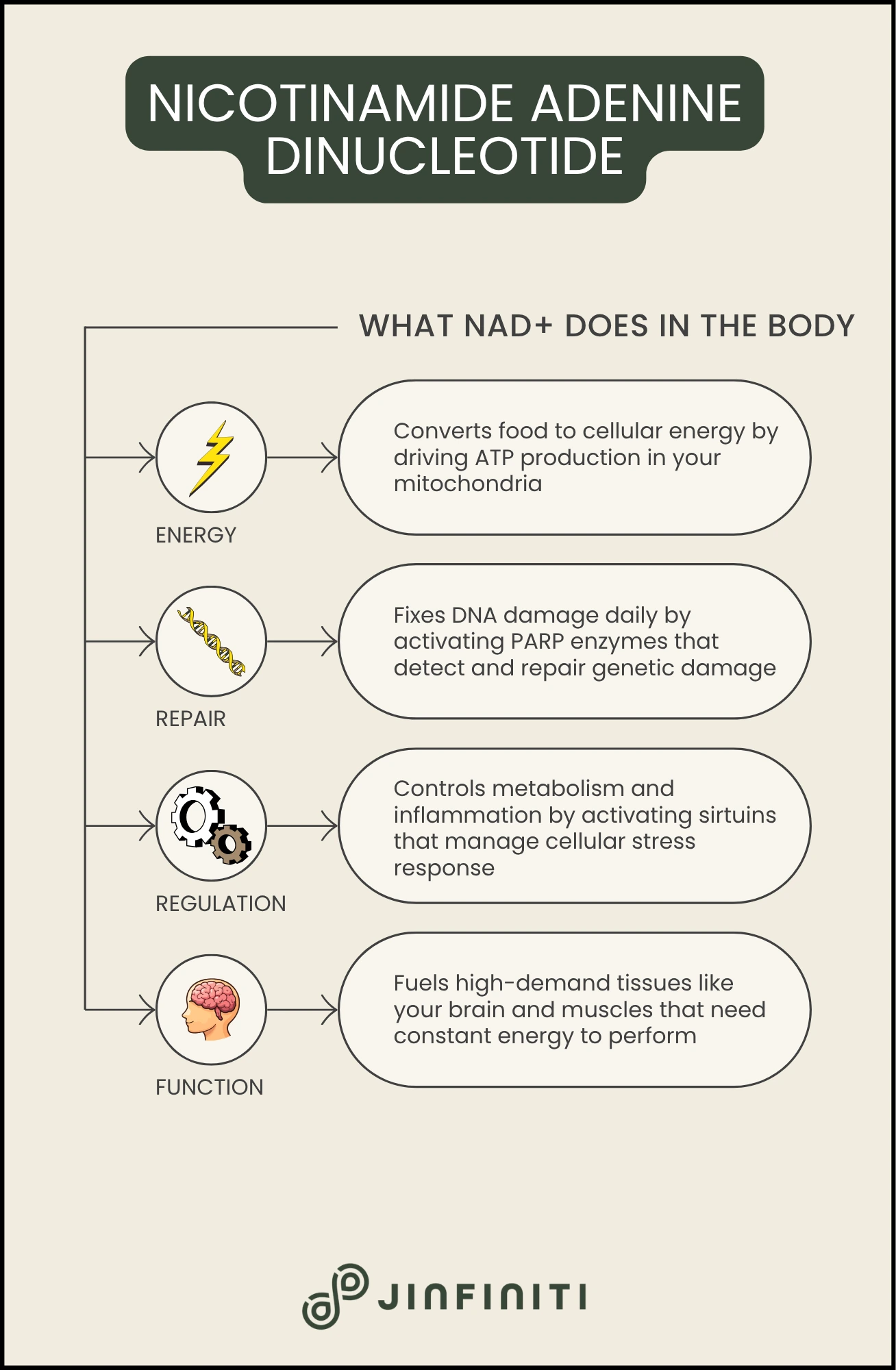
Energy production: Inside your mitochondria, NAD+ drives the reactions that convert glucose and fatty acids into ATP. Without sufficient NAD, mitochondrial function declines, and cellular energy production becomes less efficient.

DNA repair: Every day, your cells accumulate DNA damage from normal metabolism, UV exposure, and environmental toxins. NAD is consumed by enzymes called PARPs that detect and repair this damage. When NAD levels are low, DNA repair slows, and damage accumulates faster.

Metabolic regulation: A family of proteins called sirtuins only function in the presence of NAD. Sirtuins influence everything from fat storage to inflammation to circadian rhythm. They’re often called “longevity genes” because of their connection to healthy aging and stress resistance.

Brain function: Your brain represents only about 2% of your body weight but consumes roughly 20% of your total energy. NAD supports the high metabolic demands of neurons, and declining NAD in the brain has been linked to cognitive decline and neurodegenerative conditions.[3]

This isn’t just about “anti-aging.” NAD is how your body functions today. When levels are optimal, cells repair themselves efficiently, produce energy consistently, and respond to stress effectively. When levels drop, those processes slow — and you feel the difference before any disease state appears.

Infographic showing what NAD (Nicotinamide Adenine Dinucleotide) does in the body

Why NAD Levels Decline With Age

NAD decline is one of the most consistent findings in aging research. It’s been documented in rodents, primates, and humans across multiple tissues.

Human studies show that whole blood NAD levels decline significantly with age, particularly in men. Women’s levels tend to fluctuate more after age 50, likely due to hormonal changes. In skeletal muscle, the decline can be anywhere from 15% to 65%, depending on the individual and the measurement method. Brain NAD also decreases measurably, which correlates with reduced cognitive function.[1]

The decline happens through two main mechanisms.

Reduced production occurs because the enzymes responsible for making NAD become less efficient with age. The key enzyme, NAMPT, decreases in activity over time. This creates a bottleneck — your cells can’t produce NAD as quickly as they once did, even if you’re consuming adequate precursors through diet.[4]

Increased consumption happens because certain NAD-degrading enzymes become more active as you age. One called CD38 rises in response to chronic inflammation. Another group, PARPs, ramps up activity in response to accumulated DNA damage. Both consume NAD to do their jobs, which depletes the cellular pool.[5][6]

Think of it as a sink where the faucet slows while the drain widens. Less NAD coming in, more NAD going out. Over time, this leads to the net decline that begins earlier than most people realize.

What Drives NAD Decline?

Age is the primary driver, but several factors accelerate the process:

  • Chronic inflammation increases the activity of CD38 and other NAD-consuming enzymes[5]
  • Metabolic stress from a high-fat or high-sugar diet can reduce skeletal muscle NAD levels in just two months[7]
  • Obesity is associated with both lower NAMPT expression and higher PARP activity, creating a compounding effect[8]
  • DNA damage from UV exposure, toxins, or normal cellular metabolism forces PARPs to consume more NAD for repair[6]

If you’re dealing with persistent fatigue despite normal blood tests, NAD deficiency is one of the cellular-level explanations that standard panels miss.

Signs Your NAD Levels May Be Low

NAD decline doesn’t announce itself with a single, obvious symptom. Instead, it shows up as a pattern of issues that conventional testing often fails to explain.

Common signs of low NAD include:

  • Persistent fatigue that doesn’t resolve after adequate sleep — not the kind that goes away after a good night’s rest, but the kind that lingers despite doing everything “right”
  • Slower recovery from exercise, illness, or stress — when NAD levels are optimal, cells repair damage efficiently and bounce back quickly; when levels are low, recovery takes longer
  • Brain fog and difficulty concentrating — neurons are metabolically demanding, and when NAD drops, cognitive performance often follows
  • Metabolic changes — difficulty maintaining weight, worsening insulin sensitivity, or changes in how your body responds to food

If you’re still tired after 8 hours of sleep, cellular energy deficiency is worth investigating.

The challenge is that these symptoms overlap with many other conditions. Thyroid disorders, sleep apnea, anemia, hormonal imbalances, and dozens of other issues can present similarly. That’s why symptom-based guessing rarely leads to a clear answer.

Measurement is the only way to know.

The NAD Measurement Problem

Most people who take NAD supplements have no idea if they’re actually working.

The wellness industry has embraced NAD precursors like NMN and NR over the past few years. Hundreds of products now claim to boost NAD levels, often with impressive-sounding promises about energy, longevity, and cognitive performance. But very few people taking these supplements ever test their levels — before, during, or after.

That’s a problem, because NAD metabolism is highly individual. The same dose that optimizes one person’s levels might do almost nothing for another. Some people absorb precursors efficiently; others don’t. Some have high baseline consumption from inflammation or DNA damage; others don’t. Without testing, you’re guessing.

Intracellular measurement matters because that’s where NAD actually works. Some tests measure NAD in blood plasma, which can give you a general sense of systemic levels. But the NAD inside your cells — where energy production, DNA repair, and metabolic regulation happen — is what drives outcomes. Intracellular NAD testing provides a much more accurate picture of your cellular energy status.

Dr. Jin-Xiong She’s clinical research established clear benchmarks for interpreting results. Optimal NAD levels fall between 40 and 100 micromolar (μM). Anything below 40μM is considered suboptimal or deficient. Levels above 100μM may not provide additional benefits and could potentially cause issues.

These ranges give you a concrete target, not a vague reference to “normal.”

Why Testing Changes Everything

Jinfiniti developed the world’s first consumer-grade intracellular NAD test in 2019. Before that, NAD testing was largely confined to research labs. Now, you can measure your baseline, track changes over time, and personalize your approach based on data.

Here’s what measurement enables:

  • Establishing your baseline tells you where you’re starting from — you might discover your levels are already optimal, in which case supplementation isn’t needed, or you might find they’re severely deficient, which explains symptoms that have gone undiagnosed for years
  • Validating whether supplementation works removes the guesswork — some people respond well to NMN, others respond better to niacinamide or NR, and testing shows you what’s actually happening in your cells, not what a bottle label promises
  • Personalizing your dosing is critical because there’s no one-size-fits-all approach to NAD optimization — in Jinfiniti’s clinical trial, 85% of participants reached optimal NAD levels within four weeks, but that success rate depended on personalized dosing based on measured results, not generic recommendations
  • Tracking progress over time lets you adjust as needed — NAD levels aren’t static; they respond to changes in diet, exercise, stress, inflammation, and supplementation, so retesting every few months ensures you’re maintaining optimal levels rather than drifting back into deficiency

As Dr. She puts it: “Measure before acting. NAD optimization isn’t about taking the same dose as someone else and hoping it works. It’s about knowing your levels, acting on that information, and confirming the results. Precision requires data.”

Without measurement, you’re flying blind. With it, you can make informed decisions and track real progress.

How to Support Healthy NAD Levels

If you’re looking to optimize your NAD levels, the most effective approach combines testing with targeted intervention.

Here’s what works:

  • Test first — Establish your baseline with an intracellular NAD test; this removes the guesswork and tells you whether your levels are deficient, suboptimal, or already optimal
  • NAD+ precursor supplementation is the most direct way to raise levels — NMN and NR are the most studied precursors; both convert to NAD inside your cells, though they follow slightly different pathways; niacinamide (a form of vitamin B3) also works through the salvage pathway
  • Lifestyle factors can support NAD production — regular exercise, moderate caloric intake, and consistent sleep all influence NAD metabolism, though they’re unlikely to fully counter age-related decline on their own
  • Reduce chronic inflammation through diet, stress management, and addressing underlying health issues — this helps by lowering NAD consumption from enzymes like CD38
  • Retest and adjust after 4-6 weeks — if your levels haven’t reached the optimal range, adjust your dose or try a different precursor; if they have, continue monitoring periodically to ensure they stay stable

Jinfiniti’s Vitality NAD+ Booster uses a multi-pathway formula that combines NMN, niacinamide, creatine, and D-ribose. The clinical trial data showed an average doubling of NAD levels within four weeks, with 85% of participants reaching the optimal range.

The goal isn’t to chase an arbitrary number. It’s to restore your cells’ ability to produce energy efficiently, repair damage effectively, and respond to stress appropriately. When NAD levels are optimal, you feel it — and the data confirms it.

The Bottom Line

NAD is not a wellness trend. It’s a fundamental molecule that’s been studied for over a century and plays a documented role in energy production, DNA repair, and metabolic regulation. Levels decline measurably with age, and that decline has real consequences — fatigue, slower recovery, cognitive fog, and increased vulnerability to age-related disease.

The difference between vague health advice and precision medicine comes down to measurement. You can’t optimize what you don’t measure. And without data, you’re guessing whether your NAD levels are deficient, whether supplementation is working, or whether you even need it in the first place.

If you’re dealing with unexplained fatigue, cognitive decline, or signs of accelerated biological aging, NAD testing gives you a clear starting point. It’s not the only factor that matters, but it’s one you can measure, address, and track over time.

Frequently Asked Questions

Is NAD the same as vitamin B3?

NAD is a molecule your body makes from vitamin B3 (which includes niacin, niacinamide, and nicotinamide riboside). Vitamin B3 is a precursor — a building block your cells use to produce NAD. You can get vitamin B3 from food or supplements, but your body still needs to convert it into NAD through metabolic pathways. Learn more about the differences between NAD, niacin, and niacinamide.

Which foods contain NAD?

Very few foods contain NAD directly. Instead, you get NAD precursors from foods rich in vitamin B3 — like meat, fish, mushrooms, peanuts, and fortified grains — or from foods containing tryptophan, an amino acid your body can convert to NAD. However, dietary sources alone rarely raise NAD levels significantly, especially after age 40. See the full list of NAD-boosting foods.

Are NAD supplements safe?

NAD precursors like NMN, NR, and niacinamide are generally well-tolerated in clinical studies, with mild side effects like nausea or flushing reported in some people. Most research shows a favorable safety profile for short-term use. However, long-term safety data is still limited, and it’s best to work with a healthcare provider — especially if you have underlying health conditions.

Can NAD help with weight loss?

NAD doesn’t directly cause weight loss, but it plays a role in metabolic function and energy regulation. Some research suggests NAD precursors may support metabolic health, particularly when combined with exercise and caloric moderation. However, NAD supplementation is not a weight-loss drug, and results vary widely between individuals. Read more about NAD, NMN, and weight loss.

What is the difference between NAD+ and NADH?

NAD+ is the oxidized form of the molecule, ready to accept electrons during metabolic reactions. NADH is the reduced form, carrying electrons that can be used to generate ATP. They cycle back and forth continuously, and both are necessary for cellular energy production.

Can you increase NAD levels naturally without supplements?

Lifestyle factors like exercise, caloric moderation, and adequate sleep can support NAD production to some degree. However, research suggests that lifestyle changes alone are often insufficient to fully counter the age-related decline in NAD levels, particularly after age 40. Precursor supplementation is typically needed for meaningful increases.[2]

What are optimal NAD levels?

Based on Dr. Jin-Xiong She’s clinical research, optimal intracellular NAD levels fall between 40 and 100 micromolar (μM). Levels below 40μM are considered suboptimal or deficient. Levels above 100μM may not provide additional benefits and could potentially be harmful.

How do I know if my NAD levels are low?

The only reliable way to know is through testing. Symptoms like persistent fatigue, brain fog, and slow recovery can suggest low NAD, but they overlap with many other conditions. Intracellular NAD testing provides a precise measurement of your cellular levels.

Does NAD supplementation work for everyone?

NAD precursors can raise levels in most people, but individual responses vary widely. Some people absorb and convert precursors efficiently, while others need higher doses or different forms. Without testing, you won’t know if a supplement is actually working for you. That’s why personalized dosing based on measured levels is more effective than generic recommendations.

How long does it take to see results from NAD supplementation?

Most people who respond to NAD precursors notice changes within 2-4 weeks. Clinical studies, including Jinfiniti’s trial with Vitality NAD+ Booster, show measurable increases in NAD levels within four weeks. However, subjective improvements in energy, recovery, and cognitive clarity may appear sooner or later depending on your baseline levels and overall health.

Does NAD interact with GLP-1 medications?

NAD and GLP-1 pathways both influence metabolic health, and there’s emerging research on how they interact. If you’re using GLP-1 medications, NAD optimization may offer complementary benefits. Learn more about the relationship between NAD and GLP-1.

  1. Yang F, Deng X, Yu Y, Luo L, Chen X, Zheng J, et al. Association of Human Whole Blood NAD+ Contents With Aging. Frontiers Media SA; 2022. https://doi.org/10.3389/fendo.2022.829658
  2. Covarrubias AJ, Perrone R, Grozio A, Verdin E. NAD+ metabolism and its roles in cellular processes during ageing. Springer Science and Business Media LLC; 2020. https://doi.org/10.1038/s41580-020-00313-x
  3. Zhu XH, Lu M, Lee BY, Ugurbil K, Chen W. In vivo NAD assay reveals the intracellular NAD contents and redox state in healthy human brain and their age dependences. Proceedings of the National Academy of Sciences; 2015. https://doi.org/10.1073/pnas.1417921112
  4. Zhang W, Ren H, Chen W, Hu B, Feng C, Li P, et al. Nicotinamide phosphoribosyltransferase in NAD+ metabolism: physiological and pathophysiological implications. Springer Science and Business Media LLC; 2025. https://doi.org/10.1038/s41420-025-02672-w
  5. Piedra-Quintero ZL, Wilson Z, Nava P, Guerau-de-Arellano M. CD38: An Immunomodulatory Molecule in Inflammation and Autoimmunity. Frontiers Media SA; 2020. https://doi.org/10.3389/fimmu.2020.597959
  6. Sousa FG, Matuo R, Soares DG, Escargueil AE, Henriques JAP, Larsen AK, et al. PARPs and the DNA damage response. Oxford University Press (OUP); 2012. https://doi.org/10.1093/carcin/bgs132
  7. Rasool S, Geetha T, Broderick TL, Babu JR. High Fat With High Sucrose Diet Leads to Obesity and Induces Myodegeneration. Frontiers Media SA; 2018. https://doi.org/10.3389/fphys.2018.01054
  8. Rappou E, Jukarainen S, Rinnankoski-Tuikka R, Kaye S, Heinonen S, Hakkarainen A, et al. Weight Loss Is Associated With Increased NAD+/SIRT1 Expression But Reduced PARP Activity in White Adipose Tissue. The Endocrine Society; 2016. https://doi.org/10.1210/jc.2015-3054
Image of GLP-1 medication next to body tape measure

NAD and GLP-1: What the Research Actually Shows

What You Should Know

  • GLP-1 medications reduce caloric intake and weight, but up to 45% of the weight lost may come from lean body mass rather than fat alone.
  • NAD+ — a molecule found in every cell — fuels the mitochondria that produce cellular energy, and levels typically decline with age and metabolic stress.
  • Animal research suggests that intestinal NAD+ biosynthesis is required for the gut to produce GLP-1 naturally, though human data is still emerging.
  • If you’re supplementing NAD+ alongside a GLP-1 protocol, testing your intracellular NAD+ levels is the only way to know whether supplementation is actually working.

If you’re on a GLP-1 medication — Ozempic, Wegovy, Mounjaro — and you’ve been told to add NAD+ to your protocol, you’ve probably encountered some version of the same pitch: NAD+ gives you the energy back that GLP-1 drugs take away. It’s simple, it sounds plausible, and it’s only partially right.

The real relationship between NAD+ and GLP-1 is more interesting than that. There’s research — not widely discussed in consumer health circles — suggesting that NAD+ doesn’t just patch the side effects of GLP-1 medications. It plays a role in whether your body produces GLP-1 naturally in the first place. That reframes the conversation considerably.

Here’s what the evidence actually supports, where it’s still emerging, and what to consider if you’re thinking about pairing the two.

CLIA-Certified NAD Test Kit

Find out if your NAD+ is actually optimized.

Jinfiniti Intracellular NAD Test on purple background

Why GLP-1 Medications Leave Some People Feeling Depleted

GLP-1 receptor agonists work by mimicking a hormone your intestines naturally produce after eating. They slow gastric emptying, reduce appetite, and signal the brain that you’re full. The result — significant caloric restriction — is exactly what drives the weight loss.

But the body doesn’t distinguish between a medication-induced caloric deficit and a famine. When fuel intake drops, cellular energy production follows.

What Caloric Restriction Does to Cellular Energy

Your cells produce energy through the mitochondria, using a process that requires a steady supply of fuel and specific molecular cofactors — including NAD+. When you eat significantly less, the inputs into that energy production chain decrease. For many people on GLP-1 medications, the experience is fatigue, mental fog, and a general feeling of physical flatness that doesn’t match the number on the scale.

This isn’t a sign the medication isn’t working. It’s a sign the body is adapting to reduced intake — and that adaptation has cellular costs.

The Lean Mass Question

The more pressing clinical concern is what’s happening to body composition. In the STEP-1 clinical trial of semaglutide, roughly 45% of total weight lost was lean body mass rather than fat. A 2025 Cell Metabolism analysis noted that lean mass loss on GLP-1 receptor agonists has raised genuine questions about the long-term metabolic implications — particularly for people already experiencing age-related muscle decline.[1]

Losing muscle alongside fat matters because muscle is metabolically active tissue. Less muscle means a lower resting metabolic rate, reduced physical capacity, and — critically — less mitochondrial machinery to support energy production.

This is the fuller picture of why some people feel depleted on GLP-1 medications. It’s not just caloric restriction. It’s what caloric restriction, at scale and over time, does to the cellular infrastructure that produces energy in the first place.

If you’ve been experiencing that and wondering whether something deeper is going on, you might want to read more about why standard bloodwork often misses this kind of fatigue.

What NAD+ Does — and Why It Matters Here

NAD+ — nicotinamide adenine dinucleotide — is a coenzyme found in every living cell. It’s the molecule that allows your mitochondria to convert food into usable energy, supports DNA repair, and activates a class of proteins called sirtuins that regulate cellular aging and metabolism.

NAD+ levels decline with age — measurably so, beginning in the 30s and accelerating through midlife. They also decline with metabolic stress, obesity, and high-fat diets. This matters for people on GLP-1 medications because the population most likely using these drugs — adults with metabolic dysfunction, insulin resistance, or obesity — often starts from a lower NAD+ baseline to begin with.

When you add significant caloric restriction to an already-depleted NAD+ system, the cellular energy shortfall compounds. This is the specific gap NAD+ supplementation is meant to address.

A 2025 study published in Obesity found that semaglutide-induced weight loss improved mitochondrial oxidative phosphorylation efficiency in skeletal muscle in mice — meaning GLP-1 medications may independently support some mitochondrial improvements through weight loss itself.[2]

That’s genuinely encouraging. But mitochondrial efficiency and NAD+ availability are distinct variables, and the evidence for NAD+ specifically addresses the fuel supply side of the equation.

NAD+ and Your Body’s Own GLP-1 Production

Most articles frame NAD+ as a complement to GLP-1 medications — something you take alongside Ozempic to feel better. The deeper story, supported by emerging research, is that NAD+ may be upstream of GLP-1 production entirely.

How Intestinal NAD+ Controls Natural GLP-1 Production

GLP-1 is produced by specialized L-cells in the lining of your small intestine. Those cells depend on a tightly regulated internal environment to function properly — and a key part of that environment is NAD+ biosynthesis, mediated by an enzyme called NAMPT (nicotinamide phosphoribosyltransferase).

A 2022 study published in Endocrinology by Nagahisa et al. tested what happens when intestinal epithelial cells are stripped of NAMPT — and therefore unable to produce NAD+. The result was a significant reduction in GLP-1 production, decreased insulin secretion, and elevated postprandial blood glucose. The mice weren’t heavier. They just couldn’t regulate glucose properly because their guts couldn’t produce enough GLP-1.[3]

What Happens When Gut NAD+ Is Depleted

The same research team found that obese mice fed a high-fat diet showed the same pattern: compromised intestinal NAD+ biosynthesis, impaired GLP-1 production, and disrupted postprandial glucose metabolism. When they administered NMN — a key NAD+ precursor — intestinal NAD+ levels were restored, and GLP-1 production recovered along with glucose regulation.

A follow-up review in Nutrients (2023) elaborated on the mechanistic pathway: intestinal NAD+ biosynthesis, via the AMPK–NAMPT–SIRT1 axis, is critical for maintaining the gut environment that produces GLP-1. When that pathway is disrupted — by obesity, aging, or poor diet — GLP-1 production downstream suffers.[4]

It’s worth being clear: this research is primarily in animal models. Human clinical trials on this specific pathway are still underway. But the mechanistic insight changes the framing. The metabolic dysfunction that leads people to need GLP-1 medications may be partly downstream of the same NAD+ depletion those medications are compensating for. If that’s accurate, supporting NAD+ isn’t just managing side effects. It’s addressing the cellular environment the whole system depends on.

NAD+ and Muscle Preservation During GLP-1 Treatment

The lean mass concern with GLP-1 medications is real enough to take seriously, and NAD+ has a specific role to play here.

Muscle tissue contains a high density of mitochondria — more than almost any other tissue in the body. Mitochondrial function in muscle depends heavily on NAD+ availability. When NAD+ is depleted, mitochondrial output falls, and muscle cells become less efficient at producing energy and maintaining their own structure.

There’s also a creatine connection worth noting. NAD+ and creatine operate through overlapping metabolic pathways — both supporting ATP synthesis, the actual energy currency inside cells. For people concerned about muscle quality and energy output during GLP-1-induced weight loss, addressing both pathways simultaneously is a reasonable approach. If you want to understand how supplementing each of these nutrients compares in terms of NAD+ dosing specifically, the NAD+ dosage guide covers that in detail.

The 2026 Cell Reports Medicine analysis found that GLP-1 receptor agonist treatment did upregulate certain mitochondrial proteins — including SIRT5 — in skeletal muscle compared to calorie restriction alone. That’s a meaningful finding. But it also underscores that the mitochondrial effects of GLP-1 treatment are still being characterized, and that NAD+ addresses the fuel side of mitochondrial function in a way that GLP-1 doesn’t.

Measuring NAD+ While on GLP-1 Medications

The population on GLP-1 medications tends to be engaged with their health — tracking metrics, working with clinicians, paying attention to how interventions affect outcomes. Adding NAD+ supplementation to a GLP-1 protocol without measuring baseline NAD+ levels is, by the standards of that same engagement, a gap.

Intracellular NAD+ can be measured directly through a finger-prick blood test. Optimal levels, based on Jinfiniti’s clinical research, fall between 40 and 100 μM. Most adults in midlife — particularly those with obesity or metabolic dysfunction — test significantly below that range before supplementing.

“The people most likely to benefit from NAD+ support are often the ones who started below optimal levels without knowing it,” says Dr. Jin-Xiong She, founder of Jinfiniti Precision Medicine. “Supplementing without a baseline is still just guessing — and when you’re already managing a prescription protocol, precision matters more, not less.”

Knowing your starting level also allows you to calibrate dosing appropriately and confirm, after 4–6 weeks of supplementation, whether you’ve actually reached the range where NAD+ exerts its measurable effects. Niacinamide — one of the four ingredients in the Vitality NAD+ Booster — plays a specific role in that synthesis pathway; understanding what niacinamide does in the context of NAD+ production is useful for anyone building a targeted protocol.

What to Realistically Expect From NAD+ Alongside GLP-1 Therapy

NAD+ is not a GLP-1 amplifier. It won’t increase the weight-loss effect of semaglutide or make the medication work faster. What it does is support the cellular environment that gets taxed when caloric intake drops significantly and the body is remodeling its composition.

For people on GLP-1 medications, the realistic case for NAD+ includes: better mitochondrial support during caloric restriction, reduced cellular energy depletion in muscle tissue, and — based on emerging animal research — potential support for the gut environment that produces GLP-1 naturally. None of this is a guarantee. Individual response to NAD+ supplementation varies, and starting NAD+ levels, age, diet, and baseline metabolic health all affect outcomes.

The most important caveat: if you’re on a GLP-1 medication and considering adding NAD+ supplementation, talk with your clinician first. NAD+ precursors are generally well-tolerated, but any addition to an active prescription protocol warrants a conversation with the prescribing provider.

The supplementation question is secondary to the measurement question. Know your NAD+ level. Then decide what to do with that information.

Frequently Asked Questions

Can you take NAD+ with Ozempic, Wegovy, or Mounjaro?

Yes. NAD+ precursors — including NMN and NR — are generally well-tolerated and are not known to interact with GLP-1 receptor agonists. That said, if you’re on a prescription protocol, the appropriate step is to confirm with your prescribing clinician before adding any supplement.

Can you get NAD+ injections while on GLP-1 medications?

Yes. NAD+ injections aren’t known to interact with GLP-1 receptor agonists, and some clinics offer them specifically for GLP-1-related fatigue. One caveat: the NAD+ molecule is too large to enter cells directly from the bloodstream, so IV delivery loses a significant portion to breakdown before it’s usable. Subcutaneous injections perform somewhat better — but Jinfiniti’s clinical data showed their oral multi-pathway formula reached optimal intracellular levels more consistently than subcutaneous NAD+, at a fraction of the cost.

Why do GLP-1 medications cause fatigue, and can NAD+ help?

GLP-1 medications reduce caloric intake substantially, which decreases the fuel available for cellular energy production. NAD+ supports the mitochondrial machinery that converts available fuel into usable energy. For people whose NAD+ levels are already depleted — common in those with metabolic dysfunction — supplementing to optimal levels may help address that energy gap. Results vary based on where you’re starting from.

Does NAD+ affect how GLP-1 medications work?

Not directly. NAD+ and GLP-1 receptor agonists work through different mechanisms. What’s interesting is the upstream relationship: animal research suggests that NAD+ biosynthesis in the gut is required for the body to produce GLP-1 naturally. This doesn’t mean NAD+ boosts the medication — but it does suggest the two systems are more connected at a biological level than the standard framing implies.

Is lean mass loss on GLP-1 medications inevitable?

Data from the STEP-1 trial showed significant lean mass reduction alongside fat loss on semaglutide. Whether this is inevitable or modifiable depends on factors including exercise, protein intake, and mitochondrial support. NAD+ supports muscle mitochondrial function and operates through pathways that overlap with creatine — both relevant to maintaining muscle quality during weight loss.

How do you know if your NAD+ levels are actually low?

You test. Intracellular NAD+ levels can be measured through a finger-prick blood test processed in a CLIA-certified lab. Optimal levels fall between 40 and 100 μM; many adults test in the deficient or suboptimal range without symptoms specific enough to identify the cause. Testing before supplementing gives you a baseline to work from and lets you confirm, after 4–6 weeks, whether your levels have actually improved.

  1. Karasawa T, Choi RH, Meza CA, Rout S, Drummond MJ, Chaix A, et al. Unexpected effects of semaglutide on skeletal muscle mass and force-generating capacity in mice. Elsevier BV; 2025. https://doi.org/10.1016/j.cmet.2025.07.004
  2. Choi RH, Karasawa T, Meza CA, Maschek JA, Manuel AM, Nikolova LS, et al. Semaglutide‐induced weight loss improves mitochondrial energy efficiency in skeletal muscle. Wiley; 2025. https://doi.org/10.1002/oby.24274
  3. Nagahisa T, Yamaguchi S, Kosugi S, Homma K, Miyashita K, Irie J, et al. Intestinal Epithelial NAD+ Biosynthesis Regulates GLP-1 Production and Postprandial Glucose Metabolism in Mice. The Endocrine Society; 2022. https://doi.org/10.1210/endocr/bqac023
  4. Nagahisa T, Kosugi S, Yamaguchi S. Interactions between Intestinal Homeostasis and NAD+ Biology in Regulating Incretin Production and Postprandial Glucose Metabolism. MDPI AG; 2023. https://doi.org/10.3390/nu15061494
How to test cortisol levels - featured image with an overworked and stressed woman

How to Test Cortisol Levels: Methods, Timing, and Next Steps

Someone tells you your cortisol might be off. Or you’ve been reading about fatigue, unexplained weight gain, and sleep that never feels restorative — and you keep seeing the same word come up: cortisol. So you look up how to test cortisol levels, and suddenly you’re staring at three different testing options with no clear guidance on which one applies to you, when to take it, or what the number will actually mean.

Here’s the thing that makes cortisol testing confusing: cortisol isn’t a fixed number. It follows a predictable daily arc — rising sharply in the morning, declining through the day, bottoming out at night. The type of test you use, when you collect the sample, and how you prepare will determine whether the result tells you something meaningful. A single morning blood draw and a four-point salivary panel are measuring very different things.

This guide breaks down each method, explains why timing matters more than most articles acknowledge, and covers what to do — and what to look further into — once you have your results.

What You Should Know

  • Cortisol follows a daily rhythm, so the best test depends on which part of that rhythm you’re trying to assess.
  • Salivary cortisol testing is the most practical at-home option and captures the full daily pattern, not just a snapshot.
  • A “normal” cortisol result doesn’t always explain persistent fatigue — cortisol measures stress physiology, not cellular energy status.

CLIA-Certified NAD Test Kit

Cortisol doesn’t tell the whole story.

Jinfiniti Intracellular NAD Test on purple background

Why Cortisol Levels Change Throughout the Day

Understanding why cortisol moves the way it does is what makes cortisol testing interpretable. Without that context, a result is just a number.

Cortisol is produced by the adrenal glands and regulated by the hypothalamic-pituitary-adrenal (HPA) axis — a feedback loop connecting the brain to the adrenal glands. The HPA axis responds to signals from the body’s internal clock, stress inputs, blood sugar, and immune activity. Cortisol’s job is to mobilize energy, sharpen alertness, and prepare the body for demands ahead. It does that job on a schedule.

The Cortisol Awakening Response

Within the first 30 to 45 minutes after waking, cortisol levels spike — sometimes doubling from overnight lows. This is the cortisol awakening response (CAR), and it’s one of the more reliable windows into how well the HPA axis is functioning. A robust morning rise is associated with better alertness, immune regulation, and metabolic stability across the day. A blunted one — where the morning spike is flat or minimal — shows up frequently in people dealing with burnout, prolonged fatigue, and low-grade chronic stress.

After the morning peak, cortisol follows a gradual decline. By evening, levels should be low enough to allow the body to wind down and sleep.

What a Disrupted Pattern Looks Like

Under chronic stress, that arc gets distorted. Cortisol may stay elevated longer than it should, or — after sustained overactivation — the system exhausts itself and levels flatten out entirely. Neither pattern shows up clearly in a single morning blood draw. You’d see a number that looks broadly normal at the wrong moment, with no picture of how the hormone behaves across the full day.

This is why multi-point testing is considered more informative for evaluating everyday HPA function. One number in isolation doesn’t tell you much about rhythm — which is the part that actually affects how you feel.

Infographic showing how cortisol levels change throughout the day

The Three Main Ways to Test Cortisol Levels

Each testing method measures something slightly different. Matching the method to your goal matters more than most people realize.

Salivary Cortisol Testing

Salivary testing is the most practical way to check cortisol levels at home, and it has solid clinical backing. It measures free cortisol — the biologically active form — rather than total cortisol, which includes the portion bound to proteins and not available to act on tissues. Research in Nature Clinical Practice Endocrinology & Metabolism has validated salivary cortisol measurement as a clinically accurate approach, particularly for capturing cortisol at its daily nadir and assessing the morning pattern.[1]

For at-home use, comprehensive kits typically ask for four samples: immediately upon waking, around noon, late afternoon, and before bed. This multi-point approach gives a picture of the full daily arc. You can see whether the morning response is adequate, whether cortisol is declining appropriately through the day, and whether evening levels are low enough to support good sleep. That’s a lot more information than a single data point.

Blood Cortisol Testing

Blood testing is the standard clinical approach, typically drawn between 7 and 9 a.m. — the expected peak — to produce a standardized, comparable result. As MedlinePlus notes, draws are sometimes repeated later in the day to assess whether cortisol is following the expected decline, but single-time-point morning draws are far more common in routine clinical care.

Blood tests measure total cortisol, which includes both the free and protein-bound portions. For adrenal disorder screening — Cushing’s syndrome (excess production) or Addison’s disease (insufficient production) — it’s the standard method. For assessing everyday HPA function and stress-related cortisol disruption, the picture is less complete.

24-Hour Urine Testing

A 24-hour urine collection captures everything the body excretes over a full day, giving a comprehensive measure of total cortisol output rather than a moment-in-time value. This method is more common in clinical settings where there’s reason to evaluate overall adrenal production — particularly when ruling out Cushing’s syndrome or other cortisol-excess conditions.

It’s less useful for identifying a disrupted daily rhythm, since it averages everything across the full day. But for questions about total cortisol load, it provides reliable data that snapshot tests can’t.

How to Prepare for an Accurate Cortisol Test

Cortisol is responsive — to exercise, stress, sleep quality, food, and several medications. Getting a result that reflects your actual baseline means controlling for as many of those variables as possible.

A few things to account for before testing:

  • Exercise: Intense physical activity raises cortisol acutely. Most clinicians recommend avoiding strenuous workouts in the 24 hours before testing.
  • Medications: Corticosteroids (including topical skin creams), hormonal birth control, and high-dose biotin supplements can all affect readings. Don’t stop any prescribed medication without talking to your clinician first — just make sure they know what you’re taking when they interpret results.
  • Stress and sleep: Testing during an unusually difficult week, after significant sleep disruption, or following a stressful event is more likely to capture an outlier than your actual pattern.
  • For saliva samples: Don’t eat, drink (anything other than water), brush your teeth, or smoke for at least 30 minutes before collecting. For morning samples, collect within minutes of waking — before getting up, making coffee, or reaching for your phone.

Testing on a day that reasonably represents your normal — not your worst week, not your best — produces results worth interpreting.

How to Read Your Cortisol Results

Reference ranges vary by method and lab, so a number should always be read against the context provided by your testing kit or clinician rather than a generic threshold. For morning serum cortisol in adults, typical ranges fall between roughly 6 and 23 mcg/dL, though this varies by assay. Afternoon values are expected to be meaningfully lower than morning values.

For salivary testing, the pattern matters as much as any individual value. A healthy arc shows a clear morning peak, a gradual decline through the day, and low evening levels. What to look for in disrupted patterns:

  • Flat curve (morning and evening values close together): Suggests HPA dysregulation, often associated with burnout or prolonged stress.
  • Consistently elevated values: May warrant further clinical evaluation for cortisol excess.
  • Very low values throughout: Can indicate adrenal insufficiency, particularly when paired with symptoms like fatigue, dizziness, or salt cravings — worth discussing with an endocrinologist.

It’s worth saying clearly: abnormal cortisol results don’t diagnose a condition on their own. Disrupted patterns are common in people managing chronic stress, sleep disorders, and burnout — without any underlying adrenal disease. Results should be interpreted in context, and any follow-up testing or treatment decisions should involve a clinician.

When Cortisol Testing Isn’t the Whole Picture

Here’s a situation that comes up often: someone tests their cortisol, the results look broadly normal, and they’re still exhausted. Still foggy. Still not recovering the way they used to. If that sounds familiar, the issue usually isn’t that the test was wrong — it’s that cortisol measures stress system activity, not what that stress has done to the cells downstream.

Research published in Physical Therapy describes how prolonged HPA activation — the kind that accumulates over months or years of sustained stress — can lead to cortisol dysfunction and widespread inflammation that persists even after stress levels normalize. The signaling system gets dysregulated.[2]

And separately, research published in Molecular Neurobiology found (in animal models) that psychological stress reduced mitochondrial respiration in the prefrontal cortex by up to 50%, effectively cutting cellular energy output in half. That downstream effect — depleted cellular energy at the mitochondrial level — isn’t something cortisol testing measures.[3]

NAD+ (nicotinamide adenine dinucleotide), the molecule that sits at the center of cellular energy production, declines under sustained oxidative and inflammatory stress. And unlike cortisol, which may normalize while fatigue continues, intracellular NAD+ levels reflect what’s happening inside the cell right now. For people whose fatigue doesn’t resolve despite normal test results, that distinction matters.

As Dr. Jin-Xiong She, founder of Jinfiniti Precision Medicine, explains: “Cortisol tells you that the stress response has been activated. What it doesn’t tell you is what that stress has cost your cells. That’s where NAD+ measurement becomes important — you can’t address cellular energy depletion without first measuring it.”

What to Do After Getting Your Results

If results are significantly outside the expected range, follow up with a clinician — ideally an endocrinologist if an adrenal condition is suspected. Cortisol testing alone can’t identify the cause of an abnormal result; further workup is typically needed.

If results look broadly normal but symptoms persist, treat that as information too. It tells you the problem is probably not a primary adrenal disorder, and shifts the investigation toward other systems: sleep architecture, thyroid function, metabolic health, and cellular energy production are all reasonable next areas depending on your specific picture.

Whatever direction you go, measuring before making changes — rather than starting cortisol-lowering supplements or protocols based on symptoms alone — tends to produce better outcomes. That applies to cortisol and to everything downstream of it.

Frequently Asked Questions

What is the best time of day to test cortisol levels?

For blood tests, between 7 and 9 a.m. captures the expected morning peak. For salivary testing, the most informative approach is a four-point collection: at waking, around noon, late afternoon, and before bed. Multi-point salivary testing gives a picture of the daily arc that a single morning draw can’t.

Can I test cortisol levels at home without a doctor?

Yes. CLIA-certified at-home salivary cortisol kits are available without a prescription and can provide a clinically valid picture of your cortisol rhythm. Abnormal results — or normal results that don’t explain your symptoms — are worth discussing with a clinician for proper interpretation and follow-up.

How accurate are at-home salivary cortisol tests?

Salivary cortisol is a clinically validated method for measuring free cortisol. Accuracy depends heavily on following collection instructions precisely: timing, prep steps, and testing on a representative day all affect the result. Kits from accredited labs with proper certification tend to perform reliably when used correctly.

What cortisol level is considered normal?

For morning serum cortisol, typical adult reference ranges are approximately 6–23 mcg/dL, though this varies by lab. For salivary tests, ranges differ by assay and time of day. A single number without timing context is hard to interpret — the expected range for 8 a.m. is very different from the expected range for 10 p.m.

What does a flat cortisol curve mean?

A flat curve — where morning and evening values are similar rather than separated by a clear peak-to-trough decline — suggests HPA axis dysregulation. It’s commonly associated with burnout, prolonged fatigue, and chronic stress. It’s worth discussing with a clinician, especially when paired with symptoms that don’t have another clear explanation.

Can low NAD+ levels cause the same symptoms as high cortisol?

They can overlap considerably. Both are associated with fatigue, cognitive sluggishness, disrupted sleep, and reduced recovery capacity. They often occur together — prolonged cortisol dysregulation contributes to oxidative stress and NAD+ depletion over time. Measuring both, rather than assuming one explains the other, gives a more complete diagnostic picture.

  1. Carroll T, Raff H, Findling JW. Late-night salivary cortisol measurement in the diagnosis of Cushing’s syndrome. Springer Science and Business Media LLC; 2008. https://doi.org/10.1038/ncpendmet0837
  2. Hannibal KE, Bishop MD. Chronic Stress, Cortisol Dysfunction, and Pain: A Psychoneuroendocrine Rationale for Stress Management in Pain Rehabilitation. Oxford University Press (OUP); 2014. https://doi.org/10.2522/ptj.20130597
  3. Grigoruţă M, Martínez-Martínez A, Dagda RY, Dagda RK. Psychological Stress Phenocopies Brain Mitochondrial Dysfunction and Motor Deficits as Observed in a Parkinsonian Rat Model. Springer Science and Business Media LLC; 2019. https://doi.org/10.1007/s12035-019-01838-9
High folate levels on a blood test

High Folate Levels: What Elevated Folate Means on a Blood Test

You got your blood results back. Folate is flagged — higher than the reference range. And now you’re not sure whether to worry about it, reduce your supplement intake, or just wait for your next appointment and hope someone explains it.

Here’s the honest answer: an elevated folate number, on its own, tells you very little. Whether it matters, and what to do about it, depends entirely on what else is happening in your bloodwork — particularly your B12 and homocysteine levels. Without those, you’re reading one sentence from the middle of a paragraph.

This article breaks down what high folate levels actually mean on a blood test, why the number is routinely misread, and what your next step should actually be.

What You Should Know

  • A folate level above 20 ng/mL is generally considered elevated, but this number alone isn’t enough to draw conclusions from.
  • The most common cause of high folate is taking multiple supplements that each contain folic acid, often without realizing they add up.
  • High folate can mask a vitamin B12 deficiency, allowing neurological damage to progress without the usual warning signs.
  • Folate, B12, and homocysteine need to be read together to understand what an elevated folate result actually means for you.

CLIA-Certified Blood Panel

Test folate, B12, and homocysteine in one panel.

Jinfiniti AgingSOS green gradient background

What High Folate Means on a Blood Test

Folate is the natural form of vitamin B9, found in leafy greens, legumes, and citrus. Folic acid is the synthetic version, added to supplements and — in the US and Canada — mandatorily to fortified grain products since 1998. Your body processes them differently, and that distinction becomes important when levels are elevated.

When a doctor orders a folate test, they’re usually measuring one of two things.

Serum Folate vs. RBC Folate: Why the Difference Matters

Serum folate measures the amount of folate circulating in the liquid portion of your blood. It reflects recent intake — what you’ve eaten and supplemented over the past few days. Have a spinach salad and a B-complex the morning before your blood draw, and your serum folate will likely read higher than it would on a typical day.

Red blood cell (RBC) folate is a different measurement. It reflects how much folate has been incorporated into your red blood cells over their lifespan, roughly 90 to 120 days. Think of it the way you’d think of HbA1c for blood sugar: a longer-term snapshot rather than a daily reading. RBC folate is generally considered the more meaningful indicator of true folate status, but it’s ordered less frequently.

Most flagged results that people see are serum folate. That context matters: serum folate can fluctuate meaningfully based on recent meals and supplements, which means a single elevated reading doesn’t necessarily represent your baseline.

What’s Considered a High Folate Level

Standard reference ranges vary by lab, but serum folate above 20 ng/mL is widely cited as elevated. Some labs use slightly different thresholds. The important caveat is that these ranges were designed primarily to identify deficiency, not to define an upper ceiling for optimal health. A number above range is a prompt to investigate further — not a standalone diagnosis.

Why Your Folate Levels Are High

There are several reasons folate can accumulate in the blood. Understanding which one applies to you changes what, if anything, should be done about it.

The underlying mechanism in most cases is the same: intake is exceeding the body’s ability to convert and clear it. But the reasons for that imbalance vary.

Supplement Stacking — The Most Common Culprit

The recommended daily allowance for most adults is 400 micrograms (mcg) of folate. The problem is that many people are unknowingly taking several times that amount.

A standard multivitamin might contain 400 to 800 mcg of folic acid. A separate B-complex often adds another 400 to 800 mcg. If someone is also taking a prenatal vitamin or a folate-specific supplement, the cumulative dose can reach 1,500 to 2,000 mcg or more per day — before any food is factored in.

This is the most common reason for elevated serum folate: not a single high-dose supplement, but several moderate-dose ones taken simultaneously without tracking the total.

Fortified Foods Add More Than Most People Realize

Mandatory folic acid fortification of enriched grain products has been in place in the US since 1998. Bread, pasta, rice, breakfast cereals, and flour all contain added folic acid. A 2002 study found that after fortification was introduced, nearly half of participants who had previously been below the daily folate requirement were no longer deficient — which illustrates how effective, and how pervasive, fortification has become.[1]

For someone who eats a typical North American diet and also takes a daily multivitamin, baseline folic acid intake from food alone is already substantial before supplementation is layered on.

MTHFR Variants: High Serum Folate, Low Functional Folate

This is the scenario most people don’t expect: it’s possible to have elevated serum folate and still be functionally folate-deficient at the cellular level.

The MTHFR gene produces an enzyme responsible for converting folic acid into its active, usable form (5-methyltetrahydrofolate, or 5-MTHF). Common variants of this gene — particularly C677T, which affects an estimated 10 to 15% of the general population and up to 25% of people of Hispanic ancestry — reduce that conversion capacity.[2]

When the conversion process is impaired or overwhelmed, folic acid accumulates in the blood as unmetabolized folic acid (UMFA). UMFA is the synthetic form that hasn’t been converted to a form the body can actually use. High serum folate in someone with an MTHFR variant may reflect this accumulation, not genuine folate sufficiency.

This is one reason why high serum folate can coexist with symptoms you’d typically associate with deficiency — and why the number alone doesn’t tell the whole story.

Kidney Disease and Reduced Clearance

Folate is water-soluble, meaning excess is normally excreted through urine. When kidney function is compromised, that clearance slows down, and folate accumulates.

Chronic kidney disease, and even mild reductions in kidney function, can contribute to elevated levels. If kidney disease is present or suspected, that context should inform how an elevated folate result is interpreted.

The B12 Problem: Why This Is the Number to Check First

Of all the risks associated with elevated folate, the most clinically significant — and the most frequently missed — is its potential to conceal a vitamin B12 deficiency.

This isn’t a theoretical concern. It’s been recognized for decades, and it’s the reason folate and B12 should almost always be tested together.

How High Folate Can Mask a B12 Deficiency

Folate and B12 work together to produce healthy red blood cells. When either is deficient, the result is megaloblastic anemia — larger, malformed cells that can’t carry oxygen effectively. Anemia is often the first signal that prompts a B12 deficiency diagnosis.

Here’s where elevated folate becomes a problem. A 2008 review published in the American Journal of Clinical Nutrition found that high folate intake can correct the anemia associated with B12 deficiency, eliminating the hematological warning sign while the underlying deficiency continues unchecked. What it cannot do is stop the neurological damage that B12 depletion causes over time.[3]

B12 is essential for maintaining the myelin sheath — the protective coating around nerve fibers. Its depletion causes progressive neurological damage: numbness and tingling in the extremities, balance problems, cognitive decline, and in severe cases, irreversible nerve injury. Because these symptoms develop gradually and subtly, a missed diagnosis can allow damage to accumulate for months or years.

There’s also a metabolic mechanism at play. When B12 levels are low, folate becomes “trapped” in a form the body cannot use (5-methyltetrahydrofolate), causing serum folate levels to rise further. This is sometimes called the methylfolate trap. The elevated folate reading is, in part, a consequence of the B12 problem — not evidence that folate status is adequate.

High Folate With Normal B12: What That Pattern Means

This is the combination that generates the most confusion, and it deserves a direct answer.

If your folate is elevated and your B12 comes back normal, that’s generally reassuring — but “normal” B12 on a standard serum test has meaningful limitations. Serum B12 can remain within range even when B12 is functionally insufficient at the cellular level.

One NHANES review found that among older adults, high folate combined with low B12 was associated with a substantially higher risk of cognitive impairment compared to people with adequate levels of both — even when B12 appeared borderline rather than overtly deficient.[4]

The functional markers that give a clearer picture are homocysteine and methylmalonic acid (MMA). Homocysteine rises when either folate or B12 is insufficient for normal metabolism. MMA rises specifically when B12 is functionally deficient. If both are within range alongside elevated folate, the risk profile is much lower. If homocysteine is elevated, further investigation is warranted regardless of what the standard B12 number shows.

Who Is Most at Risk

A few groups are more likely to face serious consequences from the high-folate-and-low-B12 pattern:

  • Older adults. B12 absorption declines with age as stomach acid production drops. Subclinical B12 deficiency is common before it becomes clinically apparent, and high folate is most likely to mask it in this group.
  • People with MTHFR variants. UMFA accumulation is more likely when the conversion enzyme is less active, and standard folate tests don’t distinguish between metabolized and unmetabolized forms.
  • People stacking multiple supplements. This is probably the largest at-risk category by sheer numbers — health-conscious people unknowingly exceeding safe folic acid intake by combining a multivitamin, a B-complex, and fortified foods without tracking the cumulative total.

Symptoms of High Folate: When They’re Actually From Something Else

One reason high folate often goes unaddressed is that it rarely causes obvious symptoms on its own. Most people with elevated serum folate feel no different.

The symptom burden associated with high folate is almost entirely indirect — the result of what high folate is hiding or enabling, rather than a direct effect of the folate itself.

What High Folate Itself Rarely Causes

In most cases, chronically elevated serum folate from supplementation does not produce noticeable symptoms. Folate is water-soluble, and excess is partially cleared through urine, which limits acute toxicity.

The NIH Office of Dietary Supplements notes that the tolerable upper intake level for folic acid from supplements is set at 1,000 mcg per day for adults — above that, concerns shift primarily to the B12 masking issue and potential effects on immune function, not acute side effects.

Symptoms That Point to the B12 Issue Underneath

If high folate is present alongside any of the following, the question isn’t whether folate is causing them directly — it’s whether high folate has been masking a B12 deficiency that’s been quietly progressing:

  • Persistent fatigue that doesn’t improve with rest
  • Tingling or numbness in the hands or feet
  • Difficulty with balance or coordination
  • Mood changes, irritability, or low motivation
  • Brain fog or difficulty concentrating

These are B12 neurological symptoms. And in people who have been supplementing with folic acid for a long time without also monitoring B12, that possibility deserves to be taken seriously. The trail of symptoms often feels like a separate problem — which is exactly what makes this combination easy to miss on standard bloodwork.

What to Do When Your Folate Is High

Elevated folate is a prompt to look more carefully, not a reason to panic or immediately stop everything you’re taking. The right response depends on context — specifically, what the rest of your biomarkers show.

The most useful thing you can do is resist the temptation to interpret a single number in isolation.

Test First: Folate Doesn’t Tell You Much Alone

“What we see consistently is that people fixate on a single elevated marker and miss the pattern that surrounds it,” says Dr. Jin-Xiong She, founder of Jinfiniti Precision Medicine. “Folate means something different depending on what your B12 and homocysteine are doing. You can’t make a responsible recommendation without seeing the full picture.”

That full picture includes at minimum:

  • Serum or RBC folate (already have this)
  • Vitamin B12 (serum, though functional markers are more informative)
  • Homocysteine (rises when either folate or B12 is functionally insufficient)
  • Methylmalonic acid (MMA), which rises specifically when B12 is functionally deficient

If your standard bloodwork shows high folate but didn’t include those markers, that’s worth following up on — particularly if you’re over 50, taking multiple supplements, or experiencing any of the neurological symptoms described above.

Jinfiniti’s AgingSOS Advanced Panel measures homocysteine alongside NAD+, inflammatory markers, and 25 other biomarkers, giving you the broader picture that a standard folate test alone can’t provide. It’s designed precisely for situations like this — where a single flagged result only makes sense when you can see what’s happening around it.

This is also relevant for people who assume that getting tired all the time with normal blood test results means there’s no biological explanation. Standard panels often don’t include the markers that would reveal an underlying B-vitamin imbalance.

Review All Your Sources of Synthetic Folic Acid

Before adjusting anything, do a full audit of where your folic acid is coming from. Common sources people underestimate:

  • Multivitamins (typically 400 to 800 mcg per serving)
  • B-complex supplements (often another 400 to 800 mcg)
  • Prenatal vitamins (frequently 800 to 1,000 mcg)
  • Fortified breakfast cereals (up to 400 mcg per serving)
  • Enriched bread, pasta, rice, and flour

If the cumulative total is significantly above 400 mcg, that’s likely the primary driver of the elevation, and the simplest adjustment is reducing overlapping supplements. Don’t assume that more B vitamins are always better — the evidence on excess folic acid, particularly regarding UMFA accumulation and the B12 interaction, argues for a more measured approach.

The Form of Folate Matters

If continued supplementation is appropriate, the form matters significantly. Folic acid is the synthetic precursor that requires enzymatic conversion. 5-MTHF (methylfolate) is the already-active form, with a few meaningful advantages:

  • Doesn’t require the MTHFR enzyme to become usable
  • Doesn’t accumulate as UMFA when intake is high
  • Does not mask B12-related anemia the way synthetic folic acid does

This is the same logic that underlies choosing supplement forms carefully across the board — the same reason form matters when comparing magnesium glycinate vs. citrate: bioavailability and downstream effect aren’t the same across all versions of a nutrient.

For people with MTHFR variants, switching from folic acid to 5-MTHF is a particularly well-supported recommendation. For others, simply reducing total intake is often sufficient.

Work With Your Clinician, Not Around Them

High serum folate by itself doesn’t tell you whether your B12 is functionally adequate, whether you have an MTHFR variant, or whether UMFA is accumulating in your system. Those are questions that require additional testing and clinical context.

Don’t attempt to self-diagnose MTHFR from a single blood test, and don’t abruptly stop supplements without understanding what you actually need. A clinician who understands B-vitamin metabolism can help you interpret the full picture and make adjustments that are specific to your situation.

🧬 RELATED READING

Frequently Asked Questions

Is it dangerous to have high folate levels?

High folate from synthetic folic acid can pose risks — primarily by masking a vitamin B12 deficiency and, at very high doses, potentially through UMFA accumulation. Whether your specific elevated result is cause for concern depends on your B12 status, homocysteine levels, and total folic acid intake. Elevated folate from natural food sources is generally not a concern.

Can too much folic acid cause nerve damage?

Folic acid itself doesn’t cause nerve damage directly. The risk is indirect: high folic acid can mask the anemia caused by B12 deficiency, delaying diagnosis while neurological damage from the B12 deficiency progresses. If high folate and any neurological symptoms coexist, B12 status should be thoroughly evaluated — not just through a standard serum B12 test, but with functional markers like homocysteine and MMA.

What does high folate with normal B12 mean?

In many cases, this combination is not cause for concern. However, standard serum B12 tests can appear normal even when B12 is functionally insufficient. If you have high folate and normal B12 but are experiencing fatigue, numbness, or cognitive changes, it’s worth asking your clinician about homocysteine and MMA testing, which provide a more accurate picture of functional B12 status.

Can you take too much methylfolate?

Methylfolate (5-MTHF) is generally considered safer than synthetic folic acid because it doesn’t accumulate as UMFA and doesn’t mask B12 deficiency. That said, very high doses of any folate form can still interfere with folate metabolism. Some people, particularly those sensitive to methylated B vitamins, report side effects from high-dose methylfolate. Staying within reasonable supplementation ranges and working with a clinician is still the right approach.

How do I lower my folate levels?

The most straightforward step is auditing and reducing overlapping sources of synthetic folic acid — particularly multiple supplements each containing folic acid. Reducing fortified grain consumption can also help. Switching from folic acid to 5-MTHF, if supplementation is still needed, lowers the risk of accumulation. Levels typically normalize within a few weeks of reducing intake. Always confirm next steps with your clinician before making changes, particularly if other health conditions are involved.

  1. Ray JG, Vermeulen MJ, Boss SC, Cole DEC. Declining Rate of Folate Insufficiency Among Adults Following Increased Folic Acid Food Fortification in Canada. Springer Science and Business Media LLC; 2002. https://doi.org/10.1007/bf03405010
  2. Hecker J, Layton R, Parker RW. Adverse Effects of Excessive Folic Acid Consumption and Its Implications for Individuals With the Methylenetetrahydrofolate Reductase C677T Genotype. Springer Science and Business Media LLC; 2025. https://doi.org/10.7759/cureus.79374
  3. Molloy AM, Kirke PN, Brody LC, Scott JM, Mills JL. Effects of Folate and Vitamin B12 Deficiencies During Pregnancy on Fetal, Infant, and Child Development. SAGE Publications; 2008. https://doi.org/10.1177/15648265080292s114
  4. Bailey RL, Jun S, Murphy L, Green R, Gahche JJ, Dwyer JT, et al. High folic acid or folate combined with low vitamin B-12 status: potential but inconsistent association with cognitive function in a nationally representative cross-sectional sample of US older adults participating in the NHANES. Elsevier BV; 2020. https://doi.org/10.1093/ajcn/nqaa239
A woman takes a nap during an afternoon slump.

Afternoon Slump: Why You Get Tired Around 3pm Every Day

Go ahead and blame the sandwich for your afternoon slump. But research published in the journal Sleep confirmed what sleep scientists have known for decades: the afternoon energy dip happens even when people skip lunch entirely, even when they don’t know what time it is, and even when they haven’t changed anything about their day. The post-lunch dip is not a post-lunch problem.[1]

That’s either a relief or a frustration, depending on how long you’ve been trying to engineer your way out of it with a better salad.

The truth is that the afternoon crash is mostly biological — a predictable feature of how your internal clock works. For most people, it’s manageable. For others, especially women in their late 30s and beyond, it becomes something harder to dismiss: a daily wall that sleep, nutrition, and coffee can’t reliably fix.

Here’s what’s actually driving it — and how to tell the difference between a normal dip and a deeper signal.

The Short Summary

  • The 3pm energy crash is primarily a circadian rhythm phenomenon, not a result of what you ate for lunch.
  • Sleep debt significantly amplifies the dip, turning a mild alertness drop into a full cognitive shutdown.
  • Persistent afternoon fatigue that doesn’t respond to lifestyle changes may reflect declining cellular energy production, not just poor habits.
  • Measuring NAD+ levels can reveal whether a cellular energy deficit is contributing to fatigue that standard bloodwork misses.

CLIA-Certified Blood Panel

Find the root cause of low energy in the afternoon.

Jinfiniti AgingSOS green gradient background

It’s Not Your Lunch — It Is Your Biology

Most people’s instinct is to look at what they ate. That’s understandable — the timing seems suspicious. But the science has largely exonerated the meal itself.

The Circadian Dip Explained

Your circadian rhythm is a roughly 24-hour internal clock that regulates when you feel alert and when you feel drowsy. Most people are familiar with its nighttime effect — the gradual buildup of sleep pressure that eventually pulls you to bed. What’s less well known is that this same system creates a secondary dip in alertness every single afternoon, typically landing between 1pm and 4pm, depending on when you woke up and your individual chronotype.

This isn’t incidental. Research modeling sleep propensity across 24 hours identified this afternoon trough as a predictable feature of the interaction between your homeostatic sleep drive (how long you’ve been awake) and your circadian rhythm. The dip appears whether or not you eat, whether or not you’re aware of the time, and whether or not your morning was particularly demanding. It’s older than modern schedules — cultures around the world developed afternoon rest periods for good reason.[2]

For most people, this natural dip is mild. You feel a little slower, a little less sharp. You could push through it if you needed to. That’s normal.

Why Sleep Debt Makes It So Much Worse

Here’s where individual experience starts to diverge significantly. The circadian dip itself is relatively consistent, but sleep debt — the accumulated shortfall between the sleep you need and the sleep you’re actually getting — dramatically amplifies how hard you hit it.

Going to bed 45 minutes later than ideal for five consecutive nights creates a meaningful deficit. The math compounds quietly. By Thursday, the afternoon dip that was a minor inconvenience on Monday can feel like your brain stopped cooperating entirely. Mood, decision-making, and working memory all take a hit at this point, well beyond ordinary drowsiness.

This matters because most people who think they have an “afternoon slump problem” actually have a sleep debt problem that makes the slump visible. Address the debt, and the dip often becomes manageable without any other intervention.

The Lifestyle Factors That Amplify the Afternoon Crash

The circadian biology sets the timing, but habits determine the severity. A few common contributors are worth naming.

Blood Sugar and What You Eat for Lunch

While lunch doesn’t cause the afternoon dip, it can absolutely make it worse. High-carbohydrate meals — particularly refined carbs without much protein or fiber — produce a blood sugar spike followed by a drop. That drop in glucose coincides with the natural alertness dip from your circadian rhythm, and the two reinforce each other.

A lunch anchored in protein, fiber, and healthy fat keeps blood sugar more stable across the afternoon. This won’t eliminate the dip, but it can prevent the spike-and-crash pattern from amplifying what would otherwise be manageable drowsiness.

Dehydration, Caffeine Timing, and Sitting All Day

Mild dehydration — even before you feel thirsty — measurably impairs cognitive performance and contributes to fatigue. Staying consistently hydrated throughout the morning makes a real difference by mid-afternoon.

Caffeine is more complicated. It blocks adenosine, the neurotransmitter that accumulates during waking hours and drives sleep pressure. The 3pm coffee feels like it helps, and it does — temporarily. But caffeine has a half-life of five to seven hours, which means that afternoon cup is still circulating at 10pm. Sleep quality suffers, sleep debt builds, and the next day’s crash arrives a little harder. The cycle is self-reinforcing.

Brief movement — even a ten-minute walk — is one of the more reliable short-term interventions. It increases blood flow, resets alertness, and gets you out of the static posture that sedentary work creates.

When the Afternoon Slump Is More Than Just a Dip

Here’s the part that most articles skip: for a meaningful group of people, lifestyle optimization is not the answer — because lifestyle is not the root problem.

If you’re sleeping reasonably well, eating balanced meals, staying hydrated, and the afternoon crash still feels disproportionate, persistent, or like it’s getting worse over time, that pattern deserves a different explanation.

What Mitochondria Have to Do With Afternoon Fatigue

Your cells run on ATP — adenosine triphosphate — the molecule that powers essentially every biological function, from muscle contraction to neural signaling to hormone synthesis. ATP is produced in the mitochondria, the small organelles found in virtually every cell in your body.

When mitochondrial function is healthy, energy availability is relatively stable throughout the day. The circadian dip is mild, recoverable, and proportionate to sleep. When mitochondrial function is impaired — whether from chronic stress, nutrient depletion, aging, or hormonal changes — ATP output drops. The body’s baseline energy reserves are lower, and the afternoon dip that sits on top of that reduced foundation feels dramatically different. A shallow dip becomes a cliff.

This is why some people respond beautifully to better sleep and a balanced lunch, while others improve their habits and wonder why nothing changed. The problem isn’t behavioral — it’s cellular. Exploring mitochondrial support becomes relevant when the standard lifestyle fixes consistently fall short.

Why Women Often Feel It More — Estrogen, NAD+ and Mitochondrial Function

There’s a reason the search term “why do women get tired in the afternoon” is so common, and it’s not just stress or overextension.

Estrogen plays a direct role in mitochondrial efficiency. It binds to receptors within mitochondria themselves, supporting energy production and limiting oxidative damage. Research on mitochondrial function during the menopausal transition shows that declining estrogen reduces the activity of key enzymes in the metabolic cycle — the same pathways responsible for generating the NADH that fuels your cells’ energy-producing machinery.[3]

When estrogen fluctuates or declines — typically beginning in the late 30s to early 40s — mitochondrial efficiency drops alongside it. And NAD+, the coenzyme that sits at the center of cellular energy metabolism, declines in parallel. Lower NAD+ means less substrate available for your mitochondria to do their job. The afternoon dip arrives earlier, hits harder, and takes longer to recover from.

Standard bloodwork won’t catch this. A CBC, metabolic panel, and thyroid screen won’t tell you what’s happening at the intracellular level. It’s one of the most common reasons women are told their blood tests look normal while still feeling exhausted — the tests weren’t designed to look at cellular energy status.

“Most people treat the afternoon crash as a scheduling or sleep problem,” says Dr. Jin-Xiong She, founder of Jinfiniti Precision Medicine. “But when it keeps happening despite reasonable sleep and nutrition, we’re usually looking at something cellular. The question isn’t what to take — it’s what to measure first.”

What You Can Actually Do About It

The right intervention depends on what’s driving the problem. Here’s a practical sequence.

Short-Term Relief for the 3pm Wall

For the normal circadian dip, these interventions reliably help:

  • Move for 10 minutes. A walk — ideally outside — resets alertness better than another coffee.
  • Get natural light exposure. Bright light suppresses melatonin and temporarily counters the circadian dip.
  • Drink water before reaching for caffeine. Dehydration compounds fatigue, and it’s often the faster fix.
  • Eat a protein-anchored lunch. Chicken, eggs, legumes, or fish paired with fiber-rich vegetables stabilize blood sugar through the afternoon window.
  • Consider your sleep debt. If you’re consistently under-sleeping during the week, no amount of midday optimization will fully compensate.

If the Slump Keeps Happening, Measure Before You Guess

If you’re doing the basics — consistent sleep, balanced meals, movement — and the afternoon crash remains severe or is getting worse, that pattern is worth investigating rather than managing.

Fatigue that persists despite 8 hours of sleep is often a cellular signal rather than a behavioral one. Testing intracellular NAD+ levels gives you a direct window into how efficiently your cells are producing energy — something that lifestyle tracking and standard labs simply don’t reveal.

Optimal intracellular NAD+ falls between 40–100 μM. Most adults in their 40s and beyond test significantly below that range without knowing it. When NAD+ is low, everything from cognitive performance to physical recovery to afternoon energy stability is compromised — not because you haven’t tried hard enough, but because your cells don’t have the fuel they need to maintain consistent output across the day.

That’s a solvable problem. But solving it starts with knowing your number.

Frequently Asked Questions

Is the afternoon slump normal?

Yes. A dip in alertness between roughly 1pm and 4pm is a normal feature of human circadian biology. It happens independently of meals, activity, and awareness of the time. What’s not normal is a severe or worsening crash that doesn’t respond to sleep and lifestyle adjustments.

Does eating lunch cause the afternoon energy dip?

No. Research has confirmed the dip occurs even when people fast through lunch. Meal composition — particularly high-carbohydrate lunches without protein or fiber — can amplify the natural dip, but food is not the underlying cause.

Why do women seem to get hit harder by the afternoon slump?

Estrogen plays a direct role in mitochondrial function and cellular energy production. As estrogen fluctuates during perimenopause — often beginning in the late 30s or early 40s — mitochondrial efficiency drops, and NAD+ levels decline in parallel. The result is that a normal biological dip lands on a lower energy baseline, which makes it feel significantly more disruptive.

What does NAD+ have to do with afternoon fatigue?

NAD+ (nicotinamide adenine dinucleotide) is a coenzyme present in every cell that plays a central role in converting nutrients into usable cellular energy. When NAD+ levels are low, mitochondria produce less ATP — the fuel that powers cognitive and physical performance. This can make the natural afternoon alertness dip feel much more severe than it would otherwise. NAD+ levels are measurable through an intracellular test and decline predictably with age, often beginning in the 30s.

How do I know if my afternoon fatigue is a cellular energy issue?

The clearest signal is persistence despite lifestyle optimization. If you’re sleeping consistently, eating balanced meals, staying hydrated, and still hitting a significant wall every afternoon — especially if that pattern has worsened over time — measuring NAD+ levels and key biomarkers is a reasonable next step. Standard bloodwork typically won’t identify cellular energy deficits.

Can a nap help with the afternoon slump?

A short nap — 10 to 20 minutes — can meaningfully restore alertness during the circadian dip without impairing nighttime sleep. Naps longer than 30 minutes increase the risk of sleep inertia (grogginess on waking) and can compress the following night’s sleep. The timing matters: earlier in the afternoon window is better than later.

  1. Monk TH. The Post-Lunch Dip in Performance. Elsevier BV; 2005. https://doi.org/10.1016/j.csm.2004.12.002
  2. Bes F, Jobert M, Schulz H. Modeling Napping, Post-Lunch Dip, and Other Variations in Human Sleep Propensity. Oxford University Press (OUP); 2009. https://doi.org/10.1093/sleep/32.3.392
  3. Yu Y, Yapeng H, Liu Z, Fang L, Li J, Luan Y, et al. Mitochondrial dysfunction in perimenopausal mood disorders: From hormonal shifts to neuroenergetic failure (Review). Spandidos Publications; 2025. https://doi.org/10.3892/ijmm.2025.5656
A woman compares her body age to her chronological age

What Does Body Age Mean and Can You Actually Lower It?

You’ve probably come across it somewhere: a gym scale that spits out a “metabolic age,” a wellness quiz that tells you your body is 43 when your actual age is 37, or an app that promises to calculate your “real age” from a few health inputs. Most people notice the number, feel vaguely curious or vaguely alarmed, and move on without really understanding what it represents.

Body age — also called biological age — is a genuinely useful concept. The problem is that most of the tools that introduce people to it are measuring something much simpler than what the science actually describes.

The real version is worth understanding, because it’s considerably more specific — and more useful — than what those quizzes deliver.

The Short Summary

  • Body age reflects how fast your cells are actually aging, not how long you’ve been alive.
  • Most consumer body age calculators compare your health metrics to population averages — they’re not measuring cellular aging directly.
  • The biomarkers most closely linked to true biological aging include DNA methylation patterns, telomere length, chronic inflammatory load, and intracellular NAD+ levels.
  • Body age can diverge from chronological age in both directions, and several of the markers driving that gap are directly measurable and addressable.

CLIA-Certified Blood Panel

48 biomarkers that reveal your cellular age from home.

Jinfiniti AgingSOS green gradient background

Body Age Is Not What Most Calculators Are Measuring

There’s a real concept hiding inside most body age tools. But what those tools actually calculate is a different, much blunter thing.

Chronological Age vs. Body Age

Chronological age is the number of years you’ve been alive. It’s also the number that shows up as a primary risk factor in most clinical guidelines for chronic disease. That correlation is real — the longer you’ve been alive, the more accumulated cellular damage you’re likely to carry.

But it’s an average, not a certainty. Two people born the same year can be in meaningfully different cellular condition. Same genetic background, similar lifestyle choices, and one of them is functioning five years ahead of their age on the inside. The other is behind. Chronological age can’t tell you which one you are.

Body age — also called biological or physiological age — reflects the actual condition of your cells and tissues. It accounts for accumulated cellular damage, DNA expression patterns, genetic factors, how well your metabolic systems are running, and a range of other things a birthday can’t capture. It’s closer to what’s actually happening in your body right now.

What Most Body Age Tools Actually Do

The majority of body age calculators — from gym scales to wellness apps to some online “biological age” tests — work by comparing your health metrics against population averages for your age group. If your blood pressure, cholesterol, BMI, or resting heart rate sit above the average for your demographic, your body age score comes back older. Below average, and it comes back younger.

This isn’t useless. Risk factor awareness matters. But comparing your numbers to a population average is not the same thing as measuring how fast your cells are actually aging. Two people with identical risk factor scores can have meaningfully different biological ages at the cellular level. That’s why researchers have spent decades developing more specific measurement tools.

If persistent fatigue or low energy has you questioning whether your standard labs are giving you the full picture, there are specific biomarkers that standard blood tests routinely miss.

What’s Actually Happening Inside Your Cells

Real biological aging shows up at the molecular level: chemical marks accumulating on DNA, protective caps wearing down at the ends of chromosomes, inflammatory signals building in tissue, cellular energy systems losing efficiency. These are the mechanisms behind the aging process, and they’re what precision measurement actually tracks.

DNA Methylation and the Epigenetic Clock

Every time your cells divide, small chemical compounds called methyl groups attach to specific sites on your DNA. This process — DNA methylation — doesn’t alter your genetic sequence. What it does is change how genes are expressed, turning some on and some off. Over time, those methylation patterns shift in ways that correlate strongly with aging.

Researchers have used this to build what are called epigenetic clocks: models that estimate biological age from methylation data collected at hundreds or thousands of genomic sites. The best-known include the Horvath clock, PhenoAge, and GrimAge.

A 2022 review in Ageing Research Reviews concluded that these clocks correlate with morbidity, mortality, and age-related disease risk, and that they respond measurably to lifestyle interventions.[1]

Epigenetic clocks are currently the most validated single-marker approach to estimating biological age.

Telomere Length and Cellular Wear

Telomeres are the protective sequences at the ends of chromosomes — think of the plastic tips on shoelaces. Each time a cell divides, those tips get slightly shorter. When they get too short, the cell either stops dividing or initiates a stress response.

Shorter telomeres track with higher rates of age-related disease and earlier mortality. A 2021 review in Frontiers in Genetics found that telomere length is most informative when used alongside other biomarkers rather than as a standalone measure — as a single data point, it gives only a rough estimate of aging rate.[2]

No single marker tells the whole story. Multi-marker approaches consistently outperform single tests in research on biological age, and this is a good example of why.

Inflammation and Cellular Senescence

As cells age, some stop dividing but don’t die. These senescent cells, sometimes called “zombie cells,” don’t just go quiet. They secrete a mix of inflammatory proteins called the senescence-associated secretory phenotype (SASP) that can push neighboring cells toward the same state. The result is a kind of chronic, low-grade systemic inflammation researchers call “inflammaging.”

A 2023 review in Signal Transduction and Targeted Therapy describes inflammaging as one of the core drivers of biological aging, with direct connections to neurodegeneration, cardiovascular disease, and metabolic decline. The accumulation of senescent cells and the inflammatory load they produce is one of the clearest signs that body age is pulling ahead of chronological age.[3]

NAD+ Decline and Cellular Energy

NAD+ (nicotinamide adenine dinucleotide) is a molecule your cells rely on to produce energy, repair DNA, and regulate hundreds of metabolic processes. It declines steadily with age, with measurable drops often starting in the 30s.

That decline matters because NAD+ is involved in several biological aging pathways simultaneously. Lower NAD+ means less capacity for mitochondrial energy production, slower DNA repair, and upregulated inflammatory signaling.

A systematic review covering 147 studies in Experimental Gerontology found that declining NAD+ levels track closely with age-related degenerative processes, and that restoring those levels produces measurable effects in both preclinical and early clinical research.[4]

What makes NAD+ worth particular attention here is that it’s directly measurable. Unlike some aging biomarkers that require tissue biopsy or complex genomic analysis, intracellular NAD+ can be assessed from a blood sample — a clear readout of where that specific pathway stands.

If you want context on how mitochondrial supplements factor into cellular energy production, that’s a useful place to start.

How Body Age Is Actually Measured

The gap between a gym scale readout and a clinical biological age assessment is significant. Here’s what more precise measurement actually involves.

Epigenetic Clock Testing

Dedicated epigenetic age tests analyze DNA methylation patterns from a blood or saliva sample, then run the data through an established clock algorithm to generate a biological age estimate. These tests are more expensive than standard bloodwork, and predictive accuracy varies by which model is used.

A 2025 review in Frontiers in Cardiovascular Medicine notes that advances in omics technologies and biomarker research are improving the precision of biological aging assessments, with integration of multiple data streams producing more accurate and useful results than any single marker alone.[5]

Blood Biomarker Panels

Comprehensive blood panels that include inflammatory cytokines, senescence markers, NAD+ levels, longevity proteins like Klotho, and metabolic indicators give a multi-system picture of where biological aging actually stands. The value comes from looking across pathways — not just one.

A panel that measures only one or two markers will miss most of what’s driving body age. The hallmarks of aging interact with each other. Mitochondrial dysfunction drives NAD+ depletion. Cellular senescence amplifies inflammatory load. Inflammaging suppresses NAD+ metabolism. A single data point doesn’t give you an accurate picture.

What Makes a Biomarker Worth Measuring

Researchers use fairly specific criteria to evaluate aging biomarkers: they should predict health outcomes better than chronological age alone, reflect the actual mechanisms of aging rather than secondary effects of disease, be measurable repeatedly without harm, and respond to interventions in a trackable way.

Biomarkers that meet these criteria — including epigenetic methylation patterns and intracellular NAD+ — are the ones that generate useful information.

Understanding how to test NAD+ levels is a reasonable first step for anyone starting to explore their own cellular picture.

What Affects Your Body Age — and How to Improve It

The factors that drive body age aren’t abstract — they operate directly on the cellular mechanisms described above. Here’s what the research actually supports, and how to improve your body age across each lever.

How to Improve Your Body Age

Exercise

  • Regular physical activity supports telomere maintenance and lowers systemic inflammatory markers.
  • Resistance training improves body composition, helps preserve muscle mass, and supports NAD+ metabolic efficiency.
  • Regular exercise at moderate intensity — around 150 minutes per week — shows measurable effects on epigenetic aging patterns in clinical studies.

Sleep quality

  • Chronic sleep disruption is one of the fastest accelerants of epigenetic aging in the literature.
  • Poor sleep elevates inflammatory cytokines, which compounds senescent cell accumulation over time.
  • Consistent, restorative sleep is one of the few lifestyle choices that moves multiple aging pathways at once.

Diet and metabolic health

  • A balanced diet low in processed foods and refined sugars and high in vitamins and minerals reduces body fat and lowers chronic inflammatory load directly.
  • Caloric restriction and intermittent fasting show effects on NAD+ metabolism and cellular autophagy — the process by which cells clear out damaged components.
  • Blood sugar dysregulation accelerates glycation damage independently of other risk factors, adding measurable years to biological age on its own.

Stress management

  • Prolonged psychological stress correlates with accelerated telomere shortening and elevated senescence markers.
  • Chronic cortisol elevation suppresses NAD+-dependent repair mechanisms over time.
  • Exercise, sleep, and mindfulness all show overlapping effects on inflammatory and epigenetic aging markers — managing stress and managing body age are the same project.

NAD+ support

  • NAD+ can be measured directly, which means it’s one area where you can verify whether an intervention is actually working rather than assuming it is.
  • Unlike most lifestyle interventions, targeted NAD+ precursor supplementation allows you to track a specific molecular readout before and after — not just how you feel.

Why Measuring Before Acting Matters

Most people try things and hope for improvement. That’s reasonable as far as it goes — but it doesn’t tell you which pathways are actually depleted in your particular biology.

Someone with measurably low NAD+ and normal inflammatory markers has a different cellular picture from someone with elevated senescence markers and adequate NAD+. The right approach for each is different. Without a baseline, you’re applying a generic strategy to a specific problem — and you won’t know whether it worked.

🧬 RELATED READING

Getting a Clearer Picture of Your Body Age

The question people are really asking when they encounter body age calculators is: is my body holding up the way it should be? The frustration isn’t with the question. It’s that most available tools aren’t built to actually answer it.

A longevity panel like AgingSOS that includes NAD+, senescence markers, inflammatory cytokines, Klotho, and metabolic indicators doesn’t just return a number. It shows which specific systems need attention, which are functioning within range, and where to start.

“Most people come to us after they’ve already tried the obvious answers,” says Dr. Jin-Xiong She, founder of Jinfiniti Precision Medicine. “What body age really means at the cellular level is whether your systems are being maintained, or are slowly losing ground. Testing gives you that answer. Without it, you’re managing your health without knowing which problem you’re actually solving.”

Body age as a concept only becomes useful when you can measure the things behind it. A quiz score doesn’t change anything. Knowing your NAD+ is suboptimal, your inflammatory markers are elevated, or your Klotho is low — that gives you somewhere to start.

Frequently Asked Questions

What Is the Difference Between Body Age and Biological Age?

The terms are used interchangeably in most contexts. Body age and biological age both refer to how your cells and tissues are functioning compared to chronological age norms. “Body age” tends to appear in consumer-facing tools (gym scales, apps), while “biological age” is more common in clinical and research settings. Same concept, different context.

Can Body Age Be Lower Than Your Chronological Age?

Yes, and it happens more than people expect. People with consistently healthy habits, well-maintained NAD+ levels, low chronic stress, and good sleep regularly show biological ages below their chronological age on panel testing. The relationship between how long you’ve lived and how fast you’ve aged is not fixed.

What Is a Normal Body Age?

There’s no single universal standard. Biological age assessments compare your markers to reference ranges built from population data. The specific number matters less than whether your key markers are trending in the right direction — and whether the interventions you’re making are actually moving them.

Can You Reverse Your Body Age?

The evidence supports slowing the rate of biological aging and, in some cases, improving specific markers meaningfully. “Reversing” is probably stronger language than most clinical research warrants. Epigenetic clocks have shown responsiveness to lifestyle and supplementation interventions in controlled studies.

What Is the Most Accurate Way to Measure Body Age?

Epigenetic clock testing is currently the most validated single approach. In practice, multi-marker blood panels that include NAD+, inflammatory cytokines, senescence markers, and longevity proteins like Klotho give a more complete and useful picture than any single test. The goal isn’t a single number — it’s understanding which systems are on track and which need attention.

  1. Duan R, Fu Q, Sun Y, Li Q. Epigenetic clock: A promising biomarker and practical tool in aging. Elsevier BV; 2022. https://doi.org/10.1016/j.arr.2022.101743
  2. Vaiserman A, Krasnienkov D. Telomere Length as a Marker of Biological Age: State-of-the-Art, Open Issues, and Future Perspectives. Frontiers Media SA; 2021. https://doi.org/10.3389/fgene.2020.630186
  3. Li X, Li C, Zhang W, Wang Y, Qian P, Huang H. Inflammation and aging: signaling pathways and intervention therapies. Springer Science and Business Media LLC; 2023. https://doi.org/10.1038/s41392-023-01502-8
  4. Braidy N, Liu Y. NAD+ therapy in age-related degenerative disorders: A benefit/risk analysis. Elsevier BV; 2020. https://doi.org/10.1016/j.exger.2020.110831
  5. Sanada F, Hayashi S, Morishita R. Targeting the hallmarks of aging: mechanisms and therapeutic opportunities. Frontiers Media SA; 2025. https://doi.org/10.3389/fcvm.2025.1631578