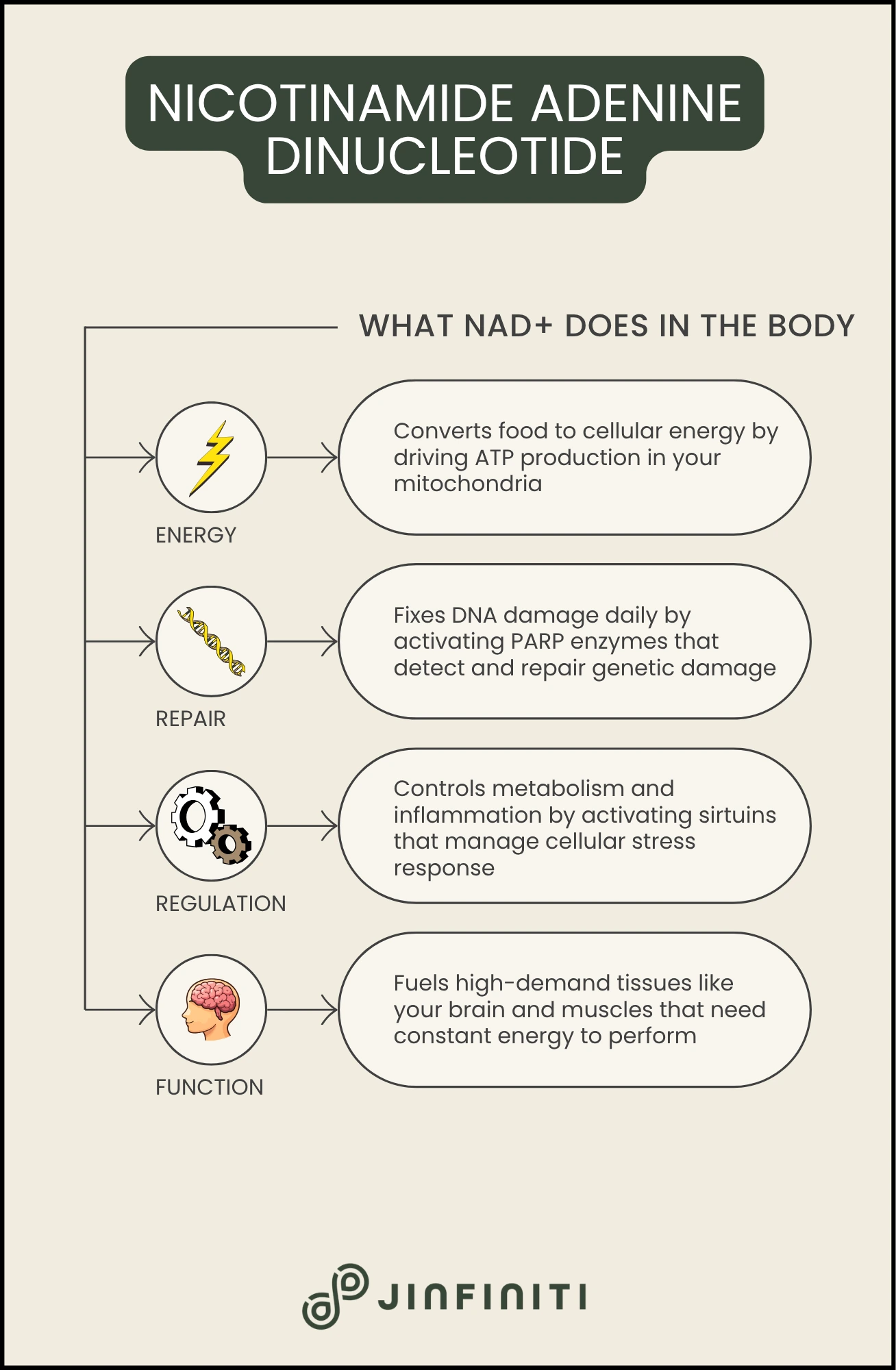
NAD is a coenzyme that turns food into cellular energy and supports DNA repair
Your levels naturally decline with age—often beginning in your 30s
Low NAD contributes to fatigue, brain fog, and slower recovery
Without testing, you can’t know if your levels are deficient or if supplementation is working
When exhaustion doesn’t respond to the standard fixes, it often points to something happening at the cellular level. One of the most common and underrecognized drivers is a decline in NAD, a molecule your cells rely on to produce energy.
NAD — short for nicotinamide adenine dinucleotide — exists in every living cell in your body. It’s not a vitamin or a hormone. It’s a coenzyme, which means it helps other molecules do their jobs. Without sufficient NAD, your cells can’t convert the food you eat into usable energy. They also can’t repair DNA damage, respond to stress, or regulate metabolism effectively.
The problem is that NAD levels decline measurably with age, often beginning in your 30s or 40s. Research shows that many people experience a 40-50% drop by age 50. And unlike most biomarkers, NAD can be measured directly — which means you can know exactly where your levels stand and take action based on data, not guesswork.[1]
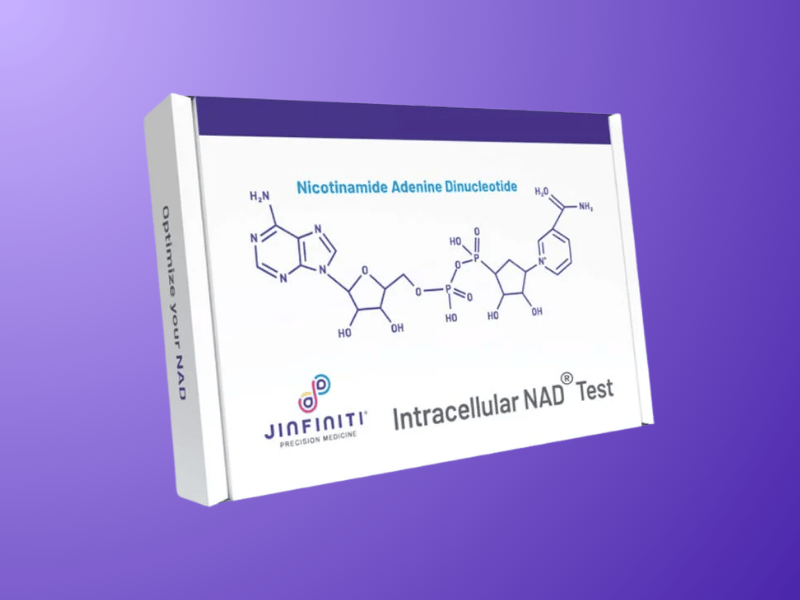
CLIA-Certified NAD Blood Test
Find out if your NAD+ is in the healthy range.
What NAD Actually Is
NAD is a small molecule found in every living cell, from bacteria to humans. It’s been studied for over a century — first discovered in 1906 during fermentation research — but our understanding of its importance in human health has deepened significantly in recent decades.
At a chemical level, NAD is made of two nucleotides joined by phosphate groups. One contains adenine, the other nicotinamide. The body can produce NAD from vitamin B3 (niacin) or the amino acid tryptophan, though most NAD is recycled through a salvage pathway rather than built from scratch.
What makes NAD essential is its ability to shuttle electrons between molecules. This electron transfer is the basis for nearly all energy production in your body.
The Two Forms: NAD+ and NADH
NAD exists in two forms that constantly cycle back and forth: NAD+ and NADH.
NAD+ is the oxidized form — think of it as an empty shuttle bus, ready to pick up electrons during metabolic reactions. NADH is the reduced form — the shuttle carrying electrons that can be used to generate ATP, your cells’ energy currency.
Together, these forms create a loop. NAD+ accepts electrons from nutrients like glucose and fat, becoming NADH. NADH then delivers those electrons to the mitochondria, where they drive ATP production. Once the electrons are dropped off, NADH converts back to NAD+, and the cycle continues.
This constant cycling is what keeps energy flowing in your cells. When NAD levels are too low, the loop slows down. Cells struggle to produce enough ATP, and you feel it as fatigue, slower recovery, or cognitive fog.
Why NAD Matters: What It Does in Your Body
NAD is involved in hundreds of cellular processes. Studies show it participates in more than 500 enzymatic reactions.[2]
A few roles stand out as particularly critical:
Energy production: Inside your mitochondria, NAD+ drives the reactions that convert glucose and fatty acids into ATP. Without sufficient NAD, mitochondrial function declines, and cellular energy production becomes less efficient.
DNA repair: Every day, your cells accumulate DNA damage from normal metabolism, UV exposure, and environmental toxins. NAD is consumed by enzymes called PARPs that detect and repair this damage. When NAD levels are low, DNA repair slows, and damage accumulates faster.
Metabolic regulation: A family of proteins called sirtuins only function in the presence of NAD. Sirtuins influence everything from fat storage to inflammation to circadian rhythm. They’re often called “longevity genes” because of their connection to healthy aging and stress resistance.
Brain function: Your brain represents only about 2% of your body weight but consumes roughly 20% of your total energy. NAD supports the high metabolic demands of neurons, and declining NAD in the brain has been linked to cognitive decline and neurodegenerative conditions.[3]
This isn’t just about “anti-aging.” NAD is how your body functions today. When levels are optimal, cells repair themselves efficiently, produce energy consistently, and respond to stress effectively. When levels drop, those processes slow — and you feel the difference before any disease state appears.
Why NAD Levels Decline With Age
NAD decline is one of the most consistent findings in aging research. It’s been documented in rodents, primates, and humans across multiple tissues.
Human studies show that whole blood NAD levels decline significantly with age, particularly in men. Women’s levels tend to fluctuate more after age 50, likely due to hormonal changes. In skeletal muscle, the decline can be anywhere from 15% to 65%, depending on the individual and the measurement method. Brain NAD also decreases measurably, which correlates with reduced cognitive function.[1]
The decline happens through two main mechanisms.
Reduced production occurs because the enzymes responsible for making NAD become less efficient with age. The key enzyme, NAMPT, decreases in activity over time. This creates a bottleneck — your cells can’t produce NAD as quickly as they once did, even if you’re consuming adequate precursors through diet.[4]
Increased consumption happens because certain NAD-degrading enzymes become more active as you age. One called CD38 rises in response to chronic inflammation. Another group, PARPs, ramps up activity in response to accumulated DNA damage. Both consume NAD to do their jobs, which depletes the cellular pool.[5][6]
Think of it as a sink where the faucet slows while the drain widens. Less NAD coming in, more NAD going out. Over time, this leads to the net decline that begins earlier than most people realize.
What Drives NAD Decline?
Age is the primary driver, but several factors accelerate the process:
Chronic inflammation increases the activity of CD38 and other NAD-consuming enzymes[5]
NAD decline doesn’t announce itself with a single, obvious symptom. Instead, it shows up as a pattern of issues that conventional testing often fails to explain.
Persistent fatigue that doesn’t resolve after adequate sleep — not the kind that goes away after a good night’s rest, but the kind that lingers despite doing everything “right”
Slower recovery from exercise, illness, or stress — when NAD levels are optimal, cells repair damage efficiently and bounce back quickly; when levels are low, recovery takes longer
Brain fog and difficulty concentrating — neurons are metabolically demanding, and when NAD drops, cognitive performance often follows
Metabolic changes — difficulty maintaining weight, worsening insulin sensitivity, or changes in how your body responds to food
The challenge is that these symptoms overlap with many other conditions. Thyroid disorders, sleep apnea, anemia, hormonal imbalances, and dozens of other issues can present similarly. That’s why symptom-based guessing rarely leads to a clear answer.
Measurement is the only way to know.
The NAD Measurement Problem
Most people who take NAD supplements have no idea if they’re actually working.
The wellness industry has embraced NAD precursors like NMN and NR over the past few years. Hundreds of products now claim to boost NAD levels, often with impressive-sounding promises about energy, longevity, and cognitive performance. But very few people taking these supplements ever test their levels — before, during, or after.
That’s a problem, because NAD metabolism is highly individual. The same dose that optimizes one person’s levels might do almost nothing for another. Some people absorb precursors efficiently; others don’t. Some have high baseline consumption from inflammation or DNA damage; others don’t. Without testing, you’re guessing.
Intracellular measurement matters because that’s where NAD actually works. Some tests measure NAD in blood plasma, which can give you a general sense of systemic levels. But the NAD inside your cells — where energy production, DNA repair, and metabolic regulation happen — is what drives outcomes. Intracellular NAD testing provides a much more accurate picture of your cellular energy status.
Dr. Jin-Xiong She’s clinical research established clear benchmarks for interpreting results. Optimal NAD levels fall between 40 and 100 micromolar (μM). Anything below 40μM is considered suboptimal or deficient. Levels above 100μM may not provide additional benefits and could potentially cause issues.
These ranges give you a concrete target, not a vague reference to “normal.”
Why Testing Changes Everything
Jinfiniti developed the world’s first consumer-grade intracellular NAD test in 2019. Before that, NAD testing was largely confined to research labs. Now, you can measure your baseline, track changes over time, and personalize your approach based on data.
Here’s what measurement enables:
Establishing your baseline tells you where you’re starting from — you might discover your levels are already optimal, in which case supplementation isn’t needed, or you might find they’re severely deficient, which explains symptoms that have gone undiagnosed for years
Validating whether supplementation works removes the guesswork — some people respond well to NMN, others respond better to niacinamide or NR, and testing shows you what’s actually happening in your cells, not what a bottle label promises
Personalizing your dosing is critical because there’s no one-size-fits-all approach to NAD optimization — in Jinfiniti’s clinical trial, 85% of participants reached optimal NAD levels within four weeks, but that success rate depended on personalized dosing based on measured results, not generic recommendations
Tracking progress over time lets you adjust as needed — NAD levels aren’t static; they respond to changes in diet, exercise, stress, inflammation, and supplementation, so retesting every few months ensures you’re maintaining optimal levels rather than drifting back into deficiency
As Dr. She puts it: “Measure before acting. NAD optimization isn’t about taking the same dose as someone else and hoping it works. It’s about knowing your levels, acting on that information, and confirming the results. Precision requires data.”
Without measurement, you’re flying blind. With it, you can make informed decisions and track real progress.
How to Support Healthy NAD Levels
If you’re looking to optimize your NAD levels, the most effective approach combines testing with targeted intervention.
Here’s what works:
Test first — Establish your baseline with an intracellular NAD test; this removes the guesswork and tells you whether your levels are deficient, suboptimal, or already optimal
NAD+ precursor supplementation is the most direct way to raise levels — NMN and NR are the most studied precursors; both convert to NAD inside your cells, though they follow slightly different pathways; niacinamide (a form of vitamin B3) also works through the salvage pathway
Lifestyle factors can support NAD production — regular exercise, moderate caloric intake, and consistent sleep all influence NAD metabolism, though they’re unlikely to fully counter age-related decline on their own
Reduce chronic inflammation through diet, stress management, and addressing underlying health issues — this helps by lowering NAD consumption from enzymes like CD38
Retest and adjust after 4-6 weeks — if your levels haven’t reached the optimal range, adjust your dose or try a different precursor; if they have, continue monitoring periodically to ensure they stay stable
Jinfiniti’s Vitality NAD+ Booster uses a multi-pathway formula that combines NMN, niacinamide, creatine, and D-ribose. The clinical trial data showed an average doubling of NAD levels within four weeks, with 85% of participants reaching the optimal range.
The goal isn’t to chase an arbitrary number. It’s to restore your cells’ ability to produce energy efficiently, repair damage effectively, and respond to stress appropriately. When NAD levels are optimal, you feel it — and the data confirms it.
NAD is not a wellness trend. It’s a fundamental molecule that’s been studied for over a century and plays a documented role in energy production, DNA repair, and metabolic regulation. Levels decline measurably with age, and that decline has real consequences — fatigue, slower recovery, cognitive fog, and increased vulnerability to age-related disease.
The difference between vague health advice and precision medicine comes down to measurement. You can’t optimize what you don’t measure. And without data, you’re guessing whether your NAD levels are deficient, whether supplementation is working, or whether you even need it in the first place.
If you’re dealing with unexplained fatigue, cognitive decline, or signs of accelerated biological aging, NAD testing gives you a clear starting point. It’s not the only factor that matters, but it’s one you can measure, address, and track over time.
Frequently Asked Questions
Is NAD the same as vitamin B3?
NAD is a molecule your body makes from vitamin B3 (which includes niacin, niacinamide, and nicotinamide riboside). Vitamin B3 is a precursor — a building block your cells use to produce NAD. You can get vitamin B3 from food or supplements, but your body still needs to convert it into NAD through metabolic pathways. Learn more about the differences between NAD, niacin, and niacinamide.
Which foods contain NAD?
Very few foods contain NAD directly. Instead, you get NAD precursors from foods rich in vitamin B3 — like meat, fish, mushrooms, peanuts, and fortified grains — or from foods containing tryptophan, an amino acid your body can convert to NAD. However, dietary sources alone rarely raise NAD levels significantly, especially after age 40. See the full list of NAD-boosting foods.
Are NAD supplements safe?
NAD precursors like NMN, NR, and niacinamide are generally well-tolerated in clinical studies, with mild side effects like nausea or flushing reported in some people. Most research shows a favorable safety profile for short-term use. However, long-term safety data is still limited, and it’s best to work with a healthcare provider — especially if you have underlying health conditions.
Can NAD help with weight loss?
NAD doesn’t directly cause weight loss, but it plays a role in metabolic function and energy regulation. Some research suggests NAD precursors may support metabolic health, particularly when combined with exercise and caloric moderation. However, NAD supplementation is not a weight-loss drug, and results vary widely between individuals. Read more about NAD, NMN, and weight loss.
What is the difference between NAD+ and NADH?
NAD+ is the oxidized form of the molecule, ready to accept electrons during metabolic reactions. NADH is the reduced form, carrying electrons that can be used to generate ATP. They cycle back and forth continuously, and both are necessary for cellular energy production.
Can you increase NAD levels naturally without supplements?
Lifestyle factors like exercise, caloric moderation, and adequate sleep can support NAD production to some degree. However, research suggests that lifestyle changes alone are often insufficient to fully counter the age-related decline in NAD levels, particularly after age 40. Precursor supplementation is typically needed for meaningful increases.[2]
What are optimal NAD levels?
Based on Dr. Jin-Xiong She’s clinical research, optimal intracellular NAD levels fall between 40 and 100 micromolar (μM). Levels below 40μM are considered suboptimal or deficient. Levels above 100μM may not provide additional benefits and could potentially be harmful.
How do I know if my NAD levels are low?
The only reliable way to know is through testing. Symptoms like persistent fatigue, brain fog, and slow recovery can suggest low NAD, but they overlap with many other conditions. Intracellular NAD testing provides a precise measurement of your cellular levels.
Does NAD supplementation work for everyone?
NAD precursors can raise levels in most people, but individual responses vary widely. Some people absorb and convert precursors efficiently, while others need higher doses or different forms. Without testing, you won’t know if a supplement is actually working for you. That’s why personalized dosing based on measured levels is more effective than generic recommendations.
How long does it take to see results from NAD supplementation?
Most people who respond to NAD precursors notice changes within 2-4 weeks. Clinical studies, including Jinfiniti’s trial with Vitality NAD+ Booster, show measurable increases in NAD levels within four weeks. However, subjective improvements in energy, recovery, and cognitive clarity may appear sooner or later depending on your baseline levels and overall health.
Does NAD interact with GLP-1 medications?
NAD and GLP-1 pathways both influence metabolic health, and there’s emerging research on how they interact. If you’re using GLP-1 medications, NAD optimization may offer complementary benefits. Learn more about the relationship between NAD and GLP-1.
Yang F, Deng X, Yu Y, Luo L, Chen X, Zheng J, et al. Association of Human Whole Blood NAD+ Contents With Aging. Frontiers Media SA; 2022. https://doi.org/10.3389/fendo.2022.829658
Covarrubias AJ, Perrone R, Grozio A, Verdin E. NAD+ metabolism and its roles in cellular processes during ageing. Springer Science and Business Media LLC; 2020. https://doi.org/10.1038/s41580-020-00313-x
Zhu XH, Lu M, Lee BY, Ugurbil K, Chen W. In vivo NAD assay reveals the intracellular NAD contents and redox state in healthy human brain and their age dependences. Proceedings of the National Academy of Sciences; 2015. https://doi.org/10.1073/pnas.1417921112
Zhang W, Ren H, Chen W, Hu B, Feng C, Li P, et al. Nicotinamide phosphoribosyltransferase in NAD+ metabolism: physiological and pathophysiological implications. Springer Science and Business Media LLC; 2025. https://doi.org/10.1038/s41420-025-02672-w
Piedra-Quintero ZL, Wilson Z, Nava P, Guerau-de-Arellano M. CD38: An Immunomodulatory Molecule in Inflammation and Autoimmunity. Frontiers Media SA; 2020. https://doi.org/10.3389/fimmu.2020.597959
Sousa FG, Matuo R, Soares DG, Escargueil AE, Henriques JAP, Larsen AK, et al. PARPs and the DNA damage response. Oxford University Press (OUP); 2012. https://doi.org/10.1093/carcin/bgs132
Rasool S, Geetha T, Broderick TL, Babu JR. High Fat With High Sucrose Diet Leads to Obesity and Induces Myodegeneration. Frontiers Media SA; 2018. https://doi.org/10.3389/fphys.2018.01054
Rappou E, Jukarainen S, Rinnankoski-Tuikka R, Kaye S, Heinonen S, Hakkarainen A, et al. Weight Loss Is Associated With Increased NAD+/SIRT1 Expression But Reduced PARP Activity in White Adipose Tissue. The Endocrine Society; 2016. https://doi.org/10.1210/jc.2015-3054
GLP-1 medications reduce caloric intake and weight, but up to 45% of the weight lost may come from lean body mass rather than fat alone.
NAD+ — a molecule found in every cell — fuels the mitochondria that produce cellular energy, and levels typically decline with age and metabolic stress.
Animal research suggests that intestinal NAD+ biosynthesis is required for the gut to produce GLP-1 naturally, though human data is still emerging.
If you’re supplementing NAD+ alongside a GLP-1 protocol, testing your intracellular NAD+ levels is the only way to know whether supplementation is actually working.
If you’re on a GLP-1 medication — Ozempic, Wegovy, Mounjaro — and you’ve been told to add NAD+ to your protocol, you’ve probably encountered some version of the same pitch: NAD+ gives you the energy back that GLP-1 drugs take away. It’s simple, it sounds plausible, and it’s only partially right.
The real relationship between NAD+ and GLP-1 is more interesting than that. There’s research — not widely discussed in consumer health circles — suggesting that NAD+ doesn’t just patch the side effects of GLP-1 medications. It plays a role in whether your body produces GLP-1 naturally in the first place. That reframes the conversation considerably.
Here’s what the evidence actually supports, where it’s still emerging, and what to consider if you’re thinking about pairing the two.
CLIA-Certified NAD Test Kit
Find out if your NAD+ is actually optimized.
Why GLP-1 Medications Leave Some People Feeling Depleted
GLP-1 receptor agonists work by mimicking a hormone your intestines naturally produce after eating. They slow gastric emptying, reduce appetite, and signal the brain that you’re full. The result — significant caloric restriction — is exactly what drives the weight loss.
But the body doesn’t distinguish between a medication-induced caloric deficit and a famine. When fuel intake drops, cellular energy production follows.
What Caloric Restriction Does to Cellular Energy
Your cells produce energy through the mitochondria, using a process that requires a steady supply of fuel and specific molecular cofactors — including NAD+. When you eat significantly less, the inputs into that energy production chain decrease. For many people on GLP-1 medications, the experience is fatigue, mental fog, and a general feeling of physical flatness that doesn’t match the number on the scale.
This isn’t a sign the medication isn’t working. It’s a sign the body is adapting to reduced intake — and that adaptation has cellular costs.
The Lean Mass Question
The more pressing clinical concern is what’s happening to body composition. In the STEP-1 clinical trial of semaglutide, roughly 45% of total weight lost was lean body mass rather than fat. A 2025 Cell Metabolism analysis noted that lean mass loss on GLP-1 receptor agonists has raised genuine questions about the long-term metabolic implications — particularly for people already experiencing age-related muscle decline.[1]
Losing muscle alongside fat matters because muscle is metabolically active tissue. Less muscle means a lower resting metabolic rate, reduced physical capacity, and — critically — less mitochondrial machinery to support energy production.
This is the fuller picture of why some people feel depleted on GLP-1 medications. It’s not just caloric restriction. It’s what caloric restriction, at scale and over time, does to the cellular infrastructure that produces energy in the first place.
NAD+ — nicotinamide adenine dinucleotide — is a coenzyme found in every living cell. It’s the molecule that allows your mitochondria to convert food into usable energy, supports DNA repair, and activates a class of proteins called sirtuins that regulate cellular aging and metabolism.
NAD+ levels decline with age — measurably so, beginning in the 30s and accelerating through midlife. They also decline with metabolic stress, obesity, and high-fat diets. This matters for people on GLP-1 medications because the population most likely using these drugs — adults with metabolic dysfunction, insulin resistance, or obesity — often starts from a lower NAD+ baseline to begin with.
When you add significant caloric restriction to an already-depleted NAD+ system, the cellular energy shortfall compounds. This is the specific gap NAD+ supplementation is meant to address.
A 2025 study published in Obesity found that semaglutide-induced weight loss improved mitochondrial oxidative phosphorylation efficiency in skeletal muscle in mice — meaning GLP-1 medications may independently support some mitochondrial improvements through weight loss itself.[2]
That’s genuinely encouraging. But mitochondrial efficiency and NAD+ availability are distinct variables, and the evidence for NAD+ specifically addresses the fuel supply side of the equation.
NAD+ and Your Body’s Own GLP-1 Production
Most articles frame NAD+ as a complement to GLP-1 medications — something you take alongside Ozempic to feel better. The deeper story, supported by emerging research, is that NAD+ may be upstream of GLP-1 production entirely.
How Intestinal NAD+ Controls Natural GLP-1 Production
GLP-1 is produced by specialized L-cells in the lining of your small intestine. Those cells depend on a tightly regulated internal environment to function properly — and a key part of that environment is NAD+ biosynthesis, mediated by an enzyme called NAMPT (nicotinamide phosphoribosyltransferase).
A 2022 study published in Endocrinology by Nagahisa et al. tested what happens when intestinal epithelial cells are stripped of NAMPT — and therefore unable to produce NAD+. The result was a significant reduction in GLP-1 production, decreased insulin secretion, and elevated postprandial blood glucose. The mice weren’t heavier. They just couldn’t regulate glucose properly because their guts couldn’t produce enough GLP-1.[3]
What Happens When Gut NAD+ Is Depleted
The same research team found that obese mice fed a high-fat diet showed the same pattern: compromised intestinal NAD+ biosynthesis, impaired GLP-1 production, and disrupted postprandial glucose metabolism. When they administered NMN — a key NAD+ precursor — intestinal NAD+ levels were restored, and GLP-1 production recovered along with glucose regulation.
A follow-up review in Nutrients (2023) elaborated on the mechanistic pathway: intestinal NAD+ biosynthesis, via the AMPK–NAMPT–SIRT1 axis, is critical for maintaining the gut environment that produces GLP-1. When that pathway is disrupted — by obesity, aging, or poor diet — GLP-1 production downstream suffers.[4]
It’s worth being clear: this research is primarily in animal models. Human clinical trials on this specific pathway are still underway. But the mechanistic insight changes the framing. The metabolic dysfunction that leads people to need GLP-1 medications may be partly downstream of the same NAD+ depletion those medications are compensating for. If that’s accurate, supporting NAD+ isn’t just managing side effects. It’s addressing the cellular environment the whole system depends on.
NAD+ and Muscle Preservation During GLP-1 Treatment
The lean mass concern with GLP-1 medications is real enough to take seriously, and NAD+ has a specific role to play here.
Muscle tissue contains a high density of mitochondria — more than almost any other tissue in the body. Mitochondrial function in muscle depends heavily on NAD+ availability. When NAD+ is depleted, mitochondrial output falls, and muscle cells become less efficient at producing energy and maintaining their own structure.
There’s also a creatine connection worth noting. NAD+ and creatine operate through overlapping metabolic pathways — both supporting ATP synthesis, the actual energy currency inside cells. For people concerned about muscle quality and energy output during GLP-1-induced weight loss, addressing both pathways simultaneously is a reasonable approach. If you want to understand how supplementing each of these nutrients compares in terms of NAD+ dosing specifically, the NAD+ dosage guide covers that in detail.
The 2026 Cell Reports Medicine analysis found that GLP-1 receptor agonist treatment did upregulate certain mitochondrial proteins — including SIRT5 — in skeletal muscle compared to calorie restriction alone. That’s a meaningful finding. But it also underscores that the mitochondrial effects of GLP-1 treatment are still being characterized, and that NAD+ addresses the fuel side of mitochondrial function in a way that GLP-1 doesn’t.
The population on GLP-1 medications tends to be engaged with their health — tracking metrics, working with clinicians, paying attention to how interventions affect outcomes. Adding NAD+ supplementation to a GLP-1 protocol without measuring baseline NAD+ levels is, by the standards of that same engagement, a gap.
Intracellular NAD+ can be measured directly through a finger-prick blood test. Optimal levels, based on Jinfiniti’s clinical research, fall between 40 and 100 μM. Most adults in midlife — particularly those with obesity or metabolic dysfunction — test significantly below that range before supplementing.
“The people most likely to benefit from NAD+ support are often the ones who started below optimal levels without knowing it,” says Dr. Jin-Xiong She, founder of Jinfiniti Precision Medicine. “Supplementing without a baseline is still just guessing — and when you’re already managing a prescription protocol, precision matters more, not less.”
Knowing your starting level also allows you to calibrate dosing appropriately and confirm, after 4–6 weeks of supplementation, whether you’ve actually reached the range where NAD+ exerts its measurable effects. Niacinamide — one of the four ingredients in the Vitality NAD+ Booster — plays a specific role in that synthesis pathway; understanding what niacinamide does in the context of NAD+ production is useful for anyone building a targeted protocol.
What to Realistically Expect From NAD+ Alongside GLP-1 Therapy
NAD+ is not a GLP-1 amplifier. It won’t increase the weight-loss effect of semaglutide or make the medication work faster. What it does is support the cellular environment that gets taxed when caloric intake drops significantly and the body is remodeling its composition.
For people on GLP-1 medications, the realistic case for NAD+ includes: better mitochondrial support during caloric restriction, reduced cellular energy depletion in muscle tissue, and — based on emerging animal research — potential support for the gut environment that produces GLP-1 naturally. None of this is a guarantee. Individual response to NAD+ supplementation varies, and starting NAD+ levels, age, diet, and baseline metabolic health all affect outcomes.
The most important caveat: if you’re on a GLP-1 medication and considering adding NAD+ supplementation, talk with your clinician first. NAD+ precursors are generally well-tolerated, but any addition to an active prescription protocol warrants a conversation with the prescribing provider.
The supplementation question is secondary to the measurement question. Know your NAD+ level. Then decide what to do with that information.
Frequently Asked Questions
Can you take NAD+ with Ozempic, Wegovy, or Mounjaro?
Yes. NAD+ precursors — including NMN and NR — are generally well-tolerated and are not known to interact with GLP-1 receptor agonists. That said, if you’re on a prescription protocol, the appropriate step is to confirm with your prescribing clinician before adding any supplement.
Can you get NAD+ injections while on GLP-1 medications?
Yes. NAD+ injections aren’t known to interact with GLP-1 receptor agonists, and some clinics offer them specifically for GLP-1-related fatigue. One caveat: the NAD+ molecule is too large to enter cells directly from the bloodstream, so IV delivery loses a significant portion to breakdown before it’s usable. Subcutaneous injections perform somewhat better — but Jinfiniti’s clinical data showed their oral multi-pathway formula reached optimal intracellular levels more consistently than subcutaneous NAD+, at a fraction of the cost.
Why do GLP-1 medications cause fatigue, and can NAD+ help?
GLP-1 medications reduce caloric intake substantially, which decreases the fuel available for cellular energy production. NAD+ supports the mitochondrial machinery that converts available fuel into usable energy. For people whose NAD+ levels are already depleted — common in those with metabolic dysfunction — supplementing to optimal levels may help address that energy gap. Results vary based on where you’re starting from.
Does NAD+ affect how GLP-1 medications work?
Not directly. NAD+ and GLP-1 receptor agonists work through different mechanisms. What’s interesting is the upstream relationship: animal research suggests that NAD+ biosynthesis in the gut is required for the body to produce GLP-1 naturally. This doesn’t mean NAD+ boosts the medication — but it does suggest the two systems are more connected at a biological level than the standard framing implies.
Is lean mass loss on GLP-1 medications inevitable?
Data from the STEP-1 trial showed significant lean mass reduction alongside fat loss on semaglutide. Whether this is inevitable or modifiable depends on factors including exercise, protein intake, and mitochondrial support. NAD+ supports muscle mitochondrial function and operates through pathways that overlap with creatine — both relevant to maintaining muscle quality during weight loss.
How do you know if your NAD+ levels are actually low?
You test. Intracellular NAD+ levels can be measured through a finger-prick blood test processed in a CLIA-certified lab. Optimal levels fall between 40 and 100 μM; many adults test in the deficient or suboptimal range without symptoms specific enough to identify the cause. Testing before supplementing gives you a baseline to work from and lets you confirm, after 4–6 weeks, whether your levels have actually improved.
Karasawa T, Choi RH, Meza CA, Rout S, Drummond MJ, Chaix A, et al. Unexpected effects of semaglutide on skeletal muscle mass and force-generating capacity in mice. Elsevier BV; 2025. https://doi.org/10.1016/j.cmet.2025.07.004
Choi RH, Karasawa T, Meza CA, Maschek JA, Manuel AM, Nikolova LS, et al. Semaglutide‐induced weight loss improves mitochondrial energy efficiency in skeletal muscle. Wiley; 2025. https://doi.org/10.1002/oby.24274
Nagahisa T, Yamaguchi S, Kosugi S, Homma K, Miyashita K, Irie J, et al. Intestinal Epithelial NAD+ Biosynthesis Regulates GLP-1 Production and Postprandial Glucose Metabolism in Mice. The Endocrine Society; 2022. https://doi.org/10.1210/endocr/bqac023
Nagahisa T, Kosugi S, Yamaguchi S. Interactions between Intestinal Homeostasis and NAD+ Biology in Regulating Incretin Production and Postprandial Glucose Metabolism. MDPI AG; 2023. https://doi.org/10.3390/nu15061494
Mitochondria produce ATP, the energy molecule every cell in your body depends on — when they decline, so does your energy, recovery, and cognitive function.
The supplements with the strongest evidence for mitochondrial support include NAD+ precursors, CoQ10, Urolithin A, PQQ, alpha-lipoic acid, and acetyl-L-carnitine — each working through different mechanisms.
NAD+ is the single most important upstream driver of mitochondrial health, and it declines measurably with age.
Testing exists to measure where your mitochondria actually stand, so you’re not supplementing blindly.
You’ve probably been told your labs look fine. Normal thyroid, normal iron, nothing that jumps out. But you’re still tired — the kind of tired that sleep doesn’t fix — and your recovery from workouts, illness, or stress takes longer than it used to.
That’s not necessarily a sign that something is wrong with your bloodwork. It may be a sign that something is happening at a level standard panels don’t measure: inside your cells, in the tiny organelles responsible for producing nearly all of your body’s energy.
Mitochondrial decline is measurable, starts earlier than most people expect — often in your 30s and 40s — and is one of the most underappreciated drivers of fatigue, cognitive slowdown, and accelerated aging. The good news is that a growing body of research points to specific supplements, lifestyle habits, and tests that can genuinely support mitochondrial function.
This guide covers all of them, with honest evidence appraisals for each.
CLIA-Certified NAD Test Kit
Is NAD+ your mitochondrial bottleneck? Find out from home.
Why Mitochondrial Decline Matters — And When It Starts
Mitochondria do much more than produce energy. They regulate inflammation, control when cells live or die, and manage the DNA repair processes that keep you healthy as you age. Their decline isn’t just about feeling tired — it contributes to insulin resistance, cardiovascular disease, cognitive decline, and accelerated cellular aging.
This happens through two compounding failures. First, mitochondria produce less ATP (adenosine triphosphate) as their electron transport chain becomes less efficient. Second, the cleanup systems that remove damaged mitochondria — mitophagy — slow down with age, leaving dysfunctional organelles in place where they generate more oxidative stress. High-energy organs feel this first: the brain, the heart, and skeletal muscle.
The Role of NAD+ as the Upstream Driver
NAD+ (nicotinamide adenine dinucleotide) sits at the center of mitochondrial function. It’s the critical electron carrier in the mitochondrial respiratory chain, and it activates the sirtuin proteins — SIRT1 and SIRT3 — that regulate mitochondrial biogenesis, stress response, and quality control. A 2025 review in npj Metabolic Health and Disease describes NAD+ as essential to virtually every aspect of mitochondrial homeostasis, from energy production to mitophagy to antioxidant defense.[1]
The problem: NAD+ levels decline with age — measurably and significantly. By middle age, many people have half the intracellular NAD+ they had in their 20s. That decline tracks closely with the symptoms most people write off as “just getting older.”
Signs Your Mitochondria May Need Support
Not all of these point definitively to mitochondrial dysfunction — but they’re worth paying attention to, especially when multiple appear together:
Persistent fatigue not explained by sleep, stress, or bloodwork
Slower recovery from exercise, illness, or stress
Brain fog, difficulty concentrating, or cognitive slowdown
Muscle weakness or loss of exercise tolerance
Increased sensitivity to cold or temperature changes
Multiple-system symptoms without a clear diagnosis
The Best Supplements for Mitochondrial Health
What follows isn’t a “take everything on this list” approach. It’s organized by mechanism — how each supplement actually supports mitochondria — with the strength of evidence called out honestly for each.
1. NAD+ Precursors (NMN and NR): Fuel for the Whole System
If there’s a single intervention that addresses mitochondrial health at the root level, NAD+ repletion is the closest candidate. NMN (nicotinamide mononucleotide) and NR (nicotinamide riboside) are both precursors that raise intracellular NAD+, which in turn activates sirtuins, improves electron transport chain function, and supports the mitophagy systems that clear out damaged mitochondria.
Research published in Cell Death & Disease demonstrated that NMN supplementation improved mitochondrial stress response in Alzheimer’s disease models, reducing protein aggregation and restoring mitochondrial quality control.[2]
A randomized controlled trial of NR supplementation found significant increases in NAD+ levels and improvements in long-COVID cognitive symptoms — notably, a condition characterized by mitochondrial dysfunction.[3]
Dosing: 250–500 mg NMN or NR daily; effectiveness varies by individual, which is why testing matters.
“NAD+ testing before and during supplementation changes everything,” says Dr. Jin-Xiong She, founder of Jinfiniti Precision Medicine. “Most people assume they’re absorbing what they’re taking. What the data actually shows is that a meaningful percentage aren’t reaching optimal levels — and without measuring, you have no way to know.”
Optimal intracellular NAD+ has been defined as 40–100 μM. Below 40 is suboptimal; below 20 is severely deficient. 85% of participants taking Vitality↑® NAD+ Booster reached optimal NAD+ levels within four weeks in a clinical setting — a result that single-ingredient precursors haven’t matched in head-to-head comparisons.
2. CoQ10: The Electron Transport Chain Essential
CoQ10 (coenzyme Q10) is concentrated in the tissues that demand the most energy — the heart, kidneys, and liver — and sits directly inside the mitochondrial electron transport chain, where it shuttles electrons between protein complexes to generate ATP. Without adequate CoQ10, that chain becomes inefficient and generates more oxidative stress as a byproduct.
Clinical trials summarized in a review on mitochondrial dysfunction and chronic disease confirm CoQ10’s role in supporting ATP production and protecting mitochondrial membranes from oxidative damage.[4]
There’s a particularly important caveat for anyone on statins: these medications can reduce CoQ10 levels by up to 40%, leaving mitochondrial function significantly impaired in people who are already managing cardiovascular risk.[5]
Two forms are available: ubiquinone (the oxidized form) and ubiquinol (the reduced, active form). Ubiquinol is better absorbed, particularly in adults over 50 whose conversion capacity has declined.
Dosing: 100–300 mg daily with a fat-containing meal. Ubiquinol preferred for older adults.
3. Urolithin A: The Mitophagy Activator
Damaged mitochondria that aren’t cleared accumulate inside cells and generate chronic oxidative stress. Urolithin A (UA) addresses this directly — it activates the PINK1 and Parkin proteins that tag worn-out mitochondria for recycling, improving the efficiency of the cellular cleanup system.
Research published in JAMA Network Open found that urolithin A supplementation improved muscle endurance in adults over 65 — a population with consistently poor mitophagy efficiency — even without exercise, improving fatigue resistance over four months. A separate study in iScience showed UA restored mitochondrial structure and function in aging and heart failure models.[6][7]
Worth being honest about: UA research in humans is still relatively early-stage compared to CoQ10 or creatine. The mechanistic data is compelling, but larger long-term human trials are still underway. It’s also worth noting that UA isn’t reliably produced from diet — it’s a byproduct of gut bacteria acting on ellagitannins from pomegranates and berries, and many people’s gut microbiome can’t produce it efficiently. Supplementation is the more predictable route. UA is included in Jinfiniti’s RejuvenAid alongside other cellular protection compounds.
Dosing: 500–1,000 mg daily.
4. PQQ: Triggering New Mitochondria
Most supplements on this list support the mitochondria you already have. PQQ (pyrroloquinoline quinone) is notable because it’s one of the few compounds with human evidence for actually stimulating the creation of new mitochondria — the process called mitochondrial biogenesis, regulated by the PGC-1α pathway.
PQQ activates NRF-1, NRF-2, and TFAM — the transcription factors that drive mitochondrial DNA replication and protein expression. Research in the Journal of the American College of Nutrition confirmed PQQ increases mitochondrial density through these mechanisms. It also reduces inflammation by inhibiting the NLRP3 inflammasome — the same pathway that contributes to both mitochondrial dysfunction and chronic inflammatory disease.[8]
Dosing: 10–20 mg daily. Often paired with CoQ10 for complementary effects.
5. Alpha-Lipoic Acid (ALA): Antioxidant for the Energy Chain
Alpha-lipoic acid functions as a cofactor for two key mitochondrial enzyme complexes — pyruvate dehydrogenase and alpha-ketoglutarate dehydrogenase — that are essential to the Krebs cycle. It also regenerates other antioxidants, including vitamin E and glutathione, which protect mitochondrial membranes from the oxidative byproducts of energy production.
What sets ALA apart from other antioxidants is that it crosses the blood-brain barrier, providing mitochondrial support in neurons — cells that are particularly energy-intensive and vulnerable to mitochondrial decline. A review in Antioxidants (Basel, Switzerland) confirmed ALA reduces free radical damage, improves mitochondrial function, and strengthens antioxidant defenses in multiple tissue types.[9]
Two forms exist: R-lipoic acid (the natural form) and the synthetic R/S mixture. R-ALA is approximately twice as bioavailable and is the better choice despite the higher cost.
Mitochondria can’t burn long-chain fatty acids for fuel without carnitine — it’s the shuttle that transports them across the mitochondrial membrane. Acetyl-L-carnitine (ALCAR) is the acetylated form, which has better brain penetration and provides the additional benefit of acetyl groups for acetylcholine synthesis.
This matters most during states when fat is the primary fuel: fasting, low-carb eating, or endurance exercise. A randomized controlled trial on centenarians found significant reductions in physical and mental fatigue after L-carnitine supplementation — a result consistent with improving mitochondrial fuel delivery in tissues where carnitine status had likely declined.[10]
ALCAR is part of the RejuvenAid formula alongside L-ergothioneine and other cellular protection compounds.
Dosing: 1,500–3,000 mg daily; one dose approximately an hour before exercise if used for performance.
6. Senolytics: Clearing the Problem at the Source
Senescent cells — the “zombie” cells that have stopped dividing but refuse to die — accumulate dysfunctional mitochondria and secrete a chronic inflammatory signal that degrades the tissue around them. Clearing these cells addresses mitochondrial dysfunction from a different angle: not by boosting energy production, but by removing the burden of cells that are actively disrupting the cellular environment.[11]
Fisetinis the most potent natural senolytic identified to date. Quercetin has both senolytic and anti-inflammatory properties, and research consistently shows the two compounds work synergistically. Bromelain, included in Jinfiniti’s SenoAid, improves absorption.[12]
Dosing: Can be taken daily or via “pulse dosing” (2–3 consecutive days per week). Quercetin 1,000 mg + Fisetin 100–200 mg.
7. Magnesium, B Vitamins, and Vitamin D: The Foundation Layer
These don’t generate the same excitement as NMN or Urolithin A, but here’s the honest reality: if you’re deficient in any of them, nothing else on this list works as well as it should.
Magnesium is required for over 300 enzymatic reactions, including several steps in the Krebs cycle that produce ATP. It’s also rapidly depleted by oxidative stress — meaning the people who need it most are often the ones who have the least. Glycinate and malate are the most bioavailable forms. For sleep specifically, magnesium glycinate is particularly well-supported.[13]
B vitamins — particularly B1 (thiamine), B2 (riboflavin), and B3 (niacinamide) — have direct roles in the electron transport chain and ATP synthesis. Niacinamide specifically is a direct NAD+ precursor, contributing to the same pathway that NMN and NR support.[14]
Vitamin D receptors are found in mitochondrial membranes, and deficiency impairs ATP production and mitochondrial respiration. Roughly 70% of adults are deficient. Vitamin D3 is best combined with K2 (MK-7 form) to ensure calcium is directed into bones rather than arterial walls.[15]
Dosing: Magnesium 300–400 mg (glycinate or malate); Vitamin D3 2,000–5,000 IU with K2 100 mcg; B vitamins best from a quality B complex or as individual supplements.
8. L-Ergothioneine: The Mitochondria-Specific Antioxidant
This one doesn’t get much coverage outside specialized longevity circles, but the mechanism is worth understanding. L-ergothioneine is an amino acid with its own dedicated mitochondrial transporter — meaning the body has evolved a specific system for concentrating it in high-energy tissues. It’s naturally found in mushrooms, but not at levels achievable from diet alone.
Emerging research suggests L-ergothioneine protects mitochondrial DNA and membranes from oxidative damage specifically in high-demand tissues like the heart, brain, and liver. Larger human trials are still underway, so the evidence is early-stage — but the mechanistic specificity is compelling. It’s included in the RejuvenAid formula alongside Urolithin A and ALCAR.[16]
Lifestyle Habits That Genuinely Support Mitochondrial Health
Supplements work better alongside lifestyle — and for some people, these interventions move the needle more than anything they’re taking.
Exercise — Especially HIIT
Physical activity is the most evidence-backed intervention for mitochondrial biogenesis. High-intensity interval training (HIIT) in particular triggers PGC-1α activation — the same pathway PQQ targets — stimulating the creation of new mitochondria. Even moderate walking improves mitochondrial efficiency over time. You don’t need an extreme protocol; you need consistency and, periodically, intensity.[17]
Fasting and Time-Restricted Eating
Going without food for 12–16 hours activates AMPK — the cellular energy sensor — which in turn triggers both autophagy and mitophagy. This is one of the most direct ways to promote mitochondrial cleanup through lifestyle. Time-restricted eating (eating within an 8–10 hour window) achieves this without extended fasting.[18]
Sauna and Cold Exposure
Heat stress activates heat shock proteins that protect mitochondria from oxidative damage, and regular sauna use has been linked to improved mitochondrial biogenesis. Cold exposure activates brown adipose tissue, which is exceptionally mitochondria-dense, and may stimulate mitochondrial production in other tissues as well.[19][20]
Sleep
Most mitochondrial repair happens during sleep. Inadequate sleep increases oxidative stress, impairs the cellular cleanup systems, and accelerates mitochondrial dysfunction — and those effects compound over time. Seven to nine hours isn’t a lifestyle preference; it’s metabolic maintenance.[21]
Diet
A diet that limits ultra-processed foods and refined sugar reduces the oxidative burden your mitochondria have to manage. Omega-3 fatty acids maintain mitochondrial membrane integrity. Polyphenol-rich foods — berries, dark leafy greens, cruciferous vegetables — support the antioxidant systems that protect mitochondrial DNA.[22]
🧬 MORE MITOCHONDRIA READS
Energy loss, slower recovery, brain fog — these aren’t random. Learn what’s actually happening at the cellular level with mitochondrial decline and why it matters.
NMN is the most direct way to raise NAD+ — but not all products deliver. Here’s how the top NMN supplements of 2026 compare on quality, dose, and clinical backing.
Should You Test for Mitochondrial Dysfunction?
Supplementing blindly is the norm — but it doesn’t have to be. Two tests are worth knowing about, and they serve different purposes.
If you’re focused on NAD+ optimization — which covers the largest group of people reading this — the Intracellular NAD® Test is the most practical place to start. It measures NAD+ inside your cells (not just in plasma), using a simple at-home finger-prick kit with CLIA-certified results. Optimal range is 40–100 μM. Below that, you have a measurable deficiency that precursor supplementation can address. Above it, you know your current approach is working. Without this number, you’re adjusting dosage by feel.
If you suspect true mitochondrial dysfunction — multiple unexplained symptoms affecting different organ systems, a family history of mitochondrial disease, or persistent decline that doesn’t respond to conventional approaches — a MitoSwab test is worth discussing with your clinician. It’s a non-invasive cheek swab that measures the activity of Complex I, Complex IV, and citrate synthase (overall mitochondrial content) in buccal cells, with an 84% correlation to the traditional gold standard of muscle biopsy. It’s designed as a diagnostic tool for dysfunction, not a longevity optimization metric — but for people with complex presentations, it provides data that can meaningfully change the conversation with a specialist.
Frequently Asked Questions
What are the signs of poor mitochondrial health?
Persistent fatigue unrelated to sleep or stress, slow recovery from exercise or illness, brain fog, muscle weakness, and temperature intolerance are common signals. When multiple symptoms affect different organ systems without a clear diagnosis, mitochondrial dysfunction is worth investigating. Talk with your clinician about whether testing is appropriate.
Which supplement is most important for mitochondrial function?
NAD+ precursors (NMN or NR) have the broadest and most mechanistically central effect — NAD+ is involved in virtually every aspect of mitochondrial function. CoQ10 is a close second and is often deficient in older adults and statin users. That said, the right priority depends on your individual baseline; testing NAD+ levels first gives you a more accurate starting point.
Can you improve mitochondrial function without supplements?
Yes, meaningfully. HIIT exercise, time-restricted eating, adequate sleep, and reducing dietary oxidative burden all support mitochondrial function through mechanisms independent of supplementation. The evidence for exercise in particular is as strong as anything in the supplement literature.
How long does it take for mitochondrial supplements to work?
NAD+ precursors produce measurable changes in intracellular NAD+ within two to four weeks in most people. CoQ10 benefits in cardiac tissue are typically studied over 12-week periods. Results vary by individual, baseline status, and whether lifestyle factors are being addressed simultaneously.
What’s the difference between primary mitochondrial disease and age-related mitochondrial decline?
Primary mitochondrial disease is a genetic condition — mutations in mitochondrial or nuclear DNA that directly impair mitochondrial function, often presenting from birth or early childhood. Age-related mitochondrial decline is a gradual process affecting most adults, driven by NAD+ depletion, oxidative damage accumulation, and slowing of mitophagy. The two are very different in severity, mechanism, and appropriate intervention. Most people reading this are dealing with the latter.
Is CoQ10 or NMN better for mitochondria?
They work through different mechanisms and aren’t really comparable. NMN supports the NAD+ system that regulates mitochondrial quality control and biogenesis. CoQ10 works directly in the electron transport chain to support ATP production. Both have strong evidence; both address different parts of the same system. If you can only pick one, test your NAD+ levels first — that will tell you whether the upstream NAD+ pathway is the priority.
Referenced Sources
Yusri K, Jose S, Vermeulen KS, Tan TCM, Sorrentino V. The role of NAD+ metabolism and its modulation of mitochondria in aging and disease. Springer Science and Business Media LLC; 2025. https://doi.org/10.1038/s44324-025-00067-0
Xiong X, Hou J, Zheng Y, Jiang T, Zhao X, Cai J, et al. NAD+-boosting agent nicotinamide mononucleotide potently improves mitochondria stress response in Alzheimer’s disease via ATF4-dependent mitochondrial UPR. Springer Science and Business Media LLC; 2024. https://doi.org/10.1038/s41419-024-07062-1
Wu CY, Reynolds WC, Abril I, McManus AJ, Brenner C, González-Irizarry G, et al. Effects of nicotinamide riboside on NAD+ levels, cognition, and symptom recovery in long-COVID: a randomized controlled trial. Elsevier BV; 2025. https://doi.org/10.1016/j.eclinm.2025.103633
Nicolson G. Mitochondrial Dysfunction and Chronic Disease: Treatment With Natural Supplements. Integrative Medicine. 2014;13(4):35–43.
Deichmann R, Lavie C, Andrews S. Coenzyme q10 and statin-induced mitochondrial dysfunction. Ochsner Journal. 2010;10(1):16–21.
Liu S, D’Amico D, Shankland E, Bhayana S, Garcia JM, Aebischer P, et al. Effect of Urolithin A Supplementation on Muscle Endurance and Mitochondrial Health in Older Adults. American Medical Association (AMA); 2022. https://doi.org/10.1001/jamanetworkopen.2021.44279
Liu S, Faitg J, Tissot C, Konstantopoulos D, Laws R, Bourdier G, et al. Urolithin A provides cardioprotection and mitochondrial quality enhancement preclinically and improves human cardiovascular health biomarkers. Elsevier BV; 2025. https://doi.org/10.1016/j.isci.2025.111814
Hwang PS, Machek SB, Cardaci TD, Wilburn DT, Kim CS, Suezaki ES, et al. Effects of Pyrroloquinoline Quinone (PQQ) Supplementation on Aerobic Exercise Performance and Indices of Mitochondrial Biogenesis in Untrained Men. Informa UK Limited; 2019. https://doi.org/10.1080/07315724.2019.1705203
Malaguarnera M, Cammalleri L, Gargante MP, Vacante M, Colonna V, Motta M. l-Carnitine treatment reduces severity of physical and mental fatigue and increases cognitive functions in centenarians: a randomized and controlled clinical trial. Elsevier BV; 2007. https://doi.org/10.1093/ajcn/86.5.1738
Chapman J, Fielder E, Passos JF. Mitochondrial dysfunction and cell senescence: deciphering a complex relationship. Wiley; 2019. https://doi.org/10.1002/1873-3468.13498
Fatima G, Dzupina A, B Alhmadi H, Magomedova A, Siddiqui Z, Mehdi A, et al. Magnesium Matters: A Comprehensive Review of Its Vital Role in Health and Diseases. Springer Science and Business Media LLC; 2024. https://doi.org/10.7759/cureus.71392
Depeint F, Bruce WR, Shangari N, Mehta R, O’Brien PJ. Mitochondrial function and toxicity: Role of the B vitamin family on mitochondrial energy metabolism. Elsevier BV; 2006. https://doi.org/10.1016/j.cbi.2006.04.014
Ricca C, Aillon A, Bergandi L, Alotto D, Castagnoli C, Silvagno F. Vitamin D Receptor Is Necessary for Mitochondrial Function and Cell Health. MDPI AG; 2018. https://doi.org/10.3390/ijms19061672
Gede AMMI, Gu Q, Phukhatmuen P, Xiong J, Zhang S, Yi M, et al. Advances and prospects of ergothioneine in the treatment of cognitive frailty. Informa UK Limited; 2025. https://doi.org/10.1080/07853890.2025.2555742
Torma F, Gombos Z, Jokai M, Takeda M, Mimura T, Radak Z. High intensity interval training and molecular adaptive response of skeletal muscle. Elsevier BV; 2019. https://doi.org/10.1016/j.smhs.2019.08.003
Wilhelmi de Toledo F, Grundler F, Sirtori CR, Ruscica M. Unravelling the health effects of fasting: a long road from obesity treatment to healthy life span increase and improved cognition. Informa UK Limited; 2020. https://doi.org/10.1080/07853890.2020.1770849
Polla BS, Kantengwa S, François D, Salvioli S, Franceschi C, Marsac C, et al. Mitochondria are selective targets for the protective effects of heat shock against oxidative injury. Proceedings of the National Academy of Sciences; 1996. https://doi.org/10.1073/pnas.93.13.6458
Huo C, Song Z, Yin J, Zhu Y, Miao X, Qian H, et al. Effect of Acute Cold Exposure on Energy Metabolism and Activity of Brown Adipose Tissue in Humans: A Systematic Review and Meta-Analysis. Frontiers Media SA; 2022. https://doi.org/10.3389/fphys.2022.917084
Richardson RB, Mailloux RJ. Mitochondria Need Their Sleep: Redox, Bioenergetics, and Temperature Regulation of Circadian Rhythms and the Role of Cysteine-Mediated Redox Signaling, Uncoupling Proteins, and Substrate Cycles. MDPI AG; 2023. https://doi.org/10.3390/antiox12030674
Do LH, Da Costa RT, Solesio ME. Effects of nutrients and diet on mitochondrial dysfunction: An opportunity for therapeutic approaches in human disease. Elsevier BV; 2025. https://doi.org/10.1016/j.biopha.2025.118493
Niacinamide has become the go-to ingredient for sensitive skin, and for good reason. Clinical trials show real improvements in skin conditions ranging from acne to hyperpigmentation to signs of aging. What most people don’t realize is that niacinamide benefits extend far beyond healthy skin maintenance — all the way down to how your cells produce energy and repair DNA.
What You Should Know
Niacinamide is one of the direct precursors to NAD+, which your cells use to create energy, repair DNA damage, and regulate metabolism.
When applied topically at a concentration of 4–5%, it has clinical efficacy at improving fine lines, dark spots, and acne.
It doesn’t cause flushing like niacin, which makes niacinamide one of the most well-tolerated forms of vitamin B3
Supplementation can increase blood levels of NAD+, but less efficiently than NMN or NR if your goal is long-term NAD+ optimization.
NMN + Niacinamide Formula
Four ingredients. One formula. Clinically validated.
What Is Niacinamide? A Type of Vitamin B3, Explained
Niacinamide — also called nicotinamide — is the amide form of vitamin B3. Your body creates it when it converts excess niacin or metabolizes tryptophan. It’s well tolerated by most people because, unlike niacin, it doesn’t cause flushing.
At the cellular level, it serves as a direct precursor to NAD+ (nicotinamide adenine dinucleotide), the coenzyme every cell depends on for energy production, DNA repair, and metabolic regulation.
Niacinamide Benefits for Skin
Niacinamide is one of the most studied ingredients in clinical dermatology, with evidence going back decades. Here are the four skin benefits with the strongest research behind them.
1. Stronger Skin Barrier
Your skin’s outermost layer holds together through a combination of proteins and lipids called ceramides. When this barrier weakens, moisture escapes and environmental irritants get in.
Research published in the Journal of Cosmetic Dermatologyconfirmed that topical niacinamide stimulates ceramide synthesis, reduces transepidermal water loss (TEWL), and increases moisture in the stratum corneum (the skin’s outer surface). It also accelerates keratinocyte differentiation, the process by which your skin continuously renews healthy cells.[1]
Skin that gets regular niacinamide holds onto moisture better and handles cold air, harsh cleansers, and pollution with less reactivity.
2. Less Hyperpigmentation
Dark spots and uneven skin tone are among the most common reasons people reach for niacinamide, and the clinical data supports this use at concentrations of 4–5%.
A 12-week double-blind, placebo-controlled trial published in Dermatologic Surgeryapplied 5% niacinamide to half the face in 50 women with signs of facial photoaging. Niacinamide produced measurable reductions in hyperpigmented spots, red blotchiness, and skin sallowness (yellowing) compared to the untreated side. It works by blocking the transfer of melanin from pigment-producing cells to the skin surface, cutting off the process that creates visible dark spots.[2]
A 2025 review published in Medicina confirmed these findings across multiple clinical settings, including melasma and post-inflammatory dark spots, at concentrations of 2–5%.[3]
3. Fewer Breakouts
Niacinamide does not kill acne-causing bacteria. It reduces the inflammation that makes breakouts angrier and slower to heal.
A 2017 review of 10 clinical studies found that 6 of 8 topical niacinamide studies showed a meaningful reduction in acne versus baseline, and both oral supplement studies did too. Niacinamide calms inflammation by suppressing the release of pro-inflammatory signaling molecules, which helps with inflammatory acne, rosacea, and contact dermatitis.[4]
Two open-label studies with 198 and 235 patients respectively found that oral niacinamide produced visible improvement in inflammatory acne, with results comparable to concurrent antibiotic treatment.
4. Reduced Fine Lines and Photoaging
The same Bissett trial found improvements in fine lines, wrinkles, and skin elasticity over the 12-week period, making it easy to compare the treated side of the face directly to the untreated side.
Research in Skin Pharmacology and Physiologyconfirmed that topical niacinamide also helps protect against the DNA damage that accumulates in skin from repeated UV exposure. These protective properties, combined with barrier strengthening and collagen support, explain why niacinamide turns up in so many anti-aging formulations.[5]
Niacinamide Benefits Beyond Skin
The four benefits above come primarily from topical use. Oral niacinamide products work differently, with effects that extend well beyond what you can see or feel at the surface.
5. NAD+ Precursor Activity
Every cell in your body depends on NAD+ (nicotinamide adenine dinucleotide) to produce energy, carry out metabolic reactions, and repair DNA damage. NAD+ levels drop steadily with age, and that decline tracks closely with the functional changes most people associate with getting older.
Niacinamide feeds into what researchers call the salvage pathway, the main route by which cells recycle and replenish their NAD+ supply. Once absorbed, it converts to NMN (nicotinamide mononucleotide) via the enzyme NAMPT, then to NAD+.
A 2021 clinical trial found that a single oral dose of 500mg niacinamide raised blood NAD+ levels measurably within 12 to 48 hours in healthy adults.[6]
As a standalone, niacinamide is less efficient than NMN or NR at raising NAD+. Both of those precursors are structurally closer to NAD+ and require fewer conversion steps. Niacinamide still contributes, and it works especially well when paired with other precursors and cofactors that support the same pathways.
6. DNA Repair Support
One of NAD+’s most important jobs is fueling the enzymes that repair damaged DNA. PARP-1, for example, responds to breaks in your DNA by calling in the cellular repair team. Every cycle of that repair process uses up NAD+, which means your cells’ ability to fix DNA damage is only as good as the NAD+ available to power it.
By contributing to NAD+ levels, niacinamide helps keep that repair capacity running. A landmark randomized controlled trial found that 500mg daily oral niacinamide significantly reduced the incidence of new non-melanoma skin cancers and actinic keratoses (precancerous skin lesions) in high-risk patients.[7]
A separate study by Drago et al. found that 88% of patients on 500mg daily niacinamide saw a reduction in actinic keratosis size, 42% experienced complete regression, and no new lesions developed during the study period. In the placebo group, 91% saw their lesions worsen.[8]
Research in this area is still early, and not every trial has shown the same results across populations. The consistent thread is that niacinamide’s contribution to NAD+ shows up in measurable reductions in UV-related skin damage over time.
7. Anti-Inflammatory Effects
The same anti-inflammatory action that makes niacinamide useful for acne and rosacea operates throughout the body when taken orally. It dials down activity in a key inflammatory signaling pathway, reducing the output of pro-inflammatory molecules across multiple tissues, not just the skin.
The 2025 review in Medicina compiled research showing niacinamide supplementation reduced brain inflammation in animal models of diabetes and Alzheimer’s disease.[3]
In separate human research, oral NR supplementation (another vitamin B3 form) reduced circulating inflammatory markers alongside improved muscle NAD+ levels in older men, pointing to the anti-inflammatory effects of B3 compounds as a class when they raise NAD+.[9]
At 250–500mg daily, niacinamide is well-tolerated. Doses up to 3g/day show a strong safety record, with occasional nausea or mild digestive effects that typically resolve when taken with food.
8. Joint Health Support
Most people taking niacinamide for joint health are doing it for osteoarthritis, and there is a small but notable clinical trial worth knowing.
A double-blind, placebo-controlled trial published in Inflammation Research (Jonas et al., 1996) randomized 72 osteoarthritis patients to niacinamide or placebo for 12 weeks. The niacinamide group showed a 29% improvement in global arthritis impact, compared to a 10% worsening in the placebo group. Joint mobility improved by 4.5 degrees over controls. The niacinamide group also reduced erythrocyte sedimentation rate (an inflammation marker) by 22% and cut their use of standard anti-inflammatory medications by 13%.[10]
The same mechanism at work in skin appears to be at work in joints, with niacinamide reducing inflammatory signaling at the cellular level wherever it lands.
Niacinamide vs. Other NAD+ Precursors
Niacinamide is one of several routes to raising NAD+, but it is not the most direct. It has a longer history, a lower cost, and stronger clinical evidence for skin health than most other NAD+ precursor forms.
NMN and NR raise NAD+ more efficiently because they sit closer to the end of the biosynthesis chain and require fewer steps to get there.
The most practical approach is using them together. Jinfiniti’s Vitality NAD+ Booster combines niacinamide with NMN, creatine monohydrate, and D-ribose, a four-ingredient formula working through multiple metabolic pathways at once. In a clinical setting, 85% of participants reached optimal NAD+ levels (40–100 μM) within four weeks, with an average doubling of baseline NAD+ levels.
“Niacinamide is one of the four ingredients in our Vitality formula for a reason,” says Dr. Jin-Xiong She, founder of Jinfiniti Precision Medicine. “It feeds the salvage pathway, which is how most of your cells replenish NAD+. But whether that actually translates to optimal intracellular levels — that’s something you can only confirm by testing.”
How to Use Niacinamide
For topical use, look for formulas with 4–5% niacinamide. That concentration has the best clinical backing for hyperpigmentation, barrier repair, and anti-aging. It pairs well with retinol, hyaluronic acid, and vitamin C, and is generally well-tolerated for daily morning and evening use.
For oral use, niacinamide is found naturally in meat, fish, eggs, legumes, and whole grains. Clinical studies have used doses from 250mg to 3g/day depending on the application. Because it skips the flushing reaction that comes with niacin, it is one of the easier B3 forms to take consistently.
If you are taking niacinamide supplements to raise NAD+ specifically, niacinamide alone is unlikely to get you to optimal intracellular levels (40–100 μM). The Intracellular NAD+ Test is the only way to know where you stand.
Frequently Asked Questions
Can you use niacinamide every day?
Yes. It is one of the few actives that tolerates daily use without irritating the skin barrier, which is why most clinical trials testing it for skin conditions like acne and hyperpigmentation used it twice daily for 8–12 weeks straight.
Is niacinamide a B vitamin?
Niacinamide is a form of vitamin B3, one of eight water-soluble B vitamins. Because it is water-soluble, excess amounts are excreted rather than stored, which contributes to its strong safety profile at typical doses.
Does niacinamide work for all skin types?
Clinical research has tested it across oily, acne-prone, dry, and aging skin, and it performs consistently across all of them. People with very sensitive skin should patch test first, but niacinamide is better tolerated than most actives with comparable benefits.
Does niacinamide help with fine lines and wrinkles?
Yes, with topical use at 4–5%. A 12-week clinical trial found measurable reductions in fine lines and wrinkles, improved elasticity, and reduced skin yellowing. It works more gradually than retinol but causes far less irritation.[2]
Can you add niacinamide to an existing skin care routine?
It layers cleanly with hyaluronic acid, vitamin C, retinol, SPF, and peptides. Apply it after lighter serums and before moisturizer. The older concern about combining it with vitamin C has not held up in more recent research.
Are there risks to taking niacinamide at high doses?
At 250–500mg/day, the safety record is strong. Doses up to 3g/day are generally well-tolerated, with occasional mild digestive effects. Above 3.5g/day, some studies have documented liver enzyme elevation and headache. If you are considering higher therapeutic doses, monitor liver health with a healthcare provider.[11]
Can niacinamide affect liver health?
At standard doses it poses no known risk to liver health. The concern arises above 3.5g/day, where elevated liver enzymes have been documented in some research. This is well above typical supplementation levels, and unlike niacin, niacinamide does not carry liver risk within its normal therapeutic range.
Does niacinamide affect blood sugar or help with diabetes?
Early research explored niacinamide for protecting insulin-producing cells in type 1 diabetes, with mixed results. For type 2 diabetes, animal studies have shown improved blood sugar markers, but human evidence at meaningful doses is still limited. It is not a substitute for any prescribed diabetes treatment.
Walocko FM, Eber AE, Keri JE, AL-Harbi MA, Nouri K. The role of nicotinamide in acne treatment. Wiley; 2017. https://doi.org/10.1111/dth.12481
Wohlrab J, Kreft D. Niacinamide – Mechanisms of Action and Its Topical Use in Dermatology. S. Karger AG; 2014. https://doi.org/10.1159/000359974
Ito TK, Sato T, Takanashi Y, Tamannaa Z, Kitamoto T, Odagiri K, et al. A single oral supplementation of nicotinamide within the daily tolerable upper level increases blood NAD+ levels in healthy subjects. Elsevier BV; 2021. https://doi.org/10.1016/j.tma.2021.09.001
Chen AC, Martin AJ, Choy B, Fernández-Peñas P, Dalziell RA, McKenzie CA, et al. A Phase 3 Randomized Trial of Nicotinamide for Skin-Cancer Chemoprevention. Massachusetts Medical Society; 2015. https://doi.org/10.1056/nejmoa1506197
Drago F, Ciccarese G, Cogorno L, Calvi C, Marsano LA, Parodi A. Prevention of non-melanoma skin cancers with nicotinamide in transplant recipients: a case-control study. JLE; 2017. https://doi.org/10.1684/ejd.2017.3025
Biţă A, Scorei IR, Ciocîlteu MV, Nicolaescu OE, Pîrvu AS, Bejenaru LE, et al. Nicotinamide Riboside, a Promising Vitamin B3 Derivative for Healthy Aging and Longevity: Current Research and Perspectives. MDPI AG; 2023. https://doi.org/10.3390/molecules28166078
Jonas WB, Rapoza CP, Blair WF. The effect of niacinamide on osteoarthritis: A pilot study. Springer Science and Business Media LLC; 1996. https://doi.org/10.1007/bf02252945
Knip M, Douek IF, Moore WPT, Gillmor HA, McLean AEM, Bingley PJ, et al. Safety of high-dose nicotinamide: a review. Springer Science and Business Media LLC; 2000. https://doi.org/10.1007/s001250051536
Joe Rogan’s supplement stack is less a fixed “shopping list” and more a living organism. It shifts with training blocks, travel, guests, and whatever topic is lighting up his curiosity that month.
This guide is a definitive review of the supplements Rogan has discussed using on The Joe Rogan Experience, plus a safety-first sidebar on the non-supplement performance tools he’s mentioned publicly.
Below, each supplement is broken down the same way: what it’s best for, what to watch out for, and who should skip it.
A clear pattern emerges: the most useful supplements Joe Rogan uses tend to fall into two buckets:
Foundational basics (nutrients and performance staples that correct common gaps).
Your needs are not Joe’s needs. Use this Joe Rogan supplement stack like a menu, not a mandate. The best results come from matching supplements to your goals, your baseline, and real feedback like labs, symptoms, and performance markers.
What to Know Before Copying Any Celebrity Stack
More pills doesn’t equal better outcomes. Supplements are most useful when they’re correcting a measurable gap or supporting a specific goal.
Dose and form matter as much as the ingredient. Magnesium oxide and magnesium glycinate are very different experiences.
Testing beats guessing. If you’re using longevity or metabolic supplements, consider biomarker-based decisions instead of vibes.
Supplements can interact with medications and health conditions. If you’re pregnant, immunocompromised, managing kidney disease, or on blood thinners, talk to a clinician.
CLIA-Certified Health Panel
Complete biomarker profile to guide your supplement stack.
The “Confidence Tiers” We Use in This Review
To keep this grounded, each item is labeled by evidence strength and real-world usefulness:
Tier 1 (Strong): Consistent benefits across multiple studies and real-world use.
Tier 2 (Good but contextual): Helpful in the right person, the right dose, the right situation.
Tier 3 (Promising but early): Some human evidence, but outcomes are inconsistent or limited.
Tier 4 (Mostly anecdote/marketing): Benefits are plausible, but evidence is thin.
Clinician territory: Not really a supplement; medical supervision recommended.
Joe Rogan Supplement List (2026)
Supplement
Category
Best for
Evidence tier
Typical dose range
Who should be cautious
Vitamin D (often paired with K2)
Foundation
Correcting deficiency, bone/immune support
Tier 1–2
600–2000 IU/day (higher if deficient per clinician)
High-dose without labs; hypercalcemia risk
Omega‑3 (EPA/DHA)
Foundation
Triglycerides, heart/brain support
Tier 1–2
~1–4 g/day EPA+DHA depending on goal
Blood thinners, surgery planning
Creatine
Performance
Strength, power, training volume
Tier 1
3–5 g/day
Kidney disease requires clinician input
Magnesium
Recovery/sleep
Sleep quality, cramps, stress support
Tier 2
100–400 mg elemental/day
Kidney disease, GI sensitivity
Probiotics
Gut
Targeted digestive support
Tier 2
Strain-specific
Immunocompromised (case-by-case)
Greens powder (AG1)
Convenience
“Nutrition insurance” (sometimes)
Tier 3–4
Product-specific
Substituting for whole food
NMN / NR
Longevity
NAD support (personalized)
Tier 1–2
Product-specific
Complex medical history; clinician input
Resveratrol
Longevity
Metabolic/inflammatory endpoints (mixed)
Tier 3
100–500 mg/day in many trials
Blood thinners
Alpha BRAIN (Onnit)
Cognition
Short-term focus experiments
Tier 3
Product-specific
Sensitive to stimulants/herbs
L‑theanine
Sleep/calm
Calm focus, sleep support
Tier 2–3
100–400 mg
Low BP, sedatives
Lion’s mane
Cognition
Early evidence for mood/cognition
Tier 3
500–3000 mg/day (varies)
Allergy to mushrooms
Zinc / Vitamin C
Immune
Cold duration support (contextual)
Tier 2–3
Zinc 50–100 mg/day short-term
Nausea; copper depletion if chronic
Curcumin / Turmeric
Inflammation
Joint discomfort, soreness
Tier 2–3
500–1500 mg curcuminoids
Blood thinners
Berberine
Metabolic
Glucose/lipids support
Tier 2–3
500 mg 2–3x/day
Med interactions, pregnancy
Note: This list is based on Joe’s own on-air comments and recurring JRE discussions. Like any routine, details can change over time.
The Foundation: Where Most People Actually Benefit
If you’re going to borrow anything from this supplement routine, borrow the basics. These aren’t flashy, but they tend to offer the best return on effort.
Vitamin D (and why K2 is often mentioned)
Best for: People with low vitamin D status, limited sun exposure, darker skin tones, winter months, or bone health goals.
Vitamin D is one of those “silent gap” nutrients: many people don’t realize they’re low until a lab shows it. Correcting deficiency can meaningfully support bone health and normal immune function. But higher and higher doses aren’t automatically better.
Pros: Strong rationale for deficiency correction; common gap.
Cons: Over-supplementation without labs can cause problems.
Not for / caution: High-dose vitamin D without monitoring; conditions affecting calcium metabolism.
If you’d rather not play “supplement label detective,” pick one simple, well-formulated D3+K2 and stick with it.
Jinfiniti’s Vitamin D3 + K2 combines D3 with MK‑7 K2 in an oil base, which is a practical setup when you’re correcting low levels under clinician guidance.
Omega‑3 fish oil (EPA/DHA)
Best for: Triglyceride support, people who rarely eat fatty fish, and those building a cardio-metabolic foundation.
Omega‑3s are one of the most researched supplement categories. The biggest “slam dunk” outcome is triglyceride reduction, while other outcomes depend on dose, population, and baseline diet.
Pros: Good evidence for triglycerides; supports overall dietary pattern.
Cons: Product quality varies; “fish oil” on a label doesn’t tell you the EPA+DHA content.
Not for / caution: High doses around surgery, or with blood thinners unless guided.
Best for: Strength and power training, higher training volume, and anyone who wants a well-supported performance staple.
Creatine has earned its reputation. In sports nutrition circles, it’s one of the most consistently effective supplements for improving strength and high-intensity performance.
If you’re already sold on creatine and want an easy “one scoop” option, Creatine + ATP pairs the gold-standard creatine monohydrate with disodium ATP for a research-backed performance boost.
If you prefer to keep it simple with plain creatine, that’s fine too. The biggest performance win is consistency.
Best for: People with low dietary magnesium intake, frequent cramps, sleep disruption, or higher training stress.
Magnesium is foundational, but it’s also a category where form matters. Some forms are more likely to cause digestive upset, while others are better tolerated.
Pros: Supports normal muscle and nerve function; often under-consumed.
Cons: Too much can cause GI distress.
Not for / caution: Kidney disease; high-dose supplementation without guidance.
This is where stacks can get noisy. The goal is to match the tool to the problem.
Probiotics
Best for: Specific, targeted digestive goals where the strain and dose match the evidence.
The probiotic story is not “take any probiotic and become a new person.” It’s more like: certain strains can help in certain contexts, and many products aren’t specific enough.
Pros: Can be useful when matched to the right use case.
Cons: Hard to evaluate quality; strain specificity is often missing.
Not for / caution: Immunocompromised individuals should consult a clinician.
Greens powders (AG1 and the “nutrition insurance” idea)
Best for: People who want convenience and understand what it can’t replace.
Greens powders can be a “better than nothing” habit for some people. The trap is thinking they replace fiber-rich whole foods, protein, or a diet with adequate micronutrients.
McGill University published a grounded critique that helps calibrate expectations.
You can also check out our comparisons of AG1 vs IM8 and Grüns vs AG1 for more detailed breakdowns.
Pros: Convenient, may help some people be more consistent.
Cons: Marketing often implies benefits that aren’t directly proven.
Not for / caution: Anyone using it as a substitute for meals.
Greens powder vs real-food alternatives (quick comparison)
Option
Fiber
Protein
Micronutrients
Best use
Greens powder
Low–moderate
Low
Variable
Convenience add-on
Fruits + veggies
High
Low–moderate
Strong
Foundation
Greek yogurt + berries
Moderate
High
Strong
Recovery + gut support
Beans/lentils
Very high
Moderate
Strong
Metabolic + gut support
Longevity and Cellular Energy Supplements
This is the most tempting part of Rogan-style stacks: the promise of more energy, better aging, sharper output. It’s also where personalization matters most.
NMN and NR (NAD precursors)
Best for: People exploring cellular energy support, especially if they plan to measure response.
NAD precursors such as NMN and NR have human studies, but outcomes depend on context and study design. NMN has randomized trial data in specific endpoints like fatigue and sleep quality in certain populations. NR also has human trial data in specific research settings.
Pros: Promising research area; plausible mechanism.
Cons: Not everyone responds the same; product quality matters.
Not for / caution: Pregnancy/breastfeeding; complex medical conditions without clinician input.
Here’s the move that keeps this category grounded: choose one NAD strategy, then verify you’re responding.
Jinfiniti’s Intracellular NAD® Test measures NAD inside your cells, so you can see whether you’re low to start and whether NMN/NR is actually moving the needle. Jinfiniti founder Dr. Jin-Xiong She considers 40–100 μM an optimized intracellular NAD range.
If you want an NAD approach that’s built as a system instead of a single-ingredient experiment, Vitality ↑® NAD+ Booster combines NMN with niacinamide, creatine, and D‑ribose to support multiple pathways involved in NAD metabolism.
If you’re specifically considering NMN, these guides can help you set expectations on dosing and safety: NMN dosage and what NMN is.
Resveratrol
Best for: People interested in cardiometabolic and inflammatory endpoints, with realistic expectations.
Resveratrol research is mixed. Some meta-analyses show modest improvements in certain markers depending on population, baseline health, and dose, while others show limited impact.
Pros: Some signals in metabolic/inflammatory pathways.
Cons: Effects aren’t consistently strong across populations.
Not for / caution: People on anticoagulants/antiplatelet medications should get clinician input.
Brain, Focus, and Sleep: Joe’s Nootropics Stack
Cognitive supplements are where expectations get dramatic and results get subtle. The best approach: treat them like a personal experiment with clear metrics.
Alpha BRAIN (Onnit)
Best for: People who want to test a finished-product nootropic for short-term focus.
There is a randomized, placebo-controlled trial on the finished product in healthy adults (not the same as proving each ingredient individually).
Pros: Some evidence exists for the finished-product category.
Cons: Results can be modest; individuals vary widely.
Not for / caution: Anyone sensitive to herbal blends or stimulants.
L‑theanine
Best for: Calm focus, smoothing caffeine edges, and sleep support for some people.
Pros: Generally well tolerated; fits well with caffeine routines.
Cons: Not a universal sleep fix.
Not for / caution: Low blood pressure or sedative medications (ask a clinician).
Lion’s mane
Best for: People exploring early evidence for cognition/mood support.
Lion’s mane has growing interest and some RCT evidence, but it’s still early and not definitive.
Pros: Interesting early human data.
Cons: Not a guaranteed cognitive upgrade.
Not for / caution: Mushroom allergy.
If you like the “brain” category but want something more comprehensive than a single ingredient, RejuvenAid® layers cognitive support (like Alpha‑GPC) with cellular defense nutrients (like ergothioneine and carnosine).
It’s a good fit if your goal is steady clarity plus long-term cellular protection, not a short-lived nootropic spike.
🧬IF YOU LIKE THIS, YOU’LL LOVE THESE
If you found this guide helpful, you’ll also like:
Best for: Short-term use when you feel a cold coming on.
The most consistent zinc story is about potentially shortening cold duration in some contexts. A Cochrane review summarizes the evidence and limitations.
Pros: Can be useful short-term.
Cons: Nausea and taste issues are common.
Not for / caution: Long-term high-dose zinc can contribute to copper imbalance.
Vitamin C
Best for: People who want modest, short-term support, not miracle prevention.
This is a powerful category when it’s matched to the right goal: joint comfort, soreness, metabolic health, and systemic inflammation.
Curcumin / Turmeric
Best for: Joint discomfort and soreness support, especially in osteoarthritis contexts.
Curcumin research includes multiple trials and meta-analyses, particularly in joint-related outcomes.
Pros: Good evidence in some joint discomfort contexts.
Cons: Absorption varies widely by formulation.
Not for / caution: Blood thinners; GI sensitivity.
If you want a joint-and-recovery option that’s more than “just curcumin,” Extra Strength Turmeric+ stacks turmeric with boswellia, ginger, and quercetin.
It also includes black pepper extract, which is often used to support curcumin bioavailability.
Berberine
Best for: Metabolic support (glucose and lipid markers), especially when paired with diet changes.
Cons: GI side effects and interactions are possible.
Not for / caution: Pregnancy; people on glucose-lowering medications should consult a clinician.
If berberine fits your metabolic goals, formulation details matter more than most people realize.
Natural Berberine+ pairs high-potency berberine with a botanical blend and black pepper extract, which is useful if you want one product instead of layering five.
Best for: People interested in emerging longevity pathways who understand evidence is early.
Senolytics are an exciting longevity concept, but most of the strong data is still preclinical or early-stage human work. It’s a “promising but early” bucket.
If you want a broader inflammation context that includes these compounds, start here with our guide to the best supplements for inflammation.
If you’re curious about senolytics but not interested in building a DIY stack, SenoAid™ Senolytic Complex combines quercetin and fisetin in one formula, with supportive ingredients like bromelain and piperine.
This category works best when you treat it like an experiment with a clear goal and timeframe, not a forever-daily habit.
Other Non-Supplement Compounds (Clinician Territory)
Rogan has openly talked about TRT (including why he started and how much difference it makes) in official JRE clips, and he’s also discussed peptides like BPC‑157 in the context of recovery and regulation (see JRE #2079).
These aren’t over-the-counter supplements in the normal sense, and their risk/benefit profile depends heavily on medical context. If you’re considering anything in this lane, treat it as a clinician-led decision, not a podcast-inspired impulse.
The Smarter Way to Borrow from Joe’s Stack
Instead of asking “What does Joe take?” ask:
What’s my goal?
What’s my baseline?
What’s the smallest set of changes that moves the needle?
Goal-based mini-stacks (examples)
Goal
Starter stack (3–5 items)
Best biomarker to check first
Training performance
Creatine, magnesium (if low), omega‑3 (if low fish intake)
Omega‑3 fish oil: Joe says he takes Carlson’s liquid fish oil in JRE #1178, also with Rhonda Patrick
Beyond that foundation, the show repeatedly circles back to performance staples (like creatine and magnesium), gut support (probiotics), immune-season add-ons (vitamin C and zinc), and longevity compounds (NMN/NR, resveratrol).
Does Joe Rogan take NMN or NR?
On JRE, NMN and NR are the NAD boosters Joe investigates most deeply, especially in his longevity conversations with researchers like David Sinclair in JRE #1234.
The practical takeaway for readers is simple: if you’re going to experiment with NAD precursors, treat it like an experiment you can verify. Measure your baseline, run a plan, then retest.
Is Alpha BRAIN actually studied?
There is a randomized, placebo-controlled trial of the finished product in healthy adults.
Are greens powders worth it?
They can be a convenience tool, but they shouldn’t replace whole food foundations.
What are the safest “first three” supplements for most people?
It depends on diet and labs, but common “foundation” candidates include vitamin D (if deficient), omega‑3 (if low fish intake), and creatine (if training). Magnesium is also common if intake is low.
Final Takeaway
Joe Rogan’s stack is a useful mirror, not a map. The best use of it is to notice which categories keep showing up and then make them personal:
Foundation first (nutrients and performance staples).
If you want the “precision” version of the longevity category, start with Intracellular NAD® testing and consider the NAD optimization approach instead of blind copying.
Disclaimer: This article is for informational purposes only and does not constitute medical advice. The products reviewed have not been evaluated by the FDA and are not intended to diagnose, treat, cure, or prevent any disease. Always consult a qualified healthcare professional before starting any new supplement regimen.
Your body runs on NAD+, a critical molecule that fuels everything from your mitochondria to DNA repair. The problem? Your NAD+ levels decline by about 50% from ages 40-60.
Low NAD+ shows up as tiredness that caffeine won’t shake, workouts that exhaust you for days, and a brain foggy AF. NMN is one of the direct precursors to NAD+, which your body can turn into cellular fuel in minutes.
Supplementing with the right NMN product can help boost your NAD+ back to healthy levels to fuel your cells, brain, and aging process. We’ve researched the best NMN supplements of 2026, and based on factors such as formulation, dosage, bioavailability, and third-party testing we’ve determined which brands actually work.
This guide was reviewed by Dr. Jin-Xiong She, PhD, genomic medicine researcher. Dr. She has published 400+ papers and leads the CLIA-certified laboratory at Jinfiniti Precision Medicine.
Best NMN Supplements of 2026 Reviewed
Best Overall: Jinfiniti Vitality NAD+ Booster
NMN per serving: Part of proprietary 4-ingredient formula Additional ingredients: Niacinamide, Creatine Monohydrate, D-Ribose Form: Powder or Lozenge Certifications: CLIA-certified lab, third-party tested, cGMP manufacturing
Jinfiniti Vitality NAD+ Booster earns our top pick because it takes a multi-pathway approach that outperforms single-ingredient NMN supplements. The patent-pending formula combines four synergistic ingredients that work through different metabolic routes to raise NAD+ levels.
In a clinical trial with 80 participants, 85% reached optimal NAD+ levels (40-100 μM) within four weeks. The average NAD+ increase was 100%, with participants showing improved six-minute walking distance and better SF-36 health scores compared to baseline.
This multi-pathway strategy matters because relying on a single NAD+ precursor leaves you vulnerable to genetic variations and metabolic bottlenecks. Vitality works through the salvage pathway (NMN), the amide pathway (niacinamide), and provides the building blocks your mitochondria need (creatine, D-ribose).
The formula is created by Dr. Jin-Xiong She, a genomic scientist with over 400 published papers and $100 million in research funding. Manufacturing occurs in a CLIA-certified laboratory with pharmaceutical-grade ingredients and third-party testing for purity.
Available in both powder and sublingual lozenge formats, Vitality allows you to choose your preferred delivery method. The lozenge provides faster absorption through oral mucosa, while the powder dissolves easily in water.
✓ Pros
✗ Cons
Clinical trial showing 85% of users reached optimal NAD+ in 4 weeks
Premium pricing compared to basic NMN
Multi-pathway formula 3x more effective than standalone precursors
Requires consistent daily use for best results
Created by scientist with 400+ published papers
Two servings daily (morning and evening)
Available in powder and lozenge forms
CLIA-certified lab testing and manufacturing
5+ years of safety data
Best for: People seeking clinically validated NAD+ restoration with a scientifically designed formula that addresses multiple metabolic pathways rather than relying on NMN alone.
Best Powder: Jinfiniti Pure NMN Powder
NMN per serving: Customizable (product available in 30g and 120g sizes) Additional ingredients: None Form: Powder Certifications: Third-party tested, pharmaceutical-grade purity (99.5%+)
Jinfiniti Pure NMN Powder provides pharmaceutical-grade NMN at 99.5%+ purity for those who prefer single-ingredient supplementation with complete dosing control. The powder format allows you to customize your dose based on your individual needs and NAD+ testing results.
Third-party testing verifies purity, with each batch screened for heavy metals, microbial contaminants, and impurities. The powder dissolves easily in water or can be taken sublingually for potentially faster absorption.
This option makes sense if you want to control exactly how much NMN you take without fixed capsule doses. You can start with 250mg and adjust up to 500-900mg based on how your body responds.
Pure NMN works best when paired with Jinfiniti’s Intracellular NAD+ Test, which measures your actual NAD+ levels before and after supplementation. This takes the guesswork out of dosing and lets you verify that your supplement is working.
✓ Pros
✗ Cons
99.5%+ pharmaceutical-grade purity
Single-ingredient formula without synergistic compounds
Flexible dosing for personalization
Requires measuring for accurate dosing
Third-party tested for quality and safety
No absorption enhancers included
Available in 30g and 120g sizes
Sublingual or oral administration options
Best for: People who want pure, single-ingredient NMN with complete control over their dosing, especially those using NAD+ testing to optimize their supplementation.
Renue By Science LIPO NMN uses powdered liposomal technology to protect NMN through the digestive system, potentially increasing absorption up to 90% compared to 10-30% for standard NMN.
A double-blind, placebo-controlled trial with 15 healthy men aged 40+ showed that 350mg liposomal NMN increased blood NAD+ levels by 84% in four weeks. NAD+ rose from 28.6 μM at baseline to 52.5 μM after supplementation, with levels remaining elevated at 36 μM four weeks after stopping.
The liposomal encapsulation works by wrapping NMN in phospholipid “bubbles” that fuse with intestinal cell membranes. This allows NMN to enter your bloodstream without relying solely on dedicated transporters, bypassing some of the metabolic degradation that reduces standard oral NMN effectiveness.
Renue uses triple-lab testing across raw materials, in-process verification, and finished product analysis. Testing occurs in ISO/IEC 17025-accredited laboratories and covers heavy metals, microbial contaminants, and NMN purity verification (>99%).
The powdered liposome format provides better stability than liquid liposomes, maintaining structural integrity for 24+ months versus 6-12 months for liquid versions.
✓ Pros
✗ Cons
Clinical study showing 84% NAD+ increase
Higher cost per milligram than standard NMN
Triple-lab testing with ISO accreditation
Small clinical trial (15 participants)
Liposomal delivery may enhance absorption
Two capsules per serving
24+ month stability (vs 6-12 months for liquids)
Can take with or without food
Best for: Those willing to invest in bioavailability enhancement technology, particularly people with digestive issues that may impair standard NMN absorption.
Best Sublingual NMN: NeuroganHealth NMN Drops
NMN per serving: 250mg per 1ml Additional ingredients: Flavoring (sour apple/mint) Form: Liquid drops Certifications: cGMP-certified, third-party tested, non-GMO, vegan
NeuroganHealth NMN Drops provides sublingual delivery designed to absorb NMN through oral mucosa for faster entry into the bloodstream. The liquid format allows for dose flexibility and theoretically bypasses some first-pass metabolism in the liver.
The recommended protocol involves holding the liquid under your tongue for 40-60 seconds before swallowing. This sublingual absorption can occur within approximately 3 minutes, compared to 5-10 minutes for capsules.
Manufactured in a family-owned, cGMP-certified facility in San Diego, NeuroganHealth emphasizes domestic production and third-party testing for purity and contaminants. The formulation is non-GMO, vegan, and gluten-free.
The 60ml bottle provides 60 servings at 250mg per serving. The label recommends 1-2 servings morning and evening “for best results,” though starting with 250mg daily is reasonable for most people.
✓ Pros
✗ Cons
Sublingual delivery for potentially faster absorption
Mid-tier pricing without confirmed absorption advantage
Third-party tested
Ambiguous dosing recommendations on label
Best for: People who prefer liquid supplements over capsules and want the convenience of adjustable dosing, though taste sensitivity may be a consideration.
Doctor’s Best NMN+ takes a synergistic approach by combining 400mg NMN with three complementary compounds that support energy metabolism and cellular health through different pathways.
The 200mg resveratrol dose activates sirtuins (longevity proteins) that depend on NAD+ for function. Research shows NMN combined with resveratrol increases NAD+ levels in heart tissue by 1.6-fold and skeletal muscle by 1.7-fold compared to NMN alone. Resveratrol can also activate NMNAT1 (the NAD+ synthesis enzyme) to increase NAD+ levels up to 5-fold.
Rhodiola rosea functions as an adaptogen that increases resistance to physical and mental stress while reducing fatigue. Clinical evidence shows 200mg rhodiola improves reaction time by 5.7-9.5%, increases correct responses in cognitive tests by 16%, and enhances time-to-exhaustion in endurance tests by 21-24%.
American ginseng (Panax quinquefolius) provides ginsenosides that enhance cellular energy production and mitochondrial function. The 50mg dose provides sustained energy effects without overstimulation.
The four-ingredient formula creates a metabolic cascade: NMN elevates NAD+ levels, resveratrol activates sirtuins that depend on NAD+, while rhodiola and ginseng enhance mitochondrial efficiency and stress resilience.
Doctor’s Best manufactures in cGMP-certified, FDA-registered facilities with a 30+ year track record. The formulation is vegan-friendly and free from common allergens.
✓ Pros
✗ Cons
Lowest cost per milligram ($0.075/mg)
Does not include absorption enhancers
Research-backed synergistic ingredients
Moderate NMN dose (400mg)
Combines NAD+ support with adaptogens
Herbal ingredients may interact with medications
Suitable for vegan and allergen-restricted diets
Resveratrol requires caution with blood thinners
Well-established supplement brand
Best for: Cost-conscious users seeking a multi-ingredient formula that addresses NAD+ elevation, energy metabolism, and stress adaptation in one supplement.
Pricing subject to change. Click links for current pricing and availability.
What is NMN?
NMN (nicotinamide mononucleotide) is a molecule your body uses to create NAD+ (nicotinamide adenine dinucleotide), a coenzyme present in every living cell. NAD+ powers hundreds of metabolic processes, from converting food into energy to repairing damaged DNA.
Your body makes NMN naturally, but production declines with age. Between ages 40 and 60, NAD+ levels drop by approximately 50%. This decline correlates with many symptoms people associate with aging: decreased energy, slower recovery, cognitive changes, and reduced metabolic function.
You can get trace amounts of NMN from foods like broccoli, cabbage, cucumber, and edamame. The problem is that you’d need to eat several pounds of these foods daily to reach the doses used in research (250-900mg). Supplementation provides a practical way to restore NAD+ levels to more youthful ranges.
NMN is one of several NAD+ precursors, including nicotinamide riboside (NR), niacin, and niacinamide. Research suggests NMN may have advantages because it converts directly to NAD+ through the salvage pathway without requiring conversion to other intermediates first.
CLIA-Certified NAD Test Kit
Test your NAD+ levels from home.
How Does NMN Work?
NMN enters your cells and converts to NAD+ within 2.5-10 minutes through the salvage pathway. This pathway uses the enzyme NAMPT (nicotinamide phosphoribosyltransferase) to recycle NAD+ building blocks into fresh NAD+.
Your small intestine contains a dedicated NMN transporter called Slc12a8 that recognizes and shuttles NMN molecules across the intestinal lining into your bloodstream. Once circulating, NMN can enter cells directly or convert to NAD+ in the bloodstream.
The key mechanisms include:
NAD+ restoration: Replenishes declining NAD+ levels to support cellular energy production and hundreds of enzymatic reactions
Sirtuin activation: Provides the NAD+ substrate that sirtuins (longevity proteins) require to function, supporting gene expression, DNA repair, and cellular stress responses
PARP support: Supplies NAD+ for PARP enzymes that repair DNA damage and maintain genome stability
Mitochondrial function: Boosts NAD+ in mitochondria where it’s needed for ATP (cellular energy) production
Circadian rhythm regulation: Supports the molecular clock proteins that depend on NAD+ for proper 24-hour cycle function
Research using isotope-labeled NMN confirms that NMN increases NAD+ levels throughout the body, including in muscle tissue, liver, heart, and brain. The effects are dose-dependent, with higher doses (up to 900mg) producing greater NAD+ elevation.
Health Benefits of NMN
Research into NMN’s health benefits spans animal studies, laboratory research, and human clinical trials. Human studies are the most relevant but also the most limited, with most examining short-term supplementation (4-12 weeks).
Energy and Metabolism
A randomized controlled trial with 80 middle-aged adults found that 300mg NMN daily for 60 days improved six-minute walking distance and SF-36 physical health scores. Participants taking 600mg showed even greater improvements in aerobic capacity.
NAD+ powers the mitochondria that generate ATP (adenosine triphosphate), your cells’ energy currency. When NAD+ levels drop, energy production becomes less efficient. Restoring NAD+ can support the metabolic processes that convert food into usable energy.
Research shows NMN supplementation may improve insulin sensitivity and glucose metabolism in both animal models and preliminary human studies. One trial found that 250mg NMN daily for 10 weeks improved insulin sensitivity in prediabetic women.
Cognitive Function
Animal research demonstrates that NMN supplementation supports memory, learning, and overall cognitive function in aging mice. These studies show NMN crosses the blood-brain barrier and increases NAD+ levels in brain tissue.
A human trial published in 2024 found that 900mg NMN daily for 60 days improved cognitive function scores in older adults compared to placebo. Participants reported better mental clarity and processing speed.
The cognitive benefits likely stem from multiple mechanisms: improved neuronal energy production, reduced oxidative stress, enhanced DNA repair in brain cells, and support for neurotransmitter synthesis that depends on NAD+.
Cardiovascular Health
Research in older adults shows that NMN supplementation may improve markers of vascular health. One study found that 250mg NMN daily for 12 weeks reduced arterial stiffness (a measure of cardiovascular aging) in middle-aged and older adults.
Animal studies demonstrate that NMN supplementation can improve blood vessel function, reduce oxidative stress in cardiovascular tissue, and support healthy blood pressure in aging animals. The mechanism appears to involve improved endothelial function (the lining of blood vessels) and reduced inflammation.
These cardiovascular effects make sense given that the heart is one of the most metabolically active organs in your body, requiring massive amounts of NAD+ for energy production.
Healthy Aging Support
The most compelling research on NMN comes from studies examining its effects on biological markers of aging. While human lifespan studies aren’t practical, research can measure biomarkers associated with healthspan (years of healthy living).
Animal research shows that NMN supplementation in older mice extends both lifespan and healthspan, with treated animals showing improved physical activity, better glucose metabolism, enhanced bone density, improved immune function, and better eye function compared to untreated aging mice.
Human studies demonstrate improvements in physical performance, metabolic health, and muscle function with NMN supplementation. These suggest that restoring NAD+ levels may support healthy aging at the cellular level.
Exercise Performance
Several studies examine NMN’s effects on exercise capacity and muscle function. Research in middle-aged runners found that NMN supplementation improved aerobic capacity during training, with the NMN group showing greater improvements in VO2 max compared to placebo.
NAD+ plays a role in muscle energy metabolism, mitochondrial biogenesis (creating new mitochondria), and muscle fiber composition. Supplementation may support exercise adaptation and recovery by ensuring muscles have adequate NAD+ for energy production and repair.
Animal studies show NMN supplementation increases endurance capacity, improves muscle strength, and enhances recovery from exercise. Human research is catching up, with recent trials confirming benefits for physical performance.
How to Choose an NMN Supplement
When evaluating NMN supplements, several factors separate products backed by research and quality testing from those making unsupported claims.
NMN Dosage
Human clinical trials typically use NMN doses between 250mg and 900mg daily. Research suggests a dose-response relationship, with higher doses (up to 900mg) producing greater NAD+ elevation.
Starting doses of 250-300mg daily allow you to assess tolerance. Most people can gradually increase to 500-900mg based on age, health goals, and individual response. Doses above 1000mg haven’t been extensively studied for long-term safety.
Age-based dosing considerations: Under 35 years (250-500mg daily), 35-60 years (500-750mg daily), over 60 years (750-1000mg daily). These ranges align with natural NAD+ decline rates.
Purity and Quality
High-quality NMN should be at least 99% pure, verified through high-performance liquid chromatography (HPLC). Lower purity means you’re paying for filler or potentially contaminated material.
Look for products that test for heavy metals (lead, mercury, arsenic, cadmium), microbial contaminants (bacteria, yeast, mold), and residual solvents from manufacturing. Certificates of Analysis (COAs) should be available showing these test results.
Pure NMN is white and odorless. Discoloration suggests oxidation or contamination. Reputable brands typically use pharmaceutical-grade ingredients and can document their sourcing.
Delivery Method
NMN supplements come in several formats, each with trade-offs:
Capsules are convenient with precise dosing. Standard capsules rely on your small intestine’s Slc12a8 transporters to absorb NMN. Absorption is limited by transporter capacity and gut bacterial degradation.
Powder allows flexible dosing and can be taken sublingually (under the tongue) or mixed in water. Sublingual administration may provide faster absorption through oral mucosa, though research on this method is limited.
Liposomal formulations encapsulate NMN in phospholipid carriers that protect it through digestion and may enhance absorption. Clinical data suggests liposomal NMN produces greater NAD+ elevation than standard NMN, though it costs more.
Sublingual lozenges or drops attempt to bypass digestive absorption by delivering NMN through oral mucosa. This can work for smaller doses but becomes less efficient at higher amounts due to capillary saturation.
Additional Ingredients
While pure NMN works independently, some formulations include synergistic compounds:
Resveratrol activates sirtuins that depend on NAD+ for function. Research shows the combination may produce greater effects than either compound alone.
Creatine and D-Ribose support ATP production alongside NAD+, providing complementary support for cellular energy.
Niacinamide works through a different NAD+ synthesis pathway, ensuring NAD+ production even if one pathway is limited.
Piperine (black pepper extract) may enhance absorption of various compounds, though specific research on NMN absorption enhancement is limited.
Multi-pathway formulas that combine different NAD+ precursors may provide more consistent results across different genetic backgrounds and metabolic states.
Third-Party Testing
Because supplements aren’t pre-approved by the FDA, independent verification provides quality assurance. Look for brands that:
Test every batch for purity and potency
Publish Certificates of Analysis showing test results
Use ISO/IEC 17025-accredited laboratories
Manufacture in cGMP-certified facilities
Screen for contaminants (heavy metals, microbes, pesticides)
Reputable brands make this testing information accessible on their website or provide it upon request. Lack of testing transparency is a red flag.
Manufacturing Standards
All U.S. supplement manufacturers must follow FDA cGMP (current Good Manufacturing Practices) regulations. These set minimum standards for quality control, documentation, and contamination prevention.
Beyond basic cGMP compliance, look for:
CLIA certification (for companies that also do laboratory testing)
NSF International or USP verification marks
ISO certifications for quality management
Documented quality control procedures
Manufacturing location matters less than certifications and testing, though domestic production often provides better transparency and accountability.
How We Tested
We evaluated these NMN supplements using systematic methodology designed to identify formulas aligned with current NAD+ research and quality standards.
Formula Analysis
We examined each product’s formulation including NMN dosage (does it fall within research-studied ranges?), delivery technology (what methods enhance bioavailability?), complementary ingredients (are additions supported by research?), and ingredient purity (unnecessary additives or allergens?).
We compared formulations against published clinical trials to verify that doses and combinations reflect studied protocols.
Quality Verification
We checked each brand’s commitment to quality through third-party testing status, COA availability, manufacturing standards (cGMP certification), and contamination screening protocols.
Preference went to brands making testing data readily accessible rather than requiring customer requests.
Value Assessment
We considered cost-effectiveness accounting for absorption enhancement technologies that may affect dosing requirements, beneficial ingredients beyond NMN alone, actual supply duration based on recommended dosing, and available bulk or subscription discounts.
Brand Reputation
We evaluated years in business and track record, customer reviews across multiple platforms, scientific expertise in formulation, sourcing and manufacturing transparency, and return policies and satisfaction guarantees.
Research Alignment
We assessed whether formulas reflect current longevity research including single-ingredient versus multi-pathway approaches, dosing strategies studied in clinical trials, mechanisms of action examined in research, and evidence supporting formula design choices.
The TAO Standard
At Jinfiniti, our TAO philosophy emphasizes Test, Act, Optimize as the most effective approach to cellular health and longevity.
While we couldn’t conduct biomarker testing on every product, we evaluated how well each formula’s design might support measurable NAD+ improvements based on existing research literature.
We believe effective supplementation works best as part of a data-driven approach that includes NAD+ testing to verify whether supplements are supporting your individual health goals. Testing eliminates guesswork and confirms you’re getting actual results rather than relying on how you feel.
Frequently Asked Questions
What is the optimal NMN dosage?
Most clinical trials use 250-900mg daily. Start with 250-300mg to assess tolerance, then adjust based on age, health goals, and individual response. Research shows dose-dependent effects, with 600-900mg producing greater NAD+ elevation than lower doses.
Studies haven’t found a clear upper limit, though doses above 1000mg lack extensive long-term safety data. Work with your healthcare provider to determine the right dose for your situation.
When should I take NMN?
Take NMN in the morning to align with your body’s natural circadian NAD+ metabolism. NAD+ levels follow daily rhythms, peaking during active hours and declining at night. Morning supplementation supports this natural cycle.
Some people split their dose between morning and early afternoon if taking 600mg or more daily. Avoid taking NMN late in the day, as it may interfere with sleep in sensitive individuals.
How long does it take to see benefits from NMN?
Individual responses vary widely. Some people report increased energy within 1-2 weeks. Most clinical trials show measurable improvements in physical performance, metabolic markers, and NAD+ levels after 4-8 weeks of consistent supplementation.
Cellular benefits likely develop over longer periods. NAD+ testing provides objective data on your individual response timeline rather than relying on subjective assessment.
Can I take NMN with other supplements?
Yes, NMN has been studied alongside various compounds, particularly resveratrol, which may enhance its effects. You can take NMN with most other supplements without concern.
Check with your healthcare provider before combining NMN with prescription medications, especially blood thinners. If you take multiple NAD+ precursors (NMN, NR, niacin), be mindful of total NAD+ precursor intake.
What’s the difference between NMN and NR?
Both NMN (nicotinamide mononucleotide) and NR (nicotinamide riboside) are NAD+ precursors, but they follow slightly different metabolic pathways. NMN is one step closer to NAD+ in the conversion pathway and may be absorbed directly through dedicated transporters.
NR must convert to NMN before becoming NAD+. Both raise NAD+ levels in human studies. NMN has gained attention recently due to emerging research, while NR has more extensive published human trials. Some people respond better to one or the other, which is why testing your NAD+ levels helps determine what works for you.
Are there side effects of NMN?
NMN appears well-tolerated at doses up to 1250mg daily based on published human trials. No serious adverse events have been reported in clinical studies.
Some people experience mild digestive discomfort when first starting NMN, especially at higher doses or on an empty stomach. This typically resolves within a few days. Rarely, some report trouble sleeping if taken too late in the day.
Stop taking NMN and consult your doctor if you experience persistent side effects. Pregnant or nursing women should avoid NMN due to lack of safety data in these populations.
Does NMN need to be taken with food?
Research shows NMN absorbs effectively with or without food. Taking it on an empty stomach may speed absorption slightly, while taking it with food can reduce digestive discomfort for sensitive individuals.
If your supplement includes fat-soluble compounds like resveratrol, taking it with a meal containing healthy fats improves absorption of those ingredients. Liposomal NMN formulations don’t require food for optimal absorption.
Should I cycle NMN or take it daily?
Most research examines continuous daily supplementation rather than cycling. Daily dosing provides consistent NAD+ support and aligns with how most clinical trials are conducted.
Some people use pulse dosing (higher doses for 2-3 days per month) based on senolytic research protocols, though this approach is more common with other compounds like fisetin. Daily dosing makes more sense for NMN given that NAD+ levels fluctuate daily and require consistent replenishment.
Can I get enough NAD+ from food?
No. While foods like broccoli, cabbage, cucumber, and edamame contain trace amounts of NMN, you’d need to consume several pounds daily to reach the 250-900mg doses used in research.
For example, broccoli contains approximately 0.25-1.12mg NMN per 100g. You’d need to eat 22-89 pounds of broccoli daily to get 250mg NMN. Supplementation is the only practical way to reach research-supported doses.
How do I know if NMN is working?
The gold standard is NAD+ testing before and after supplementation. Jinfiniti’s Intracellular NAD+ Test measures your actual cellular NAD+ levels, showing whether supplementation moves you into the optimal range (40-100 μM).
Without testing, you’re guessing based on subjective feelings like energy and recovery. Testing removes uncertainty and allows you to optimize your dose. Many people feel “fine” but have suboptimal NAD+ levels that could be improved with proper dosing.
Important Medical Disclaimer
This article is intended for informational and educational purposes only and should not be construed as medical advice. The information provided is based on currently available research and product specifications, but individual results may vary.
Consult Your Healthcare Provider: Always consult with a qualified healthcare professional before starting any new supplement regimen, especially if you:
Have existing medical conditions
Take prescription medications
Are pregnant, nursing, or planning pregnancy
Are scheduled for surgery
Have any concerns about supplement interactions
Not FDA Evaluated: The dietary supplements discussed in this article have not been evaluated by the Food and Drug Administration. These products are not intended to diagnose, treat, cure, or prevent any disease.
Research Limitations: Much of the NMN research referenced involves animal studies or short-term human trials. Long-term human studies are limited, and results from animal research may not translate directly to human health outcomes. More research is needed to fully understand NMN’s long-term effects in humans.
Brand Independence: This article provides independent product analysis based on publicly available information. Except for Jinfiniti products, we have no affiliation with the manufacturers mentioned. Product inclusion does not constitute brand endorsement beyond our own products or medical recommendation.
Individual Results Vary: Responses to supplementation can vary significantly based on individual factors including age, health status, genetics, diet, lifestyle, and baseline NAD+ levels. Results mentioned in research studies represent group averages and may not reflect your personal experience.
Testing Recommended: We recommend working with a healthcare provider and using NAD+ testing before and during supplementation to monitor your individual response and ensure supplements are appropriate for your health situation.
Pricing and Availability: Prices and product availability are subject to change. Please verify current pricing and product specifications on manufacturer websites before purchasing.
For personalized health advice and supplement recommendations tailored to your individual needs, please consult a licensed healthcare professional.
Disclaimer: This article is for informational purposes only and does not constitute medical advice. The products reviewed have not been evaluated by the FDA and are not intended to diagnose, treat, cure, or prevent any disease. Always consult a qualified healthcare professional before starting any new supplement regimen.
NAD supplements are marketed to help restore cellular energy levels, mental clarity, and slow down biological aging, but you have to pick formulas that have research to back up the claims.
The problem is figuring out which NAD+ boosters are clinically effective and which are expensive placebos. The vast majority of products rely on one precursor and hope for the best. The most effective formulas work on cellular energy from multiple angles.
Your cells need NAD+ (nicotinamide adenine dinucleotide), a coenzyme that helps drive energy production, DNA repair, and metabolic function. NAD levels in your body naturally decline by about 50% between the ages of 40 and 60. This decline is linked to chronic fatigue, brain fog, and delayed recovery from exercise and illness.
Our team tested and reviewed the best NAD supplements of 2025 to find out which formulas give real results. In this guide we cover the clinical research, third-party testing, and which ingredients actually boost cellular energy.
This guide was reviewed by Dr. Jin-Xiong She, PhD, genomic medicine researcher with over 400 published papers. Dr. She leads the CLIA-certified laboratory at Jinfiniti Precision Medicine, where his team processes 90% of the world’s NAD+ tests.
🧬Transparency note
This guide includes NAD+ supplements from Jinfiniti Precision Medicine alongside competitor products. We hold all formulas — including our own — to the same evaluation standards: clinical evidence, third-party testing, ingredient quality, and value. Our methodology and testing standards apply equally to every product reviewed.
Best NAD+ Supplements in 2025 Reviewed
Best Overall & Best for Energy: Jinfiniti Vitality ↑® NAD+ Booster
NAD+ precursor per serving: 900 mg (NMN, Niacinamide) Additional ingredients: Creatine Monohydrate, D-Ribose Form: Powder Certifications: Third-party tested, cGMP-certified, made in USA
Jinfiniti Vitality ↑® NAD+ Booster earns both our top overall pick and best for energy because it’s the only formula clinically shown to get 85% of users to optimal NAD+ levels in just 4 weeks while simultaneously supporting ATP production for sustained cellular energy.
Most NAD+ supplements rely on a single precursor and hope for the best. Vitality takes a different approach with a patent-pending 4-ingredient formula that works through multiple metabolic pathways simultaneously.
The formula combines 900mg of NAD+ precursors (NMN and niacinamide) with creatine monohydrate and D-ribose. This multi-pathway design addresses a problem most companies ignore: your cells need more than just NAD+ precursors to sustain elevated levels and maximize energy output.
Creatine supports ATP regeneration (adenosine triphosphate, the cellular energy currency), helping maintain the energy boost from increased NAD+. D-ribose provides the building blocks your cells need to produce both NAD+ and ATP efficiently. Together, they create sustained energy that doesn’t crash.
Clinical trials on this exact formula showed participants averaged a 100% increase in NAD+ levels alongside improvements in energy and mental clarity. The formula outperformed standalone NAD+ precursors by 3x and delivered results comparable to IV NAD+ therapy at a fraction of the cost.
Users report sustained mental clarity through the afternoon, better workout recovery, and the ability to handle stress without the usual energy drain. The energy boost appeared within the first two weeks and continued building through week 8.
Dr. Jin-Xiong She, who developed Vitality after years of dedicated research, explains, “Relying on a single NAD+ booster overlooks just how intricate cellular energy metabolism truly is. When we support several processes at once—such as NAD+ production, ATP generation, and the cell’s overall fuel supply—we see more consistent and lasting benefits, rather than short-lived increases.”
The powder format dissolves easily in water or your morning coffee. Two scoops daily (one morning, one evening) deliver the full clinical dose.
Jinfiniti backs the formula with over 5 years of safety data from hundreds of doctors and thousands of users. Third-party testing verifies purity and potency for every batch.
✓ Pros
✗ Cons
Clinical trial proving 85% reach optimal NAD+ in 4 weeks
Requires mixing (not grab-and-go like capsules)
Multi-pathway formula 3x more effective than single precursors
Premium pricing compared to basic NR supplements
Combines NAD+ precursors with ATP support
Two servings daily for full benefits
Created by scientist with 400+ published papers
Third-party tested with published results
Outperforms IV NAD+ at lower cost
Best for: People looking to boost NAD+ levels with proven results and full support for cellular energy, including both NAD+ and ATP production. This is especially helpful for those who often feel tired or experience low energy in the afternoon.
Best Budget Option: Life Extension NAD+ Cell Regenerator
Life Extension NAD+ Cell Regenerator offers a straightforward, clinically validated dose of Niagen (patented NR) without extras or inflated pricing.
This is pure NR supplementation done right. Each capsule delivers 300mg of Niagen, the specific form of nicotinamide riboside used in the majority of published NAD+ research.
NR converts to NAD+ through the salvage pathway (your body’s primary NAD+ recycling system responsible for 85% of production). Studies show 300mg daily can measurably increase blood NAD+ levels within weeks.
The formula’s simplicity is its strength. No proprietary blends, no underdosed “kitchen sink” ingredients, no unnecessary fillers. You get exactly what decades of research say works for NAD+ elevation.
This makes it ideal if you’re building your own supplement stack or want to avoid potential interactions with other formulas. You control what goes in your body beyond the NR.
Life Extension has operated since 1980 and maintains rigorous quality standards. The company provides Certificates of Analysis upon request and manufactures in GMP-compliant facilities.
The one-capsule serving makes dosing simple. Take it in the morning with breakfast for consistent absorption.
✓ Pros
✗ Cons
Clean, single-ingredient formula
No supporting ingredients for sustained NAD+ levels
Uses clinically studied Niagen brand NR
May plateau after 8-12 weeks without methyl donors
Accessible price point for daily use
Single pathway approach vs multi-pathway formulas
40+ years of company quality reputation
Lower precursor dose than some competitors
Easy one-capsule serving
Non-GMO certified
Best for: Budget-conscious people who want an affordable NAD+ supplement as a basic option, or those who like to add other ingredients to their routine on their own.
Best NAD+ Supplement for Women: Tru Niagen Beauty
NAD+ precursor per serving: 200 mg Nicotinamide Riboside (NR) Additional ingredients: Hyaluronic Acid, Astaxanthin, Biotin, Grape Seed Extract, Vitamin E Form: Capsules Certifications: NSF Certified for Sport, third-party tested by Alkemist Labs
Tru Niagen Beauty is our pick for women because it addresses cellular aging alongside the visible signs of aging that matter to many women—skin elasticity, hydration, and hair health.
Most NAD+ supplements only target cellular energy. Tru Niagen Beauty goes further by adding nutrients that support both NAD+ and healthy skin, hair, and nails.
The formula pairs 200mg of Niagen (the patented NR used in multiple clinical trials) with hyaluronic acid, a molecule that holds up to 1,000 times its weight in water. Your skin’s natural hyaluronic acid declines with age, leading to dryness and loss of volume.
Astaxanthin (a powerful antioxidant from marine algae) protects skin cells from oxidative stress and UV damage. Studies show it can improve skin texture and reduce fine lines when taken consistently.
Biotin supports hair growth and nail strength. Grape seed extract and vitamin E provide additional antioxidant protection against environmental stressors that accelerate skin aging.
The result is a supplement that works on two levels: boosting cellular NAD+ for energy and metabolic function while delivering compounds specifically chosen for skin, hair, and nail health.
The standard serving is 2 capsules (200mg NR), though you can take up to 4 capsules daily (400mg) for higher NAD+ support.
Tru Niagen maintains NSF Certified for Sport status across its product line, meaning every batch undergoes rigorous third-party testing for banned substances and label accuracy.
✓ Pros
✗ Cons
Combines NAD+ boosting with beauty-specific nutrients
Lower NR dose than dedicated NAD+ formulas
Hyaluronic acid for skin hydration and elasticity
Premium pricing for the category
NSF Certified for Sport testing standards
Multiple capsules per serving
Addresses both cellular and visible aging
Beauty benefits take 8-12 weeks to appear
Antioxidant protection from astaxanthin
Flexible dosing (2-4 capsules)
Best for: Women seeking cellular energy support who also want targeted benefits for skin hydration, elasticity, and overall radiance from a formula designed with beauty outcomes in mind.
Thorne ResveraCel is our top pick for resveratrol because it combines a robust NAD+ precursor dose with synergistic longevity compounds that work through complementary pathways.
Think of this as a complete aging support system in one formula. The 415mg of Niagen provides strong NAD+ elevation, while resveratrol and quercetin activate sirtuins (proteins that regulate cellular health and longevity).
Sirtuins require NAD+ to function. By boosting both NAD+ levels and sirtuin activity simultaneously, ResveraCel creates conditions for enhanced cellular repair and metabolic regulation.
The 150mg dose of trans-resveratrol matches amounts used in longevity research. Resveratrol has shown potential for cardiovascular protection, improved insulin sensitivity, and activation of genes associated with lifespan extension in animal models.
Quercetin phytosome (quercetin bound to phospholipids for better absorption) adds anti-inflammatory and antioxidant activity. Studies suggest quercetin may help clear senescent cells (damaged cells that refuse to die and contribute to aging).
Betaine serves as a methyl donor, supporting the methylation reactions needed to sustain NAD+ production. This addresses the plateau effect seen in some NAD+ supplementation where levels rise then fall after 8-12 weeks.
Thorne maintains exceptional quality standards with NSF Certified for Sport testing and TGA certification from Australia’s strict regulatory authority.
The two-capsule serving makes it easy to split the dose (one morning, one evening) or take together.
✓ Pros
✗ Cons
High-dose NR (415mg) plus longevity compounds
More expensive than single-ingredient options
Resveratrol activates sirtuins that work with NAD+
Two capsules per serving
Quercetin for senolytic and anti-inflammatory effects
Complex formula may make it harder to isolate benefits
Betaine supports sustained NAD+ production
NSF Certified for Sport and TGA certified
Targets multiple aging pathways simultaneously
Best for: Users looking for all-in-one longevity support from a single supplement, offered by a company recognized for clinical-grade formulations.
Codeage Liposomal NAD+ ULTRA uses a different method by providing real NAD+ molecules, not just precursors. These molecules are wrapped in liposomes to help your body absorb them better.
Most NAD+ supplements give you NMN or NR, which your body then converts to NAD+. This formula skips that conversion entirely and delivers 500mg of pure NAD+ directly.
The challenge with taking NAD+ orally has always been bioavailability. NAD+ molecules are large and break down quickly in the digestive system. That’s why precursors like NMN and NR became the standard approach.
Codeage addresses this through liposomal encapsulation. The NAD+ molecules are wrapped in phospholipid bubbles (derived from non-GMO sunflower oil) that protect them through digestion and allow cellular uptake.
Studies on liposomal delivery systems show they can increase bioavailability by 20-25% compared to standard formulations. Whether this advantage is enough to make direct NAD+ delivery superior to precursors remains debated, but the technology is promising.
The formula includes supporting ingredients that make sense: trans-resveratrol for sirtuin activation, quercetin for antioxidant support, betaine for methylation, and B vitamins that participate in NAD+ metabolism.
The three-capsule serving allows flexibility. You could start with two capsules and increase to three as needed.
Codeage manufactures in a cGMP-certified facility in the USA and subjects batches to third-party testing for purity and potency.
✓ Pros
✗ Cons
Delivers pure NAD+ directly (not precursors)
Three capsules per serving
Liposomal technology for enhanced absorption
Direct NAD+ approach has less research than precursors
Includes resveratrol, quercetin, and B vitamins
Higher price point
Non-GMO, vegan formulation
Effectiveness compared to precursors still debated
Made in USA cGMP facility
Third-party tested
Best for: People interested in cutting-edge NAD+ delivery technology who want to bypass the precursor conversion step, though this approach has less clinical validation than NMN/NR supplementation.
Best Sublingual: Jinfiniti Vitality ↑® NAD+ Lozenge
The Vitality ↑® Lozenge delivers the same clinically proven formula as the powder but in a sublingual format that may enhance absorption through oral mucosa.
Sublingual delivery (under the tongue) allows compounds to enter your bloodstream directly through the rich capillary network in your mouth. This bypasses first-pass metabolism in the liver, potentially increasing bioavailability.
While most NAD+ research uses oral capsules, there’s growing interest in sublingual formats. The theory is sound: NAD+ precursors absorbed through the mouth could reach cells faster and avoid degradation in the digestive tract.
The lozenge dissolves under your tongue in about 2-3 minutes. You get the same 4-ingredient, multi-pathway formula that proved 85% of users reached optimal NAD+ levels in 4 weeks.
The format offers convenience advantages. No mixing required, portable enough for travel, and easy to take at work or on the go. Just let it dissolve and you’re done.
Some users report noticing effects slightly faster with the lozenge compared to the powder, though this remains anecdotal rather than clinically proven.
The lozenge uses the same rigorous third-party testing and quality standards as all Jinfiniti products. Each batch is verified for purity and potency.
Two lozenges daily (one morning, one evening) deliver the full clinical dose.
✓ Pros
✗ Cons
Same proven formula as Best Overall pick
Limited research on sublingual NAD+ delivery
Sublingual absorption may enhance bioavailability
Takes 2-3 minutes to fully dissolve
No mixing required (grab-and-go convenience)
More expensive than powder per serving
Portable and travel-friendly
May not suit people who dislike lozenges
Backed by clinical trial showing 85% reach optimal levels
Third-party tested
Best for: People who want the clinically proven Vitality formula in a convenient sublingual format that doesn’t require mixing, ideal for busy schedules or frequent travel.
Top NAD+ Supplements Comparison Table
Product
NAD+ Precursor
Other Ingredients
Form
Third-Party Tested
Key Feature
Jinfiniti Vitality
900mg NMN + Niacinamide
Creatine, D-Ribose
Powder
Yes
Clinical validation: 85% reach optimal NAD+
Life Extension Cell Regenerator
300mg NR (Niagen)
None
Capsule
Yes
Clean single-ingredient formula
Tru Niagen Beauty
200mg NR (Niagen)
Hyaluronic Acid, Biotin, Astaxanthin
Capsule
Yes
Beauty-focused with skin nutrients
Thorne ResveraCel
415mg NR (Niagen)
Resveratrol, Quercetin, Betaine
Capsule
Yes
Complete longevity pathway support
Codeage Liposomal NAD+
500mg pure NAD+
Resveratrol, Quercetin, B vitamins
Liposomal Capsule
Yes
Direct NAD+ delivery (not precursor)
Jinfiniti Vitality Lozenge
900mg NMN + Niacinamide
Creatine, D-Ribose
Sublingual Lozenge
Yes
Sublingual absorption for convenience
Testing and formulations current as of December 2025. Always verify current specifications on product pages.
What is NAD+?
NAD+ (nicotinamide adenine dinucleotide) is a coenzyme found in every living cell. It’s a vital molecule that supports hundreds of cellular processes.
Your mitochondria (the cellular powerplants) need NAD+ to convert food into ATP, the energy currency your body runs on. Without adequate NAD+, energy production slows down[1].
NAD+ also controls DNA repair, circadian rhythms, and metabolic processes that keep cells functioning properly.
Research shows a 50% drop between ages 40 and 60. By age 80, some studies report 80% reductions from youthful levels.
Lower NAD+ means:
Less energy production
Slower DNA repair
Impaired metabolism
Reduced cellular cleanup (autophagy, the process cells use to remove damaged components)
Compromised mitochondrial health
NAD+ itself can’t be absorbed well as a supplement. It’s too big and breaks down in your stomach before it can help your cells.
That’s why NAD+ supplements use precursors—smaller molecules your body can turn into NAD+ through natural processes.
CLIA-Certified NAD Test Kit
Test your NAD+ levels from home.
How Do NAD+ Supplements Work?
NAD+ supplements give your body the building blocks it needs to make more NAD+.
You can’t take NAD+ directly because it breaks down in your stomach before reaching your cells. Instead, you take smaller molecules called precursors that your body converts into NAD+.
Think of it like this: you can’t deliver a fully assembled car to your cells, but you can deliver the parts and let your cells build it.
The two main precursors are:
NMN (nicotinamide mononucleotide): Converts directly to NAD+ inside your cells. This is a short, efficient path.
NR (nicotinamide riboside): Converts to NMN first, then to NAD+. This takes one extra step but works just as well.
Your body mainly produces NAD+ through recycling. About 85% of your NAD+ comes from breaking down and rebuilding old NAD+ molecules. This recycling system is where supplemental NMN and NR work.
Your body can also make NAD+ from vitamin B3 (niacin), but this often causes skin flushing at the doses needed to meaningfully raise NAD+.
Most NAD precursors use NMN or NR because they plug directly into your body’s main NAD+ production system. Both have proven effective in clinical trials.
NMN vs NR: Which Should You Choose?
Both NR and NMN raise NAD+ levels effectively. The differences are smaller than supplement companies want you to believe.
NMN (Nicotinamide Mononucleotide)
One step away from becoming NAD+
Slightly newer, with growing research
Effective dose: 300-900mg daily
Some studies show benefits for sleep quality
NR (Nicotinamide Riboside)
Two steps away from becoming NAD+ (converts to NMN first, then to NAD+)
More published human studies
Effective dose: 250-500mg daily
Research shows benefits for brain health markers
For specific guidance, see our detailed breakdown of optimal NMN dosage based on current research.
Which one wins?
Honestly, both work. Your cells convert either one into NAD+ efficiently.
The better questions are: What’s the dose? Is it third-party tested? Does the formula include supporting ingredients?
Studies show safe doses up to 2,000mg for NR and 1,200mg for NMN. Both have excellent safety records.
The best approach? Try both and see which your body responds to best.
Health Benefits of NAD+ Supplements
Studies on NAD+ supplements have found several possible benefits. However, most research in people has only lasted for a few weeks or months.
Energy and Metabolism Support
NAD+ is required for the electron transport chain in mitochondria—the process that converts nutrients into ATP.
Higher NAD+ levels improve mitochondrial efficiency, leading to better energy production[2].
Studies in middle-aged and older adults taking NMN or NR have reported improved fatigue scores and better physical endurance. One trial showed amateur runners taking 1,000mg NMN daily improved their aerobic capacity compared to placebo[3].
Your brain uses roughly 20% of your body’s energy despite making up only 2% of body weight.
This energy demand makes brain function particularly sensitive to NAD+ status.
Research shows NAD+ precursors may protect neurons from oxidative stress, support neurotransmitter production, and improve markers associated with cognitive decline.
A 2022 study found NR supplementation improved biomarkers related to neurodegenerative pathways in adults over 55[4].
Cellular Repair and Healthy Aging
NAD+ activates sirtuins, a family of proteins that regulate cellular health, DNA repair, and stress resistance.
Sirtuins can’t function without NAD+. Declining NAD+ levels may accelerate aging.
Animal research shows NAD+ supplementation can extend both lifespan and healthspan (years lived in good health). Human trials are shorter but show improvements in biological aging markers, inflammation levels, and cellular stress response[5].
Cardiovascular Health
NAD+ supports endothelial function (the health of blood vessel linings), blood pressure regulation, and vascular flexibility.
Studies in older adults have found NMN supplementation improved arterial stiffness and blood pressure readings.
Research published in 2024 examining adults over 40 found 250mg NMN daily for 12 weeks reduced blood pressure and arterial stiffness compared to baseline[6].
Exercise Performance and Recovery
NAD+ helps your muscles use energy, supports healthy mitochondria in muscle cells, and assists with recovery after exercise.
Athletes and active individuals often report faster recovery times and better workout performance with NAD+ supplementation.
A 2021 study in amateur runners showed NMN supplementation enhanced aerobic capacity during training, suggesting improved oxygen utilization and energy production in working muscles[7].
How to Choose a NAD+ Supplement
Selecting the right NAD+ supplement means understanding a few key factors that separate effective formulas from expensive placebos.
NAD+ Precursor Type and Dosage
Single vs. Multi-Pathway Formulas
Simple NMN or NR supplements work by feeding one pathway. Multi-ingredient formulas like Jinfiniti’s Vitality support NAD+ production through multiple pathways while also addressing ATP synthesis and methylation.
Research shows single-pathway supplements can plateau around 8-12 weeks as the body adapts or runs short on cofactors needed to sustain production.
Multi-pathway formulas help prevent this plateau.
Effective Dose Ranges
Clinical trials show 250-500mg daily for NR and 300-900mg for NMN as effective starting doses.
Higher doses up to 2,000mg NR and 1,200mg NMN have proven safe in studies. For detailed guidance on proper NAD+ dosage and frequency, research-backed recommendations can help you find your optimal intake.
Lower doses under 200mg may not provide enough precursor for meaningful NAD+ elevation, especially in people over 50 with depleted baseline levels.
Absorption Enhancement
Liposomal Technology: Wrapping NAD+ or precursors in lipid bubbles may increase absorption by protecting them through digestion. Research shows roughly 20-25% improvement in bioavailability. Learn more about liposomal NAD+ delivery and the science behind this technology.
Sublingual Formats: Lozenges and powders designed to dissolve under the tongue bypass digestive breakdown. They deliver precursors directly to the bloodstream through oral mucosa. The debate between sublingual NMN vs capsules continues as research emerges on optimal delivery methods.
With or Without Food: Some precursors absorb better with dietary fat. Check product recommendations, but many work well taken with morning meals.
The challenge with novel delivery methods? Limited clinical data. Most published NAD+ research uses standard capsules, so dosing guidance for liposomal or sublingual formats remains unclear.
Supporting Ingredients for Sustained NAD+ Elevation
TMG/Betaine (Trimethylglycine): Acts as a methyl donor. NAD+ production creates a byproduct called homocysteine that requires methyl groups to process safely. The combination of NMN and TMG hasbeen studied for supporting methylation.
Creatine Monohydrate: Supports ATP regeneration, complementing the energy boost from NAD+. When your cells have both elevated NAD+ and efficient ATP recycling, energy production remains high under stress.
D-Ribose: Provides the sugar backbone needed to build new ATP molecules. Research shows 5g daily can reduce fatigue and improve energy recovery[8].
Resveratrol and Quercetin: These polyphenols activate sirtuins and support antioxidant systems that work with NAD+ for cellular health. They don’t boost NAD+ directly but may enhance the benefits. Research on NAD+ combined with resveratrolshows potential synergistic effects for longevity.
Third-Party Testing and Quality
NAD+ precursors can degrade in heat or humidity. Quality manufacturers test every batch to verify:
Stability (product maintains potency through shelf life)
Look for companies that publish Certificates of Analysis or have NSF Certified for Sport testing, which screens for banned substances and verifies label accuracy.
Form and Convenience
Capsules: Most convenient, consistent dosing, easy to travel with. The most-researched format.
Powders: Allow flexible dosing, can be mixed into drinks, sometimes more cost-effective per serving.
Lozenges/Sublingual: Bypass digestive breakdown, convenient, may have faster absorption.
Liposomal Liquids: Enhanced absorption technology, though clinical dosing data remains limited.
How We Tested
We evaluated NAD+ supplements using a systematic methodology designed to identify formulas with clinical backing, quality manufacturing, and real-world effectiveness.
Formula Analysis
We examined each product’s ingredient list against published NAD+ research to verify:
Precursor dosing aligns with amounts shown effective in clinical trials (250-2,000mg for NR, 300-1,200mg for NMN)
Supporting ingredients have evidence for enhancing or sustaining NAD+ production
No proprietary blends that hide actual ingredient amounts
Absence of unnecessary fillers or underdosed “window dressing” ingredients
We gave preference to formulas addressing multiple aspects of cellular energy metabolism rather than relying on a single precursor alone.
Quality Verification
We checked each brand’s commitment to quality through:
Third-party testing status: Do they test batches independently for purity and potency?
Certificate of Analysis availability: Can customers access actual test results?
Manufacturing standards: GMP-certified facilities? NSF Certified for Sport?
Contamination screening: Testing for heavy metals, microbes, and other contaminants?
Brands that make test results publicly available or easily accessible scored highest for transparency.
Clinical Evidence Review
We researched whether product formulations matched research protocols:
Does the NMN or NR dose align with human clinical trials?
Are combination ingredients supported by NAD+ metabolism research?
Have the specific branded ingredients (like Niagen) been studied independently?
Does the company reference legitimate peer-reviewed research or rely on marketing claims?
Real-World Testing Factors
We considered practical use factors:
Serving size: Number of capsules/scoops required
Mixing requirements: For powders, how easily they dissolve
Taste: For flavored formats
Travel convenience: Can you easily take it on the go?
Dosing flexibility: Can you adjust intake based on your needs?
Value Assessment
We compared cost-effectiveness accounting for:
Actual precursor amount per dollar spent
Inclusion of supporting ingredients that may enhance or sustain results
Bulk purchasing or subscription discounts
Shipping costs and policies
The cheapest option isn’t always the best value if it requires higher doses or lacks ingredients for sustained effectiveness.
Frequently Asked Questions
What is the best NAD+ supplement?
Jinfiniti Vitality ↑® NAD+ Booster is our top pick because it’s the only formula with clinical data showing 85% of users reach optimal NAD+ levels in 4 weeks. The multi-pathway approach combining NMN, niacinamide, creatine, and D-ribose outperformed single-ingredient NAD+ boosters by 3x in trials.
Should I take NMN or NR?
Both NMN and NR effectively raise NAD+ levels in clinical trials. NMN is one metabolic step closer to NAD+, while NR has more published human research. Rather than choosing, consider formulas that combine both to potentially access a wider range of benefits.
What’s the optimal NAD+ dosage?
Clinical research shows effective daily doses of 250-500mg for NR and 300-900mg for NMN. Higher doses up to 2,000mg NR and 1,200mg NMN have proven safe in human trials. Start at the lower end and increase based on your response and healthcare provider guidance.
How long does it take to see results from NAD+ supplements?
Blood NAD+ levels typically increase within 1-2 weeks of consistent supplementation. Subjective energy improvements often appear by weeks 2-4. Full benefits for cellular health markers may take 8-12 weeks to develop. Results vary based on baseline NAD+ status, age, and overall health.
Users report noticeable improvements in energy, mental clarity, and recovery following a similar timeline in this NMN before and after analysis of real-world results.
Can I take NAD+ with other supplements?
NAD+ supplements generally combine safely with most other supplements. They pair well with antioxidants, B vitamins, omega-3s, and other longevity-focused nutrients. Always consult your healthcare provider before combining supplements, especially if you take prescription medications.
Are there side effects from NAD+ supplements?
NAD+ precursors (NMN and NR) are well-tolerated at research doses. Mild side effects reported in some studies include nausea, headache, or digestive discomfort, typically when starting at high doses. These effects are rare and usually resolve with continued use or dose adjustment.
Should NAD+ be taken with food?
Research protocols vary. Some studies used fasted dosing, others with meals. NAD+ precursors are fat-soluble, so taking them with food containing healthy fats may improve absorption. Follow product-specific recommendations or take with your morning meal for consistent absorption.
What time of day should I take NAD+?
Most research uses morning dosing to align with natural circadian rhythms and energy needs. Some formulas recommend split dosing (morning and evening) for sustained NAD+ elevation. Avoid taking close to bedtime as increased cellular energy might interfere with sleep for some users.
How does NAD+ compare to NMN?
NAD+ is the end product your cells need. NMN is a precursor your body converts to NAD+. Taking NMN orally is more effective than taking NAD+ directly because NMN has better bioavailability and cellular uptake. Your body efficiently converts NMN to NAD+ once absorbed.
Will NAD+ supplements help with weight loss?
NAD+ supports metabolism and mitochondrial function, which influence energy expenditure. Some research shows NAD+ precursors may improve insulin sensitivity and metabolic health markers.
NAD+ supplements aren’t weight loss drugs. Benefits for body composition appear as part of improved overall metabolic health.
Research examining NMN and weight loss shows the connection between NAD+ metabolism and body composition is more nuanced than simple calorie burning.
Important Medical Disclaimer
This article provides educational information about NAD+ supplements based on current scientific research. It should not replace medical advice from qualified healthcare professionals.
Consult Your Healthcare Provider
Always speak with your doctor before starting NAD+ supplementation, especially if you:
Have existing medical conditions
Take prescription medications
Are pregnant, nursing, or planning pregnancy
Have a personal or family history of cancer
Are scheduled for surgery
Take blood thinners or immunosuppressant drugs
Research Limitations
While human trials show NAD+ precursors safely increase NAD+ levels and cellular function markers, long-term studies (multiple years) remain limited. Most research examines weeks to months of supplementation.
Cancer research has shown tumor cells require NAD+ for growth, raising theoretical concerns about NAD+ supplementation in people with active cancer or high cancer risk. This relationship needs more research to fully understand.
FDA Status
Dietary supplements like NAD+ boosters are not evaluated by the FDA for safety or efficacy. These products are not intended to diagnose, treat, cure, or prevent any disease.
Individual Variation
Response to NAD+ supplementation varies based on age, baseline NAD+ status, genetics, overall health, and lifestyle factors. Results from research studies represent group averages and may not reflect your personal experience.
Testing Recommended
Consider testing your NAD+ levels before and during supplementation to verify the supplement is working for your biochemistry.
Jinfiniti offers the world’s only consumer NAD+ test processed in a CLIA-certified laboratory.
Learn how to test NAD+ levels accurately and what the results mean for your supplementation strategy.
For personalized guidance about NAD+ supplementation and dosing appropriate for your health status, consult a qualified healthcare provider familiar with longevity medicine.
Referenced Sources
Yusri K, Jose S, Vermeulen KS, Tan TCM, Sorrentino V. The role of NAD+ metabolism and its modulation of mitochondria in aging and disease. Springer Science and Business Media LLC; 2025. https://doi.org/10.1038/s44324-025-00067-0
Nasuhidehnavi A, Zarzycka W, Górecki I, Chiao YA, Lee CF. Emerging interactions between mitochondria and NAD+ metabolism in cardiometabolic diseases. Elsevier BV; 2025. https://doi.org/10.1016/j.tem.2024.07.010
Yi L, Maier AB, Tao R, Lin Z, Vaidya A, Pendse S, et al. The efficacy and safety of β-nicotinamide mononucleotide (NMN) supplementation in healthy middle-aged adults: a randomized, multicenter, double-blind, placebo-controlled, parallel-group, dose-dependent clinical trial. Springer Science and Business Media LLC; 2022. https://doi.org/10.1007/s11357-022-00705-1
Vreones M, Mustapic M, Moaddel R, Pucha KA, Lovett J, Seals DR, et al. Oral nicotinamide riboside raises NAD+ and lowers biomarkers of neurodegenerative pathology in plasma extracellular vesicles enriched for neuronal origin. Wiley; 2022. https://doi.org/10.1111/acel.13754
Fang EF, Lautrup S, Hou Y, Demarest TG, Croteau DL, Mattson MP, et al. NAD+ in aging: molecular mechanisms and translational implications. Elsevier BV; 2017. https://doi.org/10.1016/j.molmed.2017.08.001
Katayoshi T, Uehata S, Nakashima N, Nakajo T, Kitajima N, Kageyama M, et al. Nicotinamide adenine dinucleotide metabolism and arterial stiffness after long-term nicotinamide mononucleotide supplementation: a randomized, double-blind, placebo-controlled trial. Springer Science and Business Media LLC; 2023. https://doi.org/10.1038/s41598-023-29787-3
Liao B, Zhao Y, Wang D, Zhang X, Hao X, Hu M. Nicotinamide mononucleotide supplementation enhances aerobic capacity in amateur runners: a randomized, double-blind study. Informa UK Limited; 2021. https://doi.org/10.1186/s12970-021-00442-4
Teitelbaum JE, Johnson C, Cyr JSt. The Use of D-Ribose in Chronic Fatigue Syndrome and Fibromyalgia: A Pilot Study. Mary Ann Liebert Inc; 2006. https://doi.org/10.1089/acm.2006.12.857
NAD supplements are often sold with claims of reversing aging, boosting energy, and improving mental clarity. Many of these sound too good to be true.
Your body’s NAD+ levels drop byabout 50% between ages 40 and 60[1]. NAD is a coenzyme that metabolizes food, repairs damaged DNA, and converts nutrients into energy for your cells. Supplements like NMN or NR (nicotinamide mononucleotide or nicotinamide riboside) can boost your levels if you’re deficient.
Benefits are most apparent in people over 40 or with metabolic issues. A baseline test can also help you determine if you need them or not.
What You Should Know
NAD supplements show the most benefits in people with existing deficiencies or metabolic dysfunction
Studies suggest benefits for blood sugar control, heart health, brain function, physical performance, and DNA repair
Side effects are generally mild (nausea, bloating, headache) and resolve quickly in most people
Testing your NAD+ levels before and after supplementing removes all guesswork about effectiveness
NAD+ is the energy source for all the cells in your body. You can think of it as a rechargeable battery used for hundreds of different processes within your cells.
Your cells use NAD+ for two main jobs:
Turning food into ATP, the fuel your cells run on
Powering sirtuins and PARPs, enzymes that play key roles in DNA repair, stress response, and aging
An enzyme called CD38, which literally nibbles away at NAD+, increases as you age. This, along with a decline in your body’s own production of NAD+, results in a drop in levels as we get older[2].
The two most studied forms of NAD supplements are NMN and NR, which take slightly different paths to boosting your levels.
CLIA-Certified NAD Test Kit
Test your NAD+ levels from home.
5 Promising Benefits of NAD Supplements
Supplementing with NAD precursors can help replenish your body’s NAD levels when they’re low. Here are the 5 benefits of NAD supplements that have the most clinical support.
1. Better Blood Sugar Control and Insulin Sensitivity
Your muscle cells need to react to insulin so they can remove sugar from your blood. If this process stops working well, prediabetes or type 2 diabetes can develop.
A 2021 clinical trial published in Science gave 250 mg of NMN daily to postmenopausal women with prediabetes for 10 weeks. Using a standard test for insulin sensitivity, researchers saw clear improvements in how muscle responded to insulin[3].
Muscle samples showed that the cells were better at processing insulin signals. Genes related to muscle function were more active. These changes happened even though there was no weight loss.
NAD+ helps by turning on a protein called SIRT1, which helps cells respond to insulin and burn fat in the mitochondria. When NAD+ levels fall, this process weakens, and fat can build up in muscles and the liver, making it harder for insulin to work.
One thing to note: Studies in healthy young adults show little effect on blood sugar. The benefits seem to be greater when you already have problems with your metabolism[4].
2. Improved Heart Health and Blood Pressure
Stiff arteries and high blood pressure increase the risk of heart disease. When blood vessels become less flexible, the heart has to work harder to move blood through the body.
In a pilot study with 1000 mg of NR daily for 6 weeks, middle-aged adults with high blood pressure saw their systolic readings drop by an average of 8 mmHg[5]. This drop is similar to what some people get from blood pressure medications or major diet changes like sodium restriction.
The reason is that NR activates SIRT1 in the cells lining blood vessels. SIRT1 increases nitric oxide, which helps blood vessels relax. More NAD+ means more SIRT1 activity and better blood flow.
Other research shows NAD+ can lower inflammation markers like IL-6 and TNF-alpha in people with heart failure. These markers are linked to stiffer arteries[6].
3. Brain Function and Memory Support
Your brain uses about 20% of your body’s energy, even though it only makes up 2% of your body weight. Brain cells need a steady supply of energy and are easily affected by damage from oxidation.
NAD+ helps protect brain cells in several ways. SIRT1 and SIRT3, proteins activated by NAD+, help reduce oxidative stress and affect how certain brain proteins are processed, which may lower the risk of forming plaques linked to Alzheimer’s disease.
In animal studies on Alzheimer’s, NR supplements lowered brain inflammation, DNA damage, and tau tangles, while helping restore memory[7]. Early human studies show similar effects, with better cognitive scores and improved brain metabolism on scans[8].
A Phase I trial in people with Parkinson’s gave 3000 mg of NR daily for 4 weeks. Brain scans showed higher NAD+ levels in the brain[9].
NAD+ also regulates your sleep-wake cycle by helping control circadian rhythm. Studies in older adults found that NMN improved sleep quality and reduced daytime sleepiness, especially when taken in the afternoon[10].
4. Increased Energy and Physical Performance
As people get older, they often lose muscle, which can lead to weakness. NAD+ precursors may help the body in ways similar to exercise.
NAD+ turns on SIRT1, which then activates PGC-1alpha. This process helps the body make more mitochondria. It also changes muscle fibers from fast-twitch (which tire quickly) to slow-twitch (which last longer and burn fat better).
One study with amateur runners found that taking up to 1200 mg of NMN daily helped increase VO2 max (aerobic fitness) and the point where breathing becomes hard during exercise[11]. This happened because muscles used oxygen more efficiently, not because the heart pumped more.
For older adults, NMN supplements helped them walk faster and stand up from a chair more easily[10]. These improvements are linked to autonomy and longevity with age.
“We’ve seen that restoring NAD+ can help people feel more energetic,” says Dr. Jin-Xiong She, founder of Jinfiniti Precision Medicine. “How well it works depends on your baseline levels and overall health.”
5. DNA Repair and Cellular Protection
Your DNA is constantly getting damaged by things like sunlight, stress, and normal cell activity. To fix this damage, your cells need NAD+ to power their repair systems[12].
One of these repair helpers, PARP1, acts quickly when DNA strands break. It uses NAD+ to send out signals for other repair tools to come help. If your cells run low on NAD+, PARP1 can’t work properly, and DNA errors start to build up.
Research shows that when cells have less NAD+, they’re more easily harmed by radiation, but restoring NAD+ helps them fix DNA damage faster. This helps protect cells from stressors like environmental stress and medical scans[13].
Another enzyme, SIRT6, also relies on NAD+ to keep chromosome ends (telomeres) stable and to help fix serious DNA breaks. Sirtuins like SIRT6 also help keep the cell’s genetic instructions in order, which helps cells stay healthy as you get older.
Supplement Safety Note
Supplements receive minimal FDA regulation and may not be safe for everyone. They can interact with medications and other supplements. Always consult your doctor before starting any supplement regimen.
NAD Supplement Side Effects: What to Watch For
Clinical trials have shown that NAD supplements generally have a strong safety record. Most side effects tend to be mild and depend on the dose you take.
The most common side effects reported with NMN and NR supplements are:
Nausea
Bloating
Loose stools or diarrhea
Mild headache
Stomach discomfort
These symptoms usually show up at higher doses and often fade within a few days as your body gets used to the supplement. Unlike niacin, NMN and NR do not cause the skin flushing reaction that many find uncomfortable.
Clinical studies have tested NR in amounts up to 3000 mg daily for four weeks and NMN up to 1250 mg daily for twelve weeks. Even at these higher doses, participants did not experience serious adverse events. Liver enzyme levels and kidney function remained normal throughout the studies[14].
Before starting NAD supplements, we recommend talking with your healthcare provider if you:
Take medications for diabetes or blood sugar management
Use blood thinners
Have active cancer or a history of cancer
Are pregnant or breastfeeding
Have liver or kidney disease
NAD supplements can interact with certain medications, so it’s wise to share your full supplement list with your doctor to help prevent any unwanted interactions.
Some individuals with MTHFR genetic variants choose to combine NMN with TMG (trimethylglycine) to support methylation pathways. However, research using 1000 mg of NR daily found no significant change in homocysteine levels among healthy adults.
NMN vs NR: Which NAD Supplement Should You Choose?
Both NMN and NR will help you boost NAD levels, though they follow different pathways to reach that goal.
NR enters your cells using certain transporters. Once inside, it first becomes NMN and then converts to NAD+. NR research points to benefits for heart health, blood pressure regulation, and brain function.
NMN may enter cells directly thanks to a newly discovered transporter in the gut. Clinical studies here suggest especially strong outcomes for muscle health, physical performance, and sleep quality.
NR has been studied in humans for a longer period. NMN offers some unique benefits for metabolism, but it needs to be stored carefully so it doesn’t break down into plain nicotinamide, which can actually block the enzymes you want to support.
Whether you should take NAD+ supplements really depends on your current NAD+ levels. Clinical trials consistently show that the most significant benefits appear in individuals who already have a deficiency.
People with prediabetes, high blood pressure, older adults, or those with impaired metabolic function notice the greatest improvements. Healthy young adults tend to see minor changes.
Testing your NAD+ levels transforms supplementation from guesswork into precision health optimization:
Test your baseline NAD+ levelsto see if you actually have a deficiency. The optimal range is 40-100 basedon our clinical research. Many people over 40 fall into suboptimal or deficient ranges.
Supplement based on your resultswith targeted dosing if needed. Your NAD dosageshouldbe personalized based on your levels rather than following one-size-fits-all approaches.
Retest after 4-8 weeksto see if the intervention is working. This removes all uncertainty about whether your supplement is effective or if you need to adjust your approach.
As Dr. She notes, “Testing transforms supplementation from hope to data. We process 90% of the world’s NAD+ tests because people finally have access to this information. You can see exactly how your body responds.”
If you supplement without testing, you’re left relying on marketing claims, never truly knowing whether your NAD+ levels are increasing. You might end up spending money on supplements that have no effect — or taking doses too low to matter.
Testing gives you clear, objective data. You know where you started. You know if your supplement works. You know when you’ve reached optimal levels.
Understanding what to expect before and after helps you set realistic goals and track meaningful changes as your NAD+ levels improve.
Frequently Asked Questions About NAD Supplements
Can I boost NAD levels naturally without supplements?
Exercise, calorie restriction, and not overindulging in alcohol are some of the ways to preserve NAD+ levels. Consuming B vitamins (found in foods such as chicken, fish, and mushrooms) can also support your body’s natural NAD+ production.
Are NAD supplements better than NAD injections?
Oral supplements are the better choice for most people. NAD injections cost 3-10x more with less research supporting them.
What forms do NAD supplements come in?
NAD precursor supplements are available as:
Powder (mix with water or take sublingually)
Capsules (convenient for consistent dosing)
Lozenges (dissolve under tongue for sublingual absorption)
Powder and capsule forms have the most clinical research behind them. Sublingual NMN may offer some benefits but hasn’t been proven in head-to-head studies.
What happens if you take NAD supplements every day?
Daily NAD supplementation has been found to be safe in trials up to several months in duration. You will likely begin to plateau on benefits at 4-8 weeks as you enter your optimal level. Some people cycle their supplementation or lessen their dosage once their levels have been optimized. Repeat testing will allow you to know when you are in your desired range.
Who should avoid NAD supplements?
Do not take NAD supplements if you have active cancer, are pregnant or breastfeeding, or have severe liver or kidney disease. Consult with your doctor first if you take diabetes medications, blood thinners, or chemotherapy. Those with a personal or family history of cancer should consult their oncologist before supplementing.
Does NAD reverse aging?
NAD+ won’t make you 20 again. However, it may help restore some cellular functions that tend to decline with age. You might notice improvements in your energy levels, sleep quality, cognitive function and metabolic health.
Alegre GFS, Pastore GM. NAD+ precursors nicotinamide mononucleotide (NMN) and nicotinamide riboside (NR): potential dietary contribution to health. Springer Science and Business Media LLC; 2023. https://doi.org/10.1007/s13668-023-00475-y
Yoshino M, Yoshino J, Kayser BD, Patti GJ, Franczyk MP, Mills KF, et al. Nicotinamide mononucleotide increases muscle insulin sensitivity in prediabetic women. American Association for the Advancement of Science (AAAS); 2021. https://doi.org/10.1126/science.abe9985
Kuerec AH, Wang W, Yi L, Tao R, Lin Z, Vaidya A, et al. Towards personalized nicotinamide mononucleotide (NMN) supplementation: nicotinamide adenine dinucleotide (NAD) concentration. Elsevier BV; 2024. https://doi.org/10.1016/j.mad.2024.111917
Freeberg KA, Craighead DH, Martens CR, You Z, Chonchol M, Seals DR. Nicotinamide riboside supplementation for treating elevated systolic blood pressure and arterial stiffness in midlife and older adults. Frontiers Media SA; 2022. https://doi.org/10.3389/fcvm.2022.881703
Hou Y, Lautrup S, Cordonnier S, Wang Y, Croteau DL, Zavala E, et al. NAD+ supplementation normalizes key Alzheimer’s features and DNA damage responses in a new AD mouse model with introduced DNA repair deficiency. Proceedings of the National Academy of Sciences; 2018. https://doi.org/10.1073/pnas.1718819115
Alghamdi M, Braidy N. Supplementation with NAD+ precursors for treating Alzheimer’s disease: a metabolic approach. SAGE Publications; 2024. https://doi.org/10.3233/jad-231277
Berven H, Kverneng S, Sheard E, Søgnen M, Af Geijerstam SA, Haugarvoll K, et al. NR-SAFE: a randomized, double-blind safety trial of high dose nicotinamide riboside in Parkinson’s disease. Springer Science and Business Media LLC; 2023. https://doi.org/10.1038/s41467-023-43514-6
Kim M, Seol J, Sato T, Fukamizu Y, Sakurai T, Okura T. Effect of 12-week intake of nicotinamide mononucleotide on sleep quality, fatigue, and physical performance in older Japanese adults: a randomized, double-blind placebo-controlled study. MDPI AG; 2022. https://doi.org/10.3390/nu14040755
Benjamin C, Crews R. Nicotinamide mononucleotide supplementation: understanding metabolic variability and clinical implications. MDPI AG; 2024. https://doi.org/10.3390/metabo14060341
Svetlova M, Solovjeva L, Kropotov A, Nikiforov A. The impact of NAD bioavailability on DNA double-strand break repair capacity in human dermal fibroblasts after ionizing radiation. MDPI AG; 2023. https://doi.org/10.3390/cells12111518
Yamaguchi S, Irie J, Mitsuishi M, Uchino Y, Nakaya H, Takemura R, et al. Safety and efficacy of long-term nicotinamide mononucleotide supplementation on metabolism, sleep, and nicotinamide adenine dinucleotide biosynthesis in healthy, middle-aged Japanese men. Japan Endocrine Society; 2024. https://doi.org/10.1507/endocrj.ej23-0431
NAD+ and glutathione are two different molecules that both decrease as we age and have unique but supporting roles in cellular health.
NAD+ is your cellular fuel system. It helps produce ATP (the energy currency your cells run on) and activates repair proteins called sirtuins. Glutathione is your detox system. It binds to toxins and neutralizes free radicals before they damage your DNA.
Here’s what confuses people: they sound similar, they both decrease as you age, and they’re both promoted for longevity. But they work through entirely different mechanisms.
What You Should Know
NAD+ functions as a coenzyme for energy metabolism and activates repair proteins called sirtuins
Glutathione neutralizes free radicals and supports detoxification as your primary antioxidant defense
From ages 20 to 60, NAD+ drops by 50%, while glutathione synthesis decreases by 45%
The molecules support one another through NADPH production pathways that regenerate active glutathione.
What Are NAD+ and Glutathione?
NAD+ and glutathione are molecules that perform distinct functions in your cells — one generates energy while the other protects against oxidative damage.
NAD+: Your Cellular Energy Molecule
NAD+ (nicotinamide adenine dinucleotide) is a coenzyme that carries electrons during chemical reactions that produce ATP (adenosine triphosphate), your cells’ energy currency[1].
Your mitochondria — the cellular “powerhouses” — contain two to four times more NAD+ than other cellular areas. This concentration makes sense because energy production happens primarily in mitochondria[2].
NAD+ also fuels proteins called sirtuins that regulate DNA repair, inflammation, and metabolism. When NAD+ levels drop, these repair mechanisms slow down.
Glutathione: The Master Antioxidant
Glutathione is a tripeptide made from three amino acids: glutamic acid, cysteine, and glycine.
Your body produces glutathione naturally in your cells. It directly neutralizes reactive oxygen species (free radicals) before they damage DNA, proteins, and cell membranes. This protection prevents oxidative stress that accelerates aging.
Dr. John P. Richie Jr., professor at Penn State University College of Medicine, describes glutathione as “one of the most important molecules in all of biology.”
Glutathione also acts as a cofactor for detoxification enzymes that eliminate toxins and heavy metals[3].
How Do NAD+ and Glutathione Decline with Age?
Both molecules decrease as you age through different mechanisms and at different rates, with NAD+ dropping by approximately 50% and glutathione synthesis slowing by 45% between ages 20 and 60.
NAD+ Levels Drop by Half After 50
Muscle tissue experiences 15-65% NAD+ reductions with aging, while brain NAD+ decreases 10-25% between young adulthood and old age[4].
Studies on whole blood show approximately 40-50% reduction by age 50. Some research on plasma found steeper declines of 80-90% between young adults and elderly individuals, though that represents an extreme finding.
Dr. Shin-Ichiro Imai, NAD+ researcher at Washington University, notes that “NAD+ levels decline during the aging process and may be an Achilles’ heel, causing defects in nuclear and mitochondrial functions and resulting in many age-associated pathologies.”[5]
Glutathione Synthesis Slows Down Over Time
Glutathione doesn’t just decrease — your body loses the ability to make it efficiently.
A 2011 study found that elderly subjects had 44.9% slower glutathione synthesis rates compared to young adults[6]. The ratio of reduced glutathione (GSH) to its oxidized form (GSSG) dropped from 18.9 in young adults to 7.4 in elderly subjects. A lower ratio indicates more oxidative stress.
Liver glutathione declines 35-50% in aged animals[7], while brain glutathione drops by at least 50% over adult aging[8]. Red blood cells also show lower glutathione concentrations in older individuals.
CLIA-Certified NAD Test Kit
Test your NAD+ levels from home.
Do NAD+ and Glutathione Work Together?
NAD+ and glutathione support each other through interconnected biochemical pathways, with NAD+ metabolism producing NADPH that regenerates active glutathione from its oxidized form.
The NADPH Connection
The most direct link involves NADPH (the phosphorylated version of NAD+). An enzyme called glutathione reductase needs NADPH to regenerate active glutathione from its oxidized form.
The reaction works like this: NADPH + GSSG → NADP+ + 2GSH.
Without enough NADPH, your cells can’t keep glutathione in its active, protective form.
NAD+ metabolism supports NADPH production through several pathways. The pentose phosphate pathway generates NADPH from glucose, while mitochondrial enzymes produce NADPH to support glutathione recycling inside mitochondria[9].
The mitochondrial sirtuin SIRT3, which requires NAD+ to function, activates enzymes that generate NADPH for glutathione regeneration[10]. This creates a direct pathway from NAD+ availability to antioxidant defense.
Why You Need Both for Cellular Protection
The synergy operates bidirectionally—glutathione protects NAD+ by reducing oxidative DNA damage, which limits activation of PARP enzymes that are major consumers of NAD+.
When cells experience oxidative stress, PARPs consume NAD+ for DNA repair[11]. By preventing this damage, glutathione preserves cellular NAD+ pools.
A 2023 clinical trial demonstrated this relationship: high-dose nicotinamide riboside supplementation at 3,000 mg daily increased blood NAD+ levels five-fold while maintaining stable glutathione and GSSG levels[12]. This suggests that robust NAD+ repletion helps preserve antioxidant capacity.
Dr. Jin-Xiong She, founder of Jinfiniti Precision Medicine, explains: “When we optimize NAD+ levels through targeted supplementation, we’re not just supporting energy production but also enabling the entire antioxidant defense system to function properly. This is why our Vitality NAD+ Booster includes multiple pathway activators rather than just a single precursor.”
What Are the Big Differences Between NAD+ and Glutathione?
NAD+ and glutathione have different cellular functions, locations, mechanisms of action, and therapeutic applications, though both decline substantially with age.
Characteristic
NAD+
Glutathione
Function
Energy metabolism, DNA repair, cellular signaling
Antioxidant defense, detoxification
Main Cellular Location
Highest in mitochondria; also in nucleus and cytoplasm
Throughout cytosol, mitochondria, nucleus, endoplasmic reticulum
Mechanism of Action
Cofactor for redox reactions; substrate for sirtuins, PARPs, and CD38
Direct free radical scavenging; cofactor for detox enzymes; protein modification
Age-Related Decline
40-50% by age 50
35-50% in tissues with reduced synthesis capacity
What Depletes Them
Chronic inflammation, DNA damage, high PARP activity, poor diet
NAD+ precursor supplements (NR or NMN) and direct glutathione supplementation both increase their respective molecules, with clinical trials showing 40-90% increases in blood levels at appropriate doses.
NAD+ Precursor Supplements
You can’t effectively take NAD+ directly because it breaks down in your digestive system. Supplements use precursors like nicotinamide riboside (NR) or nicotinamide mononucleotide (NMN) that your cells convert into NAD+.
Clinical trials show NR at doses up to 2,000 mg daily is safe for up to 20 weeks and consistently increases blood NAD+ by 40-90%[13]. NMN supplementation at 250-1,000 mg daily increased whole blood NAD+ by 75% to six-fold in various trials[13].
Dr. Charles Brenner, who discovered nicotinamide riboside as an NAD+ precursor, conducted a 2016 clinical trial showing oral NR supplementation safely increased human blood NAD+ levels up to 2.7-fold[14].
Oral glutathione absorption is now supported by recent evidence when using appropriate formulations.
Dr. Richie’s 2015 randomized controlled trial found that daily oral glutathione supplementation at 250 mg or 1,000 mg for six months increased GSH levels by 30-35% in red blood cells, plasma, and immune cells[15]. Natural killer cell function increased more than two-fold in the high-dose group.
Liposomal glutathione shows 40% increases in whole blood GSH after two weeks[16]. Sublingual administration achieves superior absorption — over 80% direct entry versus less than 10% via oral routes[17].
You can also support glutathione production with precursors. GlyNAC (glycine plus N-acetylcysteine) supplementation improved multiple aging markers in elderly adults including oxidative stress and mitochondrial function[18].
What About NAD+ and Glutathione IV Therapies?
Both NAD+ and glutathione are available as intravenous (IV) treatments at wellness clinics, delivering molecules directly into your bloodstream and bypassing digestion.
NAD IV therapy coststypically range from $400-1,500 per session. Most protocols recommend weekly sessions for 4-8 weeks, then monthly maintenance. That adds up to $2,000-6,000+ annually.
Glutathione IV therapy usually runs $75-300 per session. Like NAD+, it requires regular visits to maintain levels.
Research on IV versus oral NAD+ precursors shows similar blood NAD+ increases. Some studies show NAD IV benefits for energy and cognitive function, but clinical trials comparing IV to oral NAD+ precursors found comparable results.
Glutathione IV therapy shows better absorption than standard oral capsules. The molecule breaks down in stomach acid, which is why liposomal or sublingual forms work better for oral supplementation.
The practical reality: IV therapy requires clinic visits, carries needle stick risks, and costs far more than oral options. Jinfiniti’s Vitality NAD+ Booster costs under $150 monthly and clinical trials show 85% of users reach optimal NAD+ levels in four weeks.
Test your NAD+ levels first, try oral supplementation, then retest to confirm it’s working. Save IV therapy for situations where oral options haven’t moved the needle.
Taking NAD+ and glutathione together creates a reinforcing cycle of cellular protection because NAD+ metabolism generates NADPH for glutathione recycling while glutathione protects against oxidative damage that depletes NAD+.
Since NAD+ metabolism generates NADPH for glutathione recycling, and glutathione protects against oxidative damage that depletes NAD+, maintaining both creates a reinforcing cycle of cellular protection.
Dr. She recommends practical strategies: consume sulfur-rich foods (cruciferous vegetables, onions, garlic), supplement with quality whey protein containing glutathione precursors, engage in regular exercise that boosts both NAD+ and glutathione, and consider targeted supplementation based on your individual needs.
Jinfiniti’s multi-pathway approach addresses this synergy directly. The Vitality NAD+ supplement combines NMN, niacinamide, creatine, and D-ribose to support NAD+ through multiple pathways while enabling your antioxidant systems to function optimally.
The scientific consensus recognizes that both NAD+ and glutathione decline are core aspects of the aging process. Understanding their distinct yet complementary roles gives you a roadmap for evidence-based interventions to support healthspan and longevity. The question isn’t NAD+ versus glutathione — it’s how to support both for maximum cellular resilience.
Referenced Sources
Ames BN. Prolonging healthy aging: Longevity vitamins and proteins. Proceedings of the National Academy of Sciences; 2018. https://doi.org/10.1073/pnas.1809045115
Carrara JE, Lehotay SJ, Lightfield AR, Sun D, Richie JP, Smith AH, et al. Linking soil health to human health: Arbuscular mycorrhizae play a key role in plant uptake of the antioxidant ergothioneine from soils. Wiley; 2023. https://doi.org/10.1002/ppp3.10365
Gründemann D, Harlfinger S, Golz S, Geerts A, Lazar A, Berkels R, et al. Discovery of the ergothioneine transporter. Proceedings of the National Academy of Sciences; 2005. https://doi.org/10.1073/pnas.0408624102
Sprenger HG, Mittenbühler MJ, Sun Y, Van Vranken JG, Schindler S, Jayaraj A, et al. Ergothioneine controls mitochondrial function and exercise performance via direct activation of MPST. Elsevier BV; 2025. https://doi.org/10.1016/j.cmet.2025.01.024
Petrovic D, Slade L, Paikopoulos Y, D’Andrea D, Savic N, Stancic A, et al. Ergothioneine improves healthspan of aged animals by enhancing cGPDH activity through CSE-dependent persulfidation. Elsevier BV; 2025. https://doi.org/10.1016/j.cmet.2024.12.008
Smith E, Ottosson F, Hellstrand S, Ericson U, Orho-Melander M, Fernandez C, et al. Ergothioneine is associated with reduced mortality and decreased risk of cardiovascular disease. BMJ; 2019. https://doi.org/10.1136/heartjnl-2019-315485
Wu LY, Kan CN, Cheah IK, Chong JR, Xu X, Vrooman H, et al. Low Plasma Ergothioneine Predicts Cognitive and Functional Decline in an Elderly Cohort Attending Memory Clinics. MDPI AG; 2022. https://doi.org/10.3390/antiox11091717
Shi C, Asaba S, Nakamura S, Matsui T. Ergothioneine Stimulates Ca2+-Mediated Brain-Derived Neurotrophic Factor Expression in NE-4C Nerve Cells. American Chemical Society (ACS); 2025. https://doi.org/10.1021/acsomega.4c09920
Fovet T, Guilhot C, Delobel P, Chopard A, Py G, Brioche T. Ergothioneine Improves Aerobic Performance Without Any Negative Effect on Early Muscle Recovery Signaling in Response to Acute Exercise. Frontiers Media SA; 2022. https://doi.org/10.3389/fphys.2022.834597
Okumura H, Araragi Y, Nishioka K, Yamashita R, Suzuki T, Watanabe H, et al. Estimation and Validation of an Effective Ergothioneine Dose for Improved Sleep Quality Using Physiologically Based Pharmacokinetic Model. Wiley; 2025. https://doi.org/10.1002/fsn3.70382
Hseu YC, Vudhya Gowrisankar Y, Chen XZ, Yang YC, Yang HL. The Antiaging Activity of Ergothioneine in UVA-Irradiated Human Dermal Fibroblasts via the Inhibition of the AP-1 Pathway and the Activation of Nrf2-Mediated Antioxidant Genes. Wiley; 2020. https://doi.org/10.1155/2020/2576823
D’Onofrio N, Servillo L, Giovane A, Casale R, Vitiello M, Marfella R, et al. Ergothioneine oxidation in the protection against high-glucose induced endothelial senescence: Involvement of SIRT1 and SIRT6. Elsevier BV; 2016. https://doi.org/10.1016/j.freeradbiomed.2016.04.013
Samuel P, Tsapekos M, de Pedro N, Liu AG, Casey Lippmeier J, Chen S. Ergothioneine Mitigates Telomere Shortening under Oxidative Stress Conditions. Informa UK Limited; 2020. https://doi.org/10.1080/19390211.2020.1854919
Hanayama M, Mori K, Ishimoto T, Kato Y, Kawai J. Effects of an ergothioneine-rich Pleurotus sp. on skin moisturizing functions and facial conditions: a randomized, double-blind, placebo-controlled trial. Frontiers Media SA; 2024. https://doi.org/10.3389/fmed.2024.1396783
Liu HM, Tang W, Wang XY, Jiang JJ, Zhang W, Wang W. Safe and Effective Antioxidant: The Biological Mechanism and Potential Pathways of Ergothioneine in the Skin. MDPI AG; 2023. https://doi.org/10.3390/molecules28041648
Kameda M, Teruya T, Yanagida M, Kondoh H. Frailty markers comprise blood metabolites involved in antioxidation, cognition, and mobility. Proceedings of the National Academy of Sciences; 2020. https://doi.org/10.1073/pnas.1920795117
Roda E, De Luca F, Ratto D, Priori EC, Savino E, Bottone MG, et al. Cognitive Healthy Aging in Mice: Boosting Memory by an Ergothioneine-Rich Hericium erinaceus Primordium Extract. MDPI AG; 2023. https://doi.org/10.3390/biology12020196
Tian X, Thorne JL, Moore JB. Ergothioneine: an underrecognised dietary micronutrient required for healthy ageing? Cambridge University Press (CUP); 2023. https://doi.org/10.1017/s0007114522003592
If you’ve been researching NMN supplements, you’ve probably encountered claims that sublingual powder absorbs better than capsules. Some brands insist you hold NMN under your tongue for maximum benefit.
The reality? Both methods get NMN into your system. The question isn’t whether one works—it’s which fits your lifestyle while delivering results you can measure.
What You Should Know
Oral NMN (capsules or powder) reaches your bloodstream within 2.5 to 10 minutes
No published human studies directly compare sublingual versus oral absorption rates
Every major clinical trial proving NMN benefits used oral administration, not sublingual
Your small intestine has dedicated transporters designed specifically for NMN uptake
How Your Body Actually Absorbs NMN
When you take nicotinamide mononucleotide (an NAD+ precursor), your body uses a specialized transport protein called Slc12a8. This sodium-dependent transporter sits in your small intestine, particularly concentrated in the jejunum and ileum—the core of your digestive system’s nutrient absorption zone.
Researchers at Washington University School of Medicine discovered this transporter changes everything we thought about NMN absorption. The Slc12a8 protein specifically recognizes NMN molecules and shuttles them directly into cells—no conversion needed[1].
Here’s what makes this finding significant: scientists previously assumed NMN had to convert to another compound (nicotinamide riboside) before entering cells. That conversion still happens to some degree, but the majority of NMN enters through this dedicated transporter when you take it orally[1].
NAD+ plays a critical role in cellular energy production—it’s the molecule that helps convert food into ATP (your cells’ energy currency). Without sufficient NAD+, energy production stalls.
The small intestine is where Slc12a8 lives in highest concentrations. When you swallow NMN—whether in capsules, powder mixed with water, or held under your tongue before swallowing—it eventually reaches these transporters.
Oral NMN Works Faster Than You Think
Research using isotope-labeled NMN reveals surprisingly quick absorption. Studies show NMN enters blood circulation between 2.5 and 10 minutes after oral intake, with plasma levels peaking around 5-10 minutes[2].
Within 15-30 minutes, NMN reaches your liver and begins converting to NAD+[3].
A 2022 clinical trial involving 80 middle-aged adults tested oral NMN at three doses: 300mg, 600mg, and 900mg daily. After 30 days, blood NAD+ levels increased significantly at all doses, with the highest elevation at 600-900mg[4]. The study found no safety concerns and reported improved physical performance.
Another trial by Dr. Jun Yoshino at Washington University gave 250mg of oral NMN daily to prediabetic women for 10 weeks. Muscle insulin sensitivity improved measurably. A separate study found 250mg daily boosted blood NAD+ by roughly 40% within a month[5].
These results came from standard oral administration—participants swallowed capsules or mixed powder with water.
CLIA-Certified NAD Test Kit
Test your NAD+ levels from home.
The Sublingual NMN Absorption Question
Marketing materials often claim sublingual NMN offers higher bioavailability than capsules—specifically 2-3 times better absorption. You’ll see numbers like 80% bioavailability for sublingual versus 20-30% for oral.
Here’s the problem: no peer-reviewed human clinical trial directly comparing these methods exists in scientific databases.
Sublingual delivery does work for certain compounds. The tissue under your tongue has rich blood vessel networks and thin epithelium (surface layers). Substances absorbed here enter your bloodstream directly, bypassing digestion and initial liver processing—theoretically offering faster absorption.
For sublingual absorption to provide real advantages, though, the compound needs to penetrate oral mucosa efficiently before you swallow. NMN is water-soluble with specific molecular properties that may not optimize sublingual uptake. Substances that absorb best under the tongue typically have higher fat solubility.
Dr. Andrew Huberman of Stanford reports taking NMN sublingually at doses of 1-2 grams daily, noting sustained energy. He acknowledges these observations are personal and not clinical proof. Interestingly, Huberman also takes 500mg of nicotinamide riboside without specifying sublingual use, suggesting both routes work.
Dr. David Sinclair, the Harvard longevity researcher who popularized NMN supplementation, takes his NMN orally mixed with yogurt each morning. If sublingual delivery offered clear superiority, one of NMN’s most prominent advocates would likely use it.
What Clinical Trials Actually Show
Every major NMN study published in peer-reviewed journals used oral capsules or powder mixed with water—not sublingual formulations.
These trials consistently demonstrated NAD+ elevation and measurable health improvements:
An 80-participant multicenter trial found oral doses of 300-900mg daily increased blood NAD+ significantly, with best results at 600-900mg[4]
A Japanese study showed 250mg oral NMN daily improved walking speed and sleep quality in older adults[6]
Washington University researchers demonstrated 250mg oral NMN enhanced muscle insulin sensitivity[5]
Multiple safety studies confirm oral NMN up to 1,250mg daily is well-tolerated with no serious side effects[7]
The dosing guidelines we have—the amounts known to produce benefits—come from oral administration studies. When brands recommend sublingual doses, they’re extrapolating from oral research.
“The discovery of Slc12a8 as a specific NMN transporter in the small intestine demonstrates that oral delivery targets the exact location where your body is designed to absorb this molecule,” notes Dr. Jin-Xiong She, founder of Jinfiniti Precision Medicine. “What matters most isn’t whether you hold it under your tongue—it’s consistent daily intake and measuring your response through NAD+ testing.”
The First-Pass Metabolism Myth
A common argument for sublingual delivery: it bypasses “first-pass metabolism” in your liver, theoretically improving bioavailability.
This principle applies to many drugs. But NMN behaves differently than traditional pharmaceuticals.
Recent isotope-labeling studies reveal complex NMN metabolism. Only a small portion absorbs intact after oral intake. Your gut microbiota (intestinal bacteria) converts most of it to nicotinamide and nicotinic acid through a process called deamidation. These metabolites then contribute to NAD+ through alternative pathways[8].
This bacterial processing happens before systemic absorption—meaning sublingual administration wouldn’t completely avoid it. Even NMN that reaches your bloodstream intact undergoes further metabolism in various tissues.
The key insight: your body uses multiple pathways to create NAD+ from NMN. The route matters less than the end result.
Powder vs Lozenge vs Capsule: Practical Differences
Jinfiniti offers NMN in multiple formats because different people prefer different methods.
Sublingual lozenges (like Jinfiniti’s Vitality NAD+ Booster Lozenge) dissolve under your tongue over 30-60 seconds. They may provide slightly faster initial absorption and some people report quicker energy onset. The sublingual route definitely bypasses stomach acid entirely.
Oral powder (like Jinfiniti’s Vitality NAD+ Booster Powder or Pure NMN Powder) mixes with water or yogurt. You can drink it immediately or hold it under your tongue first. This format offers dosing flexibility and typically costs less per milligram.
Capsules deliver precise, consistent doses without measuring. You swallow them immediately. Clinical trials establishing NMN safety and effectiveness predominantly used this format.
The absorption speed difference between these methods comes down to minutes—both reach your bloodstream quickly. For long-term NAD+ levels and health benefits, sustained daily intake matters more than whether absorption takes 3 minutes or 10 minutes.
The Gut Microbiome Factor
Your intestinal bacteria interact with oral NMN in unexpected ways. Studies using traceable NMN molecules show gut microbiota deamidates roughly 25-75% of orally taken NMN before it absorbs[9].
Researchers tested this by giving antibiotics to deplete gut bacteria. Animals with reduced microbiomes showed increased intact NMN absorption and higher NAD+ levels, suggesting bacteria compete for NMN.
This finding led to development of enteric-coated capsules designed to protect NMN from stomach acid and microbial degradation until reaching the small intestine. These formulations claim up to 7-fold increased bioavailability.
Sublingual administration completely bypasses gut bacteria. That sounds advantageous—except research also shows bacterial conversion of NMN contributes to NAD+ through alternative synthesis pathways. Blocking this process doesn’t necessarily improve overall outcomes.
Your body is adaptable. It uses whatever NMN-derived compounds reach your system, regardless of route.
Liposomal NMN: Worth the Premium Price?
Liposomal formulations wrap NMN in tiny fat bubbles (lipid vesicles) designed to protect the molecule and improve cellular uptake. Manufacturers position liposomal NMN as a premium option with superior absorption.
One small study in healthy men found liposomal NMN increased blood NAD+ levels by 84% after four weeks—significantly outperforming standard NMN. The liposomal group maintained elevated NAD+ even four weeks after stopping supplementation[10].
That sounds impressive. But here’s the context: liposomal delivery systems were designed for fat-soluble compounds that struggle with absorption. NMN is water-soluble and already has dedicated intestinal transporters (Slc12a8) that handle absorption efficiently.
Every clinical trial demonstrating NMN’s health benefits—improved insulin sensitivity, better physical performance, reduced biological aging—used regular powder or capsules, not liposomal forms. The long-term safety data comes from standard formulations.
Liposomal NMN costs substantially more per milligram. If you’re deciding between liposomal NMN and regular NMN plus NAD+ testing, the testing provides more value—you’ll know definitively whether your supplement works rather than hoping a premium delivery system makes a difference.
🧬 MORE ON NMN DELIVERY
Wondering about powder versus pill form? Our detailed NMN dosage guide covers optimal amounts and timing for different formats.
Curious about combining NMN with other compounds? Learn why taking NMN with resveratrol amplifies cellular benefits through complementary pathways.
What Matters More Than Delivery Method
The debate over capsules versus sublingual misses a bigger point: NMN works through consistent supplementation over time, not acute dosing.
NAD+ levels don’t spike from a single dose and stay elevated. You need daily intake to maintain higher levels. Clinical trials showing health benefits ran for weeks or months—not days.
Whether NMN absorbs in 3 minutes (sublingual) or 10 minutes (oral) becomes irrelevant when you’re supplementing daily for months. The cumulative effect drives results.
Testing your intracellular NAD+ levels before and during supplementation reveals what actually works for your body. Some people respond robustly to 250mg daily. Others need 600-900mg to reach optimal ranges (40-100μM).
Jinfiniti’s approach centers on measurement rather than assumption. You test, supplement, then retest to confirm your NAD+ levels improved.
Dosing Based on Clinical Evidence
Human trials provide practical dosing guidance:
Starting dose: 250mg daily has shown benefits across multiple studies with excellent safety records
Moderate dose: 300-600mg daily appears optimal for NAD+ elevation and metabolic improvements based on dose-response research
Higher dose: 900-1,000mg daily represents the upper studied range with no safety concerns, though benefits may plateau beyond 600mg
Timing: Most studies gave NMN in the morning, often before meals, aligning with your body’s natural NAD+ rhythms
These amounts apply to oral administration—the method used in the research. If you prefer sublingual powder or lozenges, starting in this range makes sense while you test your individual response.
The Cost-Effectiveness Angle
Specialized NMN formulations command premium prices. Liposomal versions, enteric-coated capsules, and some sublingual products cost significantly more per milligram than standard powder or capsules.
These formats may offer advantages. Enteric coating protects NMN from stomach acid. Liposomal encapsulation theoretically improves cellular uptake.
But here’s what we know with certainty: regular powder and capsules work. Clinical trials proving NMN benefits for longevity, healthy aging, and metabolic health used standard formulations.
Spending extra for unproven bioavailability gains makes less sense than investing in NAD+ testing to verify your chosen method actually works for you.
Jinfiniti’s Vitality NAD+ Booster combines NMN with creatine monohydrate, D-ribose, and niacinamide—a multi-pathway formula that clinical trials show increases NAD+ more effectively than NMN alone. Available as both powder and lozenge, it gives you format choice without sacrificing the synergistic formulation.
How to Choose Your NMN Format
Consider these factors when selecting between sublingual and oral:
🧬 Choose sublingual lozenges if:
You want potentially faster initial absorption
You prefer not swallowing capsules
You don’t mind holding something under your tongue briefly
You like having a defined serving in lozenge form
🧬 Choose oral powder if:
You want dosing flexibility
You prefer mixing with beverages or food
You want the most cost-effective option per milligram
You like measuring your own servings
🧬 Choose capsules if:
You want the easiest, most convenient method
You prefer precise, consistent dosing without measuring
You’re following dosing protocols from clinical trials
You value the format used in published research
Honestly? Any of these methods can work. The best format is the one you’ll take consistently every day.
Testing Beats Guessing
Arguments about absorption rates and bioavailability percentages become academic when you can measure actual results.
Jinfiniti’s Intracellular NAD+ Test provides CLIA-certified measurement of your NAD+ levels using a simple at-home finger prick. Results come back in about a week.
Test before starting supplementation. Take your chosen NMN format for 4-6 weeks. Test again.
If your levels moved from deficient (under 40μM) into optimal range (40-100μM), your approach works—regardless of delivery method. If levels didn’t improve enough, adjust your dose or try a different formulation.
This test-and-verify approach removes guesswork. You know definitively whether your NMN supplementation produces measurable cellular changes.
Dr. She developed Jinfiniti’s testing to address precisely this issue: too many people spend money on supplements without confirming they’re having the intended effect.
The Bottom Line on NMN Delivery
Sublingual NMN may offer marginal advantages in absorption speed. Oral capsules have the strongest clinical backing from published research. Powder provides flexibility and value.
All three methods successfully deliver NMN into your system and can increase NAD+ levels when used consistently.
The most important factors aren’t about delivery route:
Take NMN daily, not sporadically
Use adequate doses (250-600mg for most people)
Choose pharmaceutical-grade purity
Verify results through NAD+ testing
Pair with complementary compounds like creatine and D-ribose
Jinfiniti’s Vitality NAD+ Booster addresses that last point by combining NMN with synergistic ingredients in both powder and lozenge formats. Clinical trials show this multi-pathway formula helps 85% of users reach optimal NAD+ levels within 4 weeks—significantly better than NMN alone.
Whether you swallow, dissolve under your tongue, or mix with morning coffee matters far less than consistent intake and measurement. The right format is whichever one you’ll actually use every single day for months.
Referenced Sources
1. Grozio A, Mills KF, Yoshino J, Bruzzone S, Sociali G, Tokizane K, et al. Slc12a8 is a nicotinamide mononucleotide transporter. Springer Science and Business Media LLC; 2019. https://doi.org/10.1038/s42255-018-0009-4
2. Shade CW. The Science Behind NMN-A Stable, Reliable NAD+Activator and Anti-Aging Molecule. Integrative Medicine 2020;19 1:12–14.
3. Mills KF, Yoshida S, Stein LR, Grozio A, Kubota S, Sasaki Y, et al. Long-Term Administration of Nicotinamide Mononucleotide Mitigates Age-Associated Physiological Decline in Mice. Elsevier BV; 2016. https://doi.org/10.1016/j.cmet.2016.09.013
4. Yi L, Maier AB, Tao R, Lin Z, Vaidya A, Pendse S, et al. The efficacy and safety of β-nicotinamide mononucleotide (NMN) supplementation in healthy middle-aged adults: a randomized, multicenter, double-blind, placebo-controlled, parallel-group, dose-dependent clinical trial. Springer Science and Business Media LLC; 2022. https://doi.org/10.1007/s11357-022-00705-1
5. Yoshino M, Yoshino J, Kayser BD, Patti GJ, Franczyk MP, Mills KF, et al. Nicotinamide mononucleotide increases muscle insulin sensitivity in prediabetic women. American Association for the Advancement of Science (AAAS); 2021. https://doi.org/10.1126/science.abe9985
6. Morifuji M, Higashi S, Ebihara S, Nagata M. Ingestion of β-nicotinamide mononucleotide increased blood NAD levels, maintained walking speed, and improved sleep quality in older adults in a double-blind randomized, placebo-controlled study. Springer Science and Business Media LLC; 2024. https://doi.org/10.1007/s11357-024-01204-1
7. Igarashi M, Nakagawa-Nagahama Y, Miura M, Kashiwabara K, Yaku K, Sawada M, et al. Chronic nicotinamide mononucleotide supplementation elevates blood nicotinamide adenine dinucleotide levels and alters muscle function in healthy older men. Springer Science and Business Media LLC; 2022. https://doi.org/10.1038/s41514-022-00084-z
8. Yaku K, Palikhe S, Iqbal T, Hayat F, Watanabe Y, Fujisaka S, et al. Nicotinamide riboside and nicotinamide mononucleotide facilitate NAD + synthesis via enterohepatic circulation. American Association for the Advancement of Science (AAAS); 2025. https://doi.org/10.1126/sciadv.adr1538
9. Kim LJ, Chalmers TJ, Madawala R, Smith GC, Li C, Das A, et al. Nicotinamide mononucleotide (NMN) deamidation by host-microbiome interactions. Cold Spring Harbor Laboratory; 2020. https://doi.org/10.1101/2020.09.10.289561
10. Kawakami S, Maeda Y, Fukuzawa Y. Intervention Study Comparing Blood NAD+ Concentrations with Liposomal and Non-Liposomal Nicotinamide Mononucleotide. Annals of Clinical and Medical Case Reports; 2025. https://doi.org/10.47829/acmcr.2025.141102