




What You Should Know
- GLP-1 medications reduce caloric intake and weight, but up to 45% of the weight lost may come from lean body mass rather than fat alone.
- NAD+ — a molecule found in every cell — fuels the mitochondria that produce cellular energy, and levels typically decline with age and metabolic stress.
- Animal research suggests that intestinal NAD+ biosynthesis is required for the gut to produce GLP-1 naturally, though human data is still emerging.
- If you’re supplementing NAD+ alongside a GLP-1 protocol, testing your intracellular NAD+ levels is the only way to know whether supplementation is actually working.
If you’re on a GLP-1 medication — Ozempic, Wegovy, Mounjaro — and you’ve been told to add NAD+ to your protocol, you’ve probably encountered some version of the same pitch: NAD+ gives you the energy back that GLP-1 drugs take away. It’s simple, it sounds plausible, and it’s only partially right.
The real relationship between NAD+ and GLP-1 is more interesting than that. There’s research — not widely discussed in consumer health circles — suggesting that NAD+ doesn’t just patch the side effects of GLP-1 medications. It plays a role in whether your body produces GLP-1 naturally in the first place. That reframes the conversation considerably.
Here’s what the evidence actually supports, where it’s still emerging, and what to consider if you’re thinking about pairing the two.
CLIA-Certified NAD Test Kit
Find out if your NAD+ is actually optimized.
Why GLP-1 Medications Leave Some People Feeling Depleted
GLP-1 receptor agonists work by mimicking a hormone your intestines naturally produce after eating. They slow gastric emptying, reduce appetite, and signal the brain that you’re full. The result — significant caloric restriction — is exactly what drives the weight loss.
But the body doesn’t distinguish between a medication-induced caloric deficit and a famine. When fuel intake drops, cellular energy production follows.
What Caloric Restriction Does to Cellular Energy
Your cells produce energy through the mitochondria, using a process that requires a steady supply of fuel and specific molecular cofactors — including NAD+. When you eat significantly less, the inputs into that energy production chain decrease. For many people on GLP-1 medications, the experience is fatigue, mental fog, and a general feeling of physical flatness that doesn’t match the number on the scale.
This isn’t a sign the medication isn’t working. It’s a sign the body is adapting to reduced intake — and that adaptation has cellular costs.
The Lean Mass Question
The more pressing clinical concern is what’s happening to body composition. In the STEP-1 clinical trial of semaglutide, roughly 45% of total weight lost was lean body mass rather than fat. A 2025 Cell Metabolism analysis noted that lean mass loss on GLP-1 receptor agonists has raised genuine questions about the long-term metabolic implications — particularly for people already experiencing age-related muscle decline.[1]
Losing muscle alongside fat matters because muscle is metabolically active tissue. Less muscle means a lower resting metabolic rate, reduced physical capacity, and — critically — less mitochondrial machinery to support energy production.
This is the fuller picture of why some people feel depleted on GLP-1 medications. It’s not just caloric restriction. It’s what caloric restriction, at scale and over time, does to the cellular infrastructure that produces energy in the first place.
If you’ve been experiencing that and wondering whether something deeper is going on, you might want to read more about why standard bloodwork often misses this kind of fatigue.
What NAD+ Does — and Why It Matters Here
NAD+ — nicotinamide adenine dinucleotide — is a coenzyme found in every living cell. It’s the molecule that allows your mitochondria to convert food into usable energy, supports DNA repair, and activates a class of proteins called sirtuins that regulate cellular aging and metabolism.
NAD+ levels decline with age — measurably so, beginning in the 30s and accelerating through midlife. They also decline with metabolic stress, obesity, and high-fat diets. This matters for people on GLP-1 medications because the population most likely using these drugs — adults with metabolic dysfunction, insulin resistance, or obesity — often starts from a lower NAD+ baseline to begin with.
When you add significant caloric restriction to an already-depleted NAD+ system, the cellular energy shortfall compounds. This is the specific gap NAD+ supplementation is meant to address.
A 2025 study published in Obesity found that semaglutide-induced weight loss improved mitochondrial oxidative phosphorylation efficiency in skeletal muscle in mice — meaning GLP-1 medications may independently support some mitochondrial improvements through weight loss itself.[2]
That’s genuinely encouraging. But mitochondrial efficiency and NAD+ availability are distinct variables, and the evidence for NAD+ specifically addresses the fuel supply side of the equation.
NAD+ and Your Body’s Own GLP-1 Production
Most articles frame NAD+ as a complement to GLP-1 medications — something you take alongside Ozempic to feel better. The deeper story, supported by emerging research, is that NAD+ may be upstream of GLP-1 production entirely.
How Intestinal NAD+ Controls Natural GLP-1 Production
GLP-1 is produced by specialized L-cells in the lining of your small intestine. Those cells depend on a tightly regulated internal environment to function properly — and a key part of that environment is NAD+ biosynthesis, mediated by an enzyme called NAMPT (nicotinamide phosphoribosyltransferase).
A 2022 study published in Endocrinology by Nagahisa et al. tested what happens when intestinal epithelial cells are stripped of NAMPT — and therefore unable to produce NAD+. The result was a significant reduction in GLP-1 production, decreased insulin secretion, and elevated postprandial blood glucose. The mice weren’t heavier. They just couldn’t regulate glucose properly because their guts couldn’t produce enough GLP-1.[3]
What Happens When Gut NAD+ Is Depleted
The same research team found that obese mice fed a high-fat diet showed the same pattern: compromised intestinal NAD+ biosynthesis, impaired GLP-1 production, and disrupted postprandial glucose metabolism. When they administered NMN — a key NAD+ precursor — intestinal NAD+ levels were restored, and GLP-1 production recovered along with glucose regulation.
A follow-up review in Nutrients (2023) elaborated on the mechanistic pathway: intestinal NAD+ biosynthesis, via the AMPK–NAMPT–SIRT1 axis, is critical for maintaining the gut environment that produces GLP-1. When that pathway is disrupted — by obesity, aging, or poor diet — GLP-1 production downstream suffers.[4]
It’s worth being clear: this research is primarily in animal models. Human clinical trials on this specific pathway are still underway. But the mechanistic insight changes the framing. The metabolic dysfunction that leads people to need GLP-1 medications may be partly downstream of the same NAD+ depletion those medications are compensating for. If that’s accurate, supporting NAD+ isn’t just managing side effects. It’s addressing the cellular environment the whole system depends on.
NAD+ and Muscle Preservation During GLP-1 Treatment
The lean mass concern with GLP-1 medications is real enough to take seriously, and NAD+ has a specific role to play here.
Muscle tissue contains a high density of mitochondria — more than almost any other tissue in the body. Mitochondrial function in muscle depends heavily on NAD+ availability. When NAD+ is depleted, mitochondrial output falls, and muscle cells become less efficient at producing energy and maintaining their own structure.
There’s also a creatine connection worth noting. NAD+ and creatine operate through overlapping metabolic pathways — both supporting ATP synthesis, the actual energy currency inside cells. For people concerned about muscle quality and energy output during GLP-1-induced weight loss, addressing both pathways simultaneously is a reasonable approach. If you want to understand how supplementing each of these nutrients compares in terms of NAD+ dosing specifically, the NAD+ dosage guide covers that in detail.
The 2026 Cell Reports Medicine analysis found that GLP-1 receptor agonist treatment did upregulate certain mitochondrial proteins — including SIRT5 — in skeletal muscle compared to calorie restriction alone. That’s a meaningful finding. But it also underscores that the mitochondrial effects of GLP-1 treatment are still being characterized, and that NAD+ addresses the fuel side of mitochondrial function in a way that GLP-1 doesn’t.
Measuring NAD+ While on GLP-1 Medications
The population on GLP-1 medications tends to be engaged with their health — tracking metrics, working with clinicians, paying attention to how interventions affect outcomes. Adding NAD+ supplementation to a GLP-1 protocol without measuring baseline NAD+ levels is, by the standards of that same engagement, a gap.
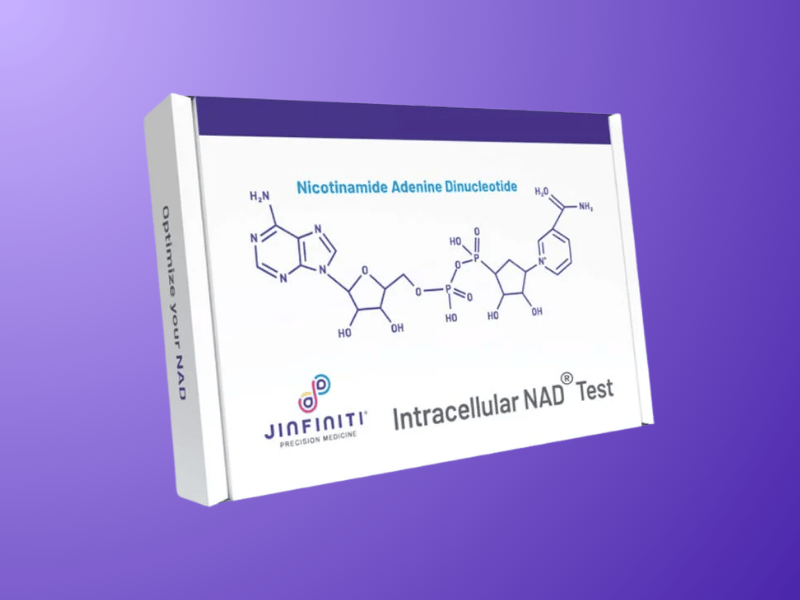
Intracellular NAD+ can be measured directly through a finger-prick blood test. Optimal levels, based on Jinfiniti’s clinical research, fall between 40 and 100 μM. Most adults in midlife — particularly those with obesity or metabolic dysfunction — test significantly below that range before supplementing.
“The people most likely to benefit from NAD+ support are often the ones who started below optimal levels without knowing it,” says Dr. Jin-Xiong She, founder of Jinfiniti Precision Medicine. “Supplementing without a baseline is still just guessing — and when you’re already managing a prescription protocol, precision matters more, not less.”
Knowing your starting level also allows you to calibrate dosing appropriately and confirm, after 4–6 weeks of supplementation, whether you’ve actually reached the range where NAD+ exerts its measurable effects. Niacinamide — one of the four ingredients in the Vitality NAD+ Booster — plays a specific role in that synthesis pathway; understanding what niacinamide does in the context of NAD+ production is useful for anyone building a targeted protocol.
What to Realistically Expect From NAD+ Alongside GLP-1 Therapy
NAD+ is not a GLP-1 amplifier. It won’t increase the weight-loss effect of semaglutide or make the medication work faster. What it does is support the cellular environment that gets taxed when caloric intake drops significantly and the body is remodeling its composition.
For people on GLP-1 medications, the realistic case for NAD+ includes: better mitochondrial support during caloric restriction, reduced cellular energy depletion in muscle tissue, and — based on emerging animal research — potential support for the gut environment that produces GLP-1 naturally. None of this is a guarantee. Individual response to NAD+ supplementation varies, and starting NAD+ levels, age, diet, and baseline metabolic health all affect outcomes.
The most important caveat: if you’re on a GLP-1 medication and considering adding NAD+ supplementation, talk with your clinician first. NAD+ precursors are generally well-tolerated, but any addition to an active prescription protocol warrants a conversation with the prescribing provider.
The supplementation question is secondary to the measurement question. Know your NAD+ level. Then decide what to do with that information.
Frequently Asked Questions
Can you take NAD+ with Ozempic, Wegovy, or Mounjaro?
Yes. NAD+ precursors — including NMN and NR — are generally well-tolerated and are not known to interact with GLP-1 receptor agonists. That said, if you’re on a prescription protocol, the appropriate step is to confirm with your prescribing clinician before adding any supplement.
Can you get NAD+ injections while on GLP-1 medications?
Yes. NAD+ injections aren’t known to interact with GLP-1 receptor agonists, and some clinics offer them specifically for GLP-1-related fatigue. One caveat: the NAD+ molecule is too large to enter cells directly from the bloodstream, so IV delivery loses a significant portion to breakdown before it’s usable. Subcutaneous injections perform somewhat better — but Jinfiniti’s clinical data showed their oral multi-pathway formula reached optimal intracellular levels more consistently than subcutaneous NAD+, at a fraction of the cost.
Why do GLP-1 medications cause fatigue, and can NAD+ help?
GLP-1 medications reduce caloric intake substantially, which decreases the fuel available for cellular energy production. NAD+ supports the mitochondrial machinery that converts available fuel into usable energy. For people whose NAD+ levels are already depleted — common in those with metabolic dysfunction — supplementing to optimal levels may help address that energy gap. Results vary based on where you’re starting from.
Does NAD+ affect how GLP-1 medications work?
Not directly. NAD+ and GLP-1 receptor agonists work through different mechanisms. What’s interesting is the upstream relationship: animal research suggests that NAD+ biosynthesis in the gut is required for the body to produce GLP-1 naturally. This doesn’t mean NAD+ boosts the medication — but it does suggest the two systems are more connected at a biological level than the standard framing implies.
Is lean mass loss on GLP-1 medications inevitable?
Data from the STEP-1 trial showed significant lean mass reduction alongside fat loss on semaglutide. Whether this is inevitable or modifiable depends on factors including exercise, protein intake, and mitochondrial support. NAD+ supports muscle mitochondrial function and operates through pathways that overlap with creatine — both relevant to maintaining muscle quality during weight loss.
How do you know if your NAD+ levels are actually low?
You test. Intracellular NAD+ levels can be measured through a finger-prick blood test processed in a CLIA-certified lab. Optimal levels fall between 40 and 100 μM; many adults test in the deficient or suboptimal range without symptoms specific enough to identify the cause. Testing before supplementing gives you a baseline to work from and lets you confirm, after 4–6 weeks, whether your levels have actually improved.
