




Vital Minerals Complex
Dual-form magnesium for sleep and cellular energy.

Spend five minutes in any supplement aisle and you’ll find a dozen forms of magnesium, each with a label implying it’s the one you should be taking. Most of us eventually narrow it down to two: malate and glycinate. Both are well-absorbed and widely recommended. And both claim to help with fatigue — so which one actually works for you?
The answer isn’t about which form is “better.” It’s about what your health goals actually are.
What You Should Know
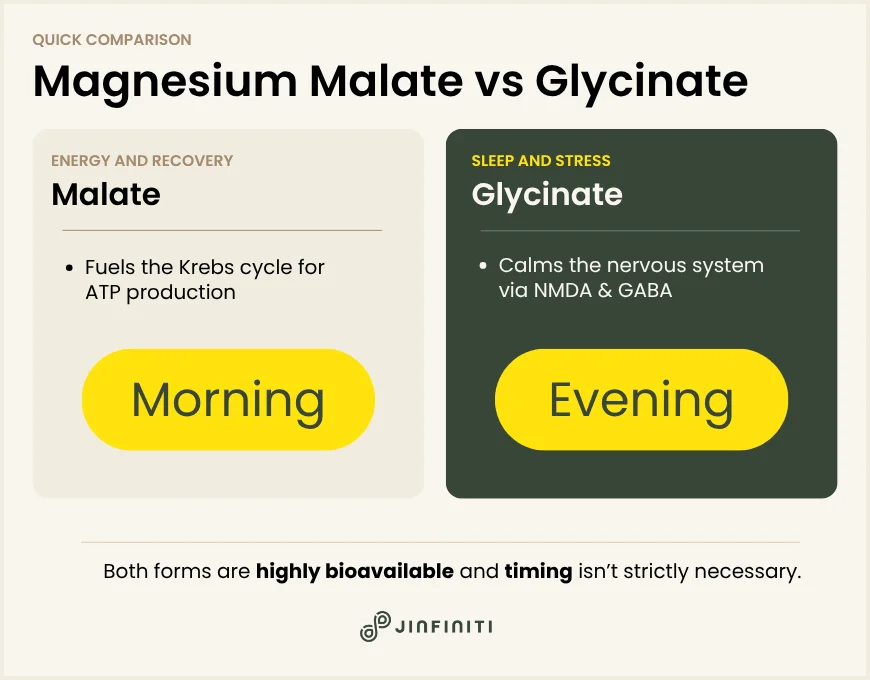
- Magnesium malate is bonded with malic acid, a compound involved in ATP production; it’s typically better suited for energy and muscle recovery
- Magnesium bisglycinate is bonded with two glycine molecules that help calm the nervous system; it’s better suited for sleep and stress
- Both forms are well-absorbed; the meaningful difference is what the bonded compound adds beyond the magnesium itself
- Using both forms at different times of day is a valid approach, and some supplements are formulated to include both
Magnesium Malate and Glycinate: The Differences
Both malate and glycinate (often appearing on labels as bisglycinate) are organic, chelated forms of magnesium — meaning the mineral is bonded to another compound to improve absorption and reduce digestive side effects. That’s where the similarity ends. What they’re bonded to shapes how they work.
Magnesium Malate: The Energy Form
Magnesium malate pairs magnesium with malic acid, a naturally occurring compound found in apples and most fruits. Malic acid is a substrate in the Krebs cycle — the chain of reactions your mitochondria use to generate ATP, the form of energy your cells actually run on. When malate is absorbed alongside magnesium, both compounds become available to support energy production from different angles simultaneously.
That mechanism is part of why magnesium malate has been studied in the context of fibromyalgia, a condition linked to impaired cellular energy and muscle pain. A 1992 study by Abraham and Flechas treated 15 fibromyalgia patients with combined magnesium malate supplementation for 8 weeks and saw meaningful reductions in tender point scores, with some participants reporting improvement within 48 hours. A subsequent double-blind crossover trial by Russell et al. produced more mixed results, showing no significant improvement in the blinded phase. The fibromyalgia evidence isn’t settled.
What is consistent across the research: malate supports ATP-related processes, and people who experience low daytime energy, persistent muscle soreness, or post-exertional fatigue tend to respond better to this form. It’s energizing enough that most practitioners recommend taking it in the morning or early afternoon.
Magnesium Glycinate: The Calm Form
Magnesium glycinate bonds magnesium to two glycine molecules. Glycine is an inhibitory neurotransmitter — it interacts with NMDA receptors in the brain in a way that reduces neural excitability, and research suggests it may lower core body temperature, which is part of what initiates healthy sleep onset.
A 2025 randomized controlled trial in 153 participants with poor sleep quality found that magnesium bisglycinate improved insomnia symptoms compared to placebo, though the effect was modest. A broader systematic review of 15 interventional trials concluded that the majority showed improvement in at least one sleep or anxiety parameter with magnesium supplementation.
The glycine component also appears to have some tissue-specific effects. Animal data suggest bisglycinate may increase brain magnesium concentrations more than other forms — which may explain why it tends to have a more pronounced effect on mood and nervous system symptoms even at comparable doses.
Digestively, bisglycinate is one of the gentlest forms available. It bypasses the osmotic mechanism that makes forms like oxide or citrate laxative at higher doses.
Absorption: Is One Form More Bioavailable?
Magnesium marketing often implies that one form is dramatically more bioavailable than another. The reality is more nuanced.
Both malate and glycinate are chelated organic forms, and research on magnesium bioavailability suggests most organic salts are absorbed at similar rates in the small intestine. Bisglycinate’s edge, if any, appears tissue-specific: it may deliver magnesium to brain tissue more efficiently, whereas its effect on muscle magnesium levels is minimal.
Malate’s advantage isn’t absorption — it’s the malic acid itself. Malic acid contributes to energy metabolism independently of the magnesium it carries. You’re effectively getting two functional compounds in one, which is why malate tends to be the preferred form for people dealing with fatigue or muscle-related symptoms.
For most people, the absorption difference between these two forms isn’t the deciding factor. What matters more is matching the form to the goal.
Magnesium Malate vs. Bisglycinate: Quick Comparison
| Magnesium malate | Magnesium bisglycinate | |
|---|---|---|
| Bonded with | Malic acid | Two glycine molecules |
| Primary mechanism | Krebs cycle / ATP synthesis | NMDA/GABA nervous system support |
| Best timing | Morning or early afternoon | Evening |
| Best for | Energy, muscle fatigue, recovery | Sleep, stress, anxiety |
| Digestive tolerance | Good | Very gentle |
| Research base | Fibromyalgia, exercise recovery | Sleep quality, anxiety reduction |
Which Magnesium Form Should You Take?
Most comparison guides end here: pick based on your goal. That advice isn’t wrong, but it skips a step.
Around 48% of Americans don’t meet the RDA for magnesium through diet alone. But magnesium deficiency produces symptoms that overlap with a lot of other things — thyroid dysfunction, low NAD+, chronic stress, poor sleep hygiene. Supplementing the right form helps. Supplementing when something else is driving the symptoms doesn’t move the needle.
So: what’s the most likely driver?
⚡Choose Magnesium Malate If You’re Dealing With…
- Low daytime energy that sleep doesn’t fix
- Muscle soreness that lingers longer than it should after exercise
- Fatigue without a clear cause, especially mid-afternoon
- Fibromyalgia or chronic muscle pain (with the caveat that the evidence here is promising but mixed)
💤Choose Magnesium Glycinate If You’re Dealing With…
- Trouble falling or staying asleep
- An overactive mind at night
- Stress or anxiety that feels like a background hum you can’t quiet
- Digestive sensitivity to other magnesium forms
Consider Using Both Forms
Taking malate in the morning and bisglycinate in the evening is a strategy some practitioners recommend, and it makes biological sense. You’re supporting energy production during the day and nervous system recovery at night.
This is actually how Jinfiniti’s Vital Minerals Complex is formulated: 240mg of dual-form magnesium combining malate and glycinate in a single supplement. Rather than treating malate and bisglycinate as competing options, the formula treats them as complementary. If you’re not sure which you need — or suspect you need both — that’s the more practical starting point.
For a closer look at how magnesium forms compare across other common pairings, see our guide on magnesium glycinate vs. citrate.
The Magnesium-Energy Connection Most People Miss
Persistent fatigue is one of the most common reasons people turn to magnesium in the first place. But magnesium doesn’t work in isolation.
Magnesium is a cofactor in over 300 enzymatic reactions — including several involved in NAD+ metabolism. NAD+ (nicotinamide adenine dinucleotide) is the molecule your mitochondria depend on to generate ATP that powers cellular function. When magnesium levels are low and NAD+ levels are low at the same time, the energy shortfall comes from two directions. No amount of malate will fully compensate for depleted NAD+.
“Magnesium and NAD+ work hand in hand at the mitochondrial level,” says Dr. Jin-Xiong She, founder of Jinfiniti Precision Medicine. “Addressing one without the other is like fixing one flat tire on a car that has two.”
That’s part of why some people try magnesium, feel a modest improvement, and plateau. Magnesium may be contributing — but it may not be the whole picture. If energy doesn’t recover meaningfully with supplementation, NAD+ deficiency is often the next variable to investigate. It’s also one of the few intracellular deficiencies you can actually test for before supplementing.
For a fuller picture of what supports mitochondrial energy production, see: The Best Mitochondrial Supplements.
Frequently Asked Questions
Is Magnesium Bisglycinate the Same as Magnesium Glycinate?
Yes. The terms are used interchangeably. Both refer to magnesium chelated with two glycine molecules. “Bisglycinate” specifies that there are two glycine molecules bonded to the magnesium (bi = two); “glycinate” is the shorthand most commonly used in supplement marketing. Same compound, different label conventions.
Can I Take Magnesium Malate and Bisglycinate Together?
Yes, and for many people it makes practical sense. Taking malate in the morning and bisglycinate in the evening aligns each form with its primary function — energy support during the day, nervous system recovery at night. Some supplements, including Jinfiniti’s Vital Minerals Complex, combine both forms in a single daily formula.
When Should I Take Magnesium Malate vs. Bisglycinate?
Malate is best taken in the morning or early afternoon. Its energizing properties can interfere with sleep if taken close to bedtime. Bisglycinate is best taken in the evening, where it supports the nervous system wind-down and sleep onset. If you’re using a combined supplement, taking it with dinner is a reasonable middle ground.
Which Form Is Easiest on the Stomach?
Bisglycinate. It bypasses the osmotic laxative effect that makes magnesium oxide and magnesium citrate problematic at higher doses. Malate is also well-tolerated for most people, but bisglycinate is generally the first recommendation for anyone with a sensitive digestive system.
Can Magnesium Supplements Cause Side Effects?
At normal doses (under 350mg of supplemental magnesium per day, per the National Institutes of Health’s tolerable upper intake level), magnesium supplements are well-tolerated for most adults. High doses of oxide and citrate can cause loose stools or cramping. Both malate and bisglycinate are considerably gentler. Anyone with kidney disease should talk with a clinician before supplementing, as impaired kidneys can’t clear excess magnesium efficiently.
