




What You Should Know
- Urolithin A activates mitophagy, the process that clears out damaged mitochondria; NAD+ fuels the healthy ones that remain
- They work through separate biological pathways and address different sides of mitochondrial health
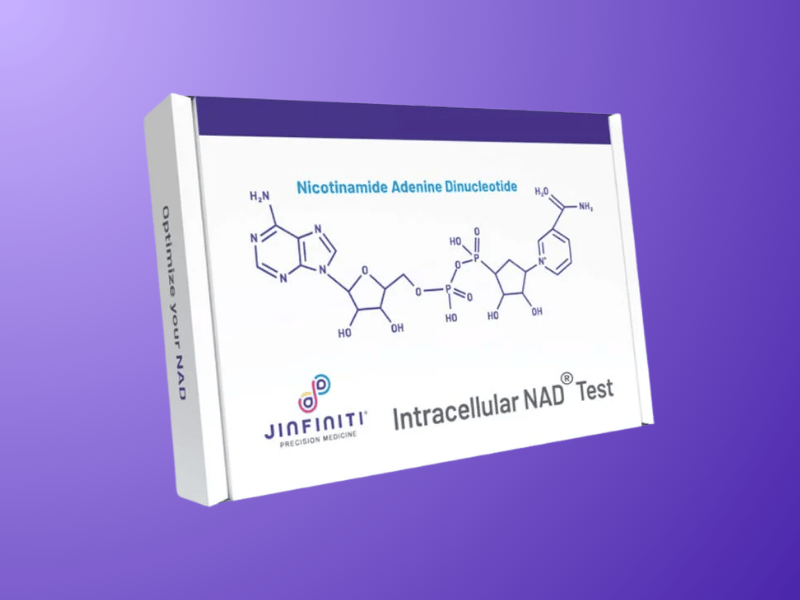
- NAD+ levels can be measured precisely with an at-home intracellular test; urolithin A activity cannot
- Most people have insufficient NAD+ levels before adding mitophagy support — making NAD+ optimization the logical starting point
Somewhere between the longevity podcasts and the supplement reviews, urolithin A graduated from obscure compound to mainstream recommendation. For people already taking NAD+ precursors, the question followed quickly: are these doing the same thing? Should I add urolithin A? Am I doubling up on something, or covering something new?
They’re covering something new. Urolithin A and NAD+ work through different biological mechanisms, on different timelines, with different evidence bases behind them — and understanding how they diverge changes how you’d sequence either one.
CLIA-Certified NAD Blood Test
Find out if your NAD+ is in the healthy range.
What Each One Actually Does
Both urolithin A and NAD+ relate to mitochondrial health. That’s where the similarity mostly ends. They operate at completely different stages of the mitochondrial lifecycle, and conflating them leads to poorly sequenced supplementation.

Urolithin A: The Cleanup Signal
Urolithin A is a postbiotic — not a supplement in the traditional sense, but a compound your gut bacteria produce when they metabolize ellagitannins, polyphenols found in foods like pomegranate, walnuts, and certain berries. The catch is that only about 30–40% of people have the right gut bacteria to convert efficiently. Most people consuming pomegranate juice aren’t producing meaningful levels of urolithin A at all.
Its primary function is activating mitophagy — your cells’ built-in quality control system for mitochondria. Translation: it signals your body to find the damaged, underperforming mitochondria, break them down, and replace them with new ones.
The specific mechanism runs through the PINK1/Parkin pathway: damaged mitochondria are flagged, tagged for removal, cleared out, and recycled. Think of it as the inspection program running in the background of your cells. Old, inefficient units get removed so the network as a whole performs better.
The functional benefits show up slowly. In a 2022 randomized clinical trial published in JAMA Network Open, 66 older adults taking 1,000 mg of urolithin A daily for four months showed significant improvements in both hand and leg muscle endurance compared to placebo, along with reductions in inflammatory and mitochondrial stress biomarkers.
A separate 2022 trial in Cell Reports Medicine found roughly 12% improvements in leg muscle strength in middle-aged adults over a similar timeframe. Cellular gene signatures appear within about four weeks; functional changes tend to emerge at eight to sixteen weeks.
NAD+: The Fuel That Keeps the System Running
NAD+ (nicotinamide adenine dinucleotide) is a coenzyme present in every cell. It shuttles electrons between molecules in the reactions that produce ATP — the energy currency your cells run on. Without sufficient NAD+, mitochondria can’t generate energy efficiently, even if they’re structurally intact.
NAD+ also serves as a substrate for sirtuins and PARPs — enzyme families responsible for DNA repair, stress resistance, and metabolic regulation. Translation: NAD+ isn’t only about energy. It’s also the signal that tells your cells to repair damage, manage inflammation, and maintain function under stress. No NAD+, no repair signal.
The problem is decline. NAD+ levels drop measurably with age, often beginning in the 30s and continuing throughout life. That decline tracks closely with the fatigue, cognitive fog, and slower recovery that many people start noticing in midlife — and that standard bloodwork rarely explains. NMN and NR raise cellular NAD+ levels, typically within days to weeks of starting supplementation.
How They Compare, Side by Side
| Aspect | Urolithin A | NAD+ |
|---|---|---|
| Primary action | Clears damaged mitochondria (mitophagy) | Fuels energy production and DNA repair |
| Works through | PINK1/Parkin mitophagy pathway | Redox reactions, sirtuins, PARPs |
| Speed of effect | 8–16 weeks for functional changes | Days to weeks for NAD+ elevation |
| Measurable? | No consumer test exists | Yes — intracellular blood spot test |
| Food sources | Pomegranate, walnuts, berries | Niacin, NMN, NR precursors |
| Gut dependency | Yes (conversion varies widely) | No |
| Best evidence for | Muscle endurance, mitochondrial quality | Cellular energy, cognitive function, repair |
One of These Can Be Measured. The Other Can’t.
You can measure one of these. You can’t measure the other.
Intracellular NAD+ levels can be tested directly — from a finger-prick blood spot sample, processed through a CLIA-certified lab — and the results tell you exactly where you stand. You can test before starting supplementation, again at four to eight weeks, and know with precision whether your intervention is working and whether your dose needs adjusting.
Urolithin A has no equivalent. There’s no at-home test that tells you whether your mitophagy is active, how efficiently your gut is converting, or whether the supplement you’re taking is doing anything measurable. The clinical evidence for urolithin A is real and encouraging, but the individual feedback loop simply doesn’t exist yet.
Supplementation without measurement is guesswork. You can spend months on a stack you believe is working with no objective signal either way.
“Most people come to us having already tried several supplements, often including NAD+ precursors, without ever testing their baseline,” says Dr. Jin-Xiong She, founder of Jinfiniti Precision Medicine and a genomic scientist with over 400 peer-reviewed publications. “When we test them, a significant portion are still deficient. The supplement was real — but the dose or formulation wasn’t moving their levels into the optimal range. That’s what testing reveals.”
Can They Work Together?
They can, and the case for combining them is straightforward: they address two different phases of the mitochondrial lifecycle. Urolithin A removes underperforming mitochondria; NAD+ fuels and maintains the ones that remain. One clears, the other powers. Those aren’t redundant functions — they’re sequential ones.
Some preclinical work suggests urolithin A may also modestly elevate NAD+ levels by improving overall mitochondrial efficiency — but this has only been observed in animal models so far. Human data confirming that effect isn’t available yet.
What the Research Supports (and What It Doesn’t)
There are no head-to-head human trials directly comparing urolithin A and NAD+ supplementation. The strongest clinical evidence for urolithin A is in muscle endurance and mitochondrial biomarkers in older and middle-aged adults. For NAD+ precursors, Jinfiniti’s clinical data showed 85% of participants reaching optimal intracellular NAD+ levels within four weeks of using the Vitality↑® NAD+ Booster — with average levels doubling — which is among the most rigorous published results in consumer longevity supplementation.
A 2024 study in Frontiers in Aging Neuroscience compared urolithin A and nicotinamide riboside (NR) in human microglial cells and found that both reduced DNA damage-induced cellular senescence, though through different pathways — a finding that supports the case for combining them rather than treating them as interchangeable.
How to Think About Sequencing
If your NAD+ levels are deficient — which is common and often invisible without testing — adding urolithin A on top of a fuel-depleted system is like cleaning a factory floor before turning the power back on. The cleanup matters, but it can’t compensate for missing energy.
Establishing an optimal NAD+ baseline first gives your mitochondria the fuel they need to function well. Once that’s verified and stable, urolithin A becomes a logical complement — one that improves the quality of the mitochondrial network your NAD+ is now powering effectively.
Which One Should You Prioritize?
If you don’t know your NAD+ baseline, start there. NAD+ deficiency is common, measurable, and often the root cause of energy and cognitive complaints that other bloodwork misses. Testing first tells you whether your levels are deficient, suboptimal, or already in range — and that answer changes what you do next.
If your NAD+ levels are already confirmed optimal and you’re focused on muscle endurance, exercise recovery, or longer-range mitochondrial quality as you age, urolithin A is a well-supported complement.
For most people doing this seriously, the goal is eventually both. The order matters more than people assume — and measurement is what makes the sequence rational instead of guessed at.
Frequently Asked Questions
Is urolithin A the same as NAD+?
No. They’re chemically distinct and work through separate pathways. Urolithin A is a gut-derived postbiotic that activates mitophagy — the removal of damaged mitochondria. NAD+ is a coenzyme that fuels energy production and activates DNA repair enzymes. They address complementary but different aspects of cellular health.
Does urolithin A raise NAD+ levels?
Animal studies suggest it may modestly, by improving mitochondrial efficiency — but this hasn’t been confirmed in human trials. It’s not a substitute for direct NAD+ supplementation if your levels are deficient.
Can I take urolithin A and NMN together?
Yes. They target different parts of the mitochondrial lifecycle and are generally considered complementary. NMN supports energy production and sirtuin activity; urolithin A supports mitochondrial quality control. No known interaction between them.
How long does urolithin A take to work compared to NAD+?
NAD+ precursors can elevate cellular NAD+ within days to a few weeks. Urolithin A works on a slower cadence — cellular gene signatures appear around four weeks, functional changes in endurance and strength typically at eight to sixteen weeks, based on the 2022 clinical trials.
How do I know if my NAD+ levels are optimal?
An intracellular NAD+ test measures your actual cellular NAD+ concentration from a finger-prick blood sample and tells you whether you’re in the optimal range (40–100 μM), suboptimal, or deficient. It’s the only objective way to know whether your supplementation is working — and how much to adjust.
