





The Short Answer
- For most people, the best NAD booster is an oral NMN or NR supplement, not an IV drip.
- NMN and NR both roughly doubled blood NAD+ in two weeks in a head-to-head trial.
- Test your NAD+ before you start, then retest at four to six weeks.
- Niacinamide alone didn’t raise blood NAD+ in a recent trial, and evidence for IV NAD+ is thin.
You’ve got four tabs open: an NMN powder, an NR capsule, a liposomal NAD+ shot and a clinic offering a drip. Each one calls itself an NAD booster, and each one sounds sure of itself. For most people, an oral NMN or NR supplement is the NAD booster to start with, checked with a test. The form matters less than whether it raises the NAD+ inside your own cells, and that part you can measure.
Our Intracellular NAD+ Test is a finger-prick test that shows your NAD+ level before you buy anything. Retest four to six weeks after you start a booster to see if it’s working for you.
What Is an NAD Booster?
An NAD booster is any supplement or treatment meant to raise NAD+, a molecule every cell uses to turn food into energy and repair DNA. Levels tend to fall as you age, which is why NAD+ comes up so often in talk about healthspan, the years you spend in good health.
Most boosters don’t contain NAD+ itself. They give your body a building block, called a precursor, that cells turn into NAD+. NMN and NR are the best-studied ones. Niacinamide and niacin are older forms of vitamin B3 that feed the same system by a slower route.
Types of NAD Boosters Compared
The forms differ in how many steps they take to become NAD+ and in how much human research backs them.
| NAD booster | How it raises NAD+ | Human evidence | Things to know |
|---|---|---|---|
| NMN | Converted to NAD+ in one step | Several controlled trials | Most studied at 250 to 900 mg a day |
| NR | Converted to NMN, then NAD+ | Several controlled trials | Similar rise to NMN at the same dose |
| Niacinamide | Recycled into NAD+ by a slower route | Little rise at 500 mg in a recent trial | Cheap, no flushing |
| Niacin | Separate B3 route | Raises NAD+; flushing is common | High doses need medical supervision |
| Liposomal or oral NAD+ | Whole NAD+ in a fat coating | Very limited | Unclear how much reaches your cells |
| IV or injected NAD+ | Straight into the blood | One small pilot study | Cleared from blood fast; hours in a chair |
| Multi-ingredient formula | Several routes at once | Varies by formula | Check the dose of each ingredient |
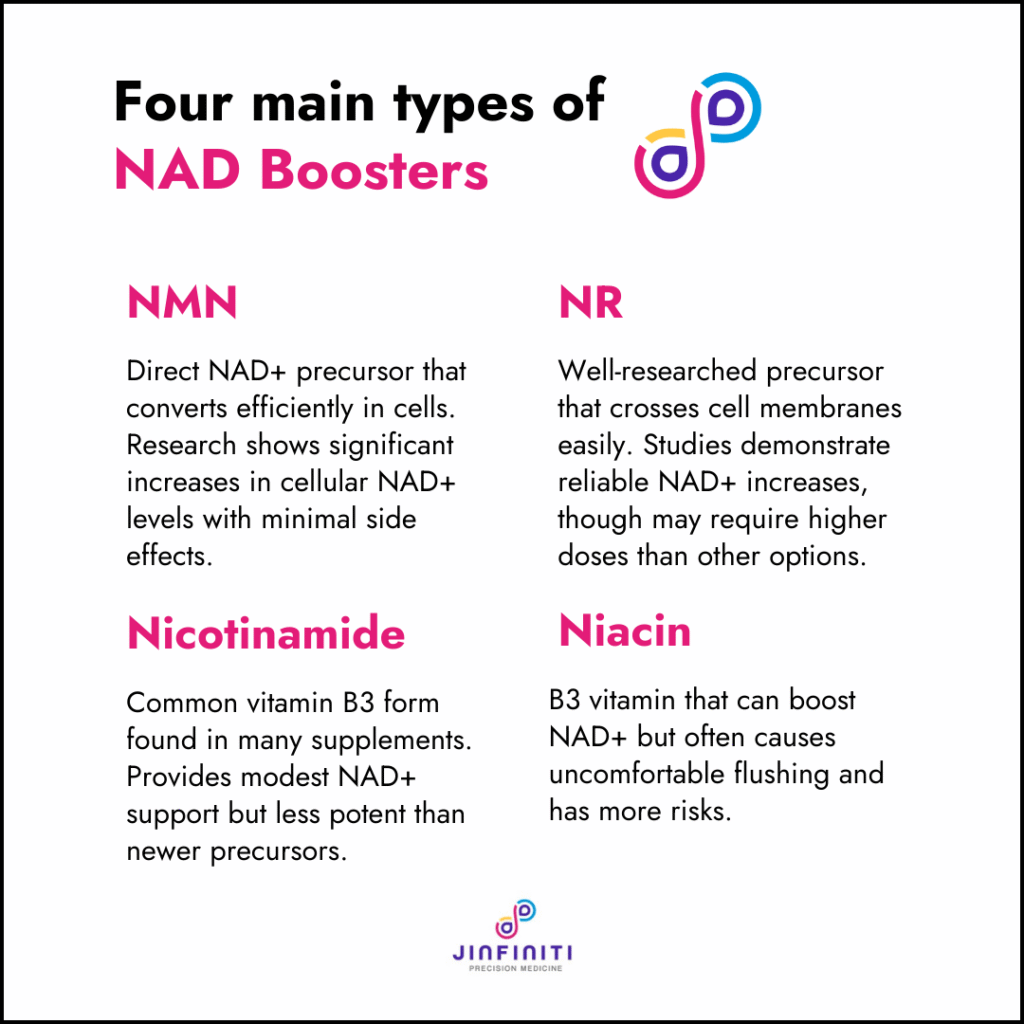
NMN
NMN (nicotinamide mononucleotide) is one step away from NAD+, and it has the most human trials behind it. In an 80-person trial, people took 300, 600 or 900 mg a day for 60 days. Blood NAD+ rose at every dose and was highest at 600 and 900 mg.
NR
NR (nicotinamide riboside) takes one extra step, but your cells handle it well. In a six-week trial in 24 middle-aged and older adults, 1,000 mg a day raised NAD+ in blood cells by about 60% compared with placebo. If you’re stuck choosing between the two, our NR vs NMN comparison covers it in more detail.
Niacinamide and Niacin
These are the classic forms of vitamin B3. In a head-to-head trial in 67 healthy adults, 500 mg a day of niacinamide didn’t raise blood NAD+ after two weeks, while NMN and NR did. Niacin can raise NAD+, but the hot, itchy flush stops many people at low doses. For how the B3 forms differ, see niacin vs niacinamide.
Liposomal NAD+
Liposomal products wrap whole NAD+ in tiny fat bubbles to protect it on the way through your gut. It’s a reasonable idea, but we haven’t found controlled human trials showing it raises NAD+ inside cells. Our guide to liposomal NAD+ walks through what’s known so far.
NAD+ IV and Injections
A drip puts NAD+ straight into your blood, so it sounds like the fastest route. In a small pilot study of a six-hour infusion, blood NAD+ didn’t budge for the first two hours because the body cleared it as fast as it went in. Our look at NAD+ injections vs oral NAD covers cost and side effects.
Multi-Ingredient NAD+ Formulas
Some boosters combine a precursor with ingredients that feed NAD+ through other precursor pathways. Our Vitality↑® NAD+ Booster pairs 500 mg of NMN per scoop with niacinamide, D-ribose and creatine. In Jinfiniti’s own four-week study of 26 adults taking two scoops a day, 22 reached the 40 to 100 µM range Dr. She uses as his optimal target.
Do NAD Boosters Actually Work?
For raising NAD+, yes. Controlled trials show NMN and NR reliably lift blood levels in adults, to about double within two weeks in one trial.
What happens after that is less clear. People in the 80-person NMN trial walked farther in a six-minute test than people on placebo, and the NR trial hinted at lower blood pressure. Those are encouraging early signs from short trials. So think of an NAD booster as one measurable step for healthspan, not a fix for aging (no supplement has earned that title yet).
Natural Ways to Raise NAD+ Without a Supplement
A booster works best on top of habits that already support NAD+, and two of them cost nothing.
Exercise
Training helps your muscles make more of their own NAD+. In a 12-week study, both cardio and weight training raised the enzyme muscles use to recycle NAD+ by about 30% in adults over 55. That’s a booster you can’t buy, which is a little annoying and a little wonderful.
Food
Your body builds NAD+ from vitamin B3 and tryptophan in food. Fish, chicken, mushrooms, peanuts and whole grains all help. The amounts are small next to a supplement, but NAD+ foods cover the basics without any cost.
How to Choose an NAD Booster and Check It’s Working
Two people on the same scoop can end up in very different places, so the label can’t tell you how much NAD+ your cells are making. A test can, and the plan is short.
- Test first. An intracellular NAD+ test from a finger prick gives your starting level in µM.
- Pick one oral booster. NMN, NR or a multi-ingredient formula, at a studied dose.
- Keep it steady. Same dose, same time, every day for at least four weeks.
- Retest at four to six weeks. If you’re under 40 µM, adjust the dose or switch forms, then test again.
| Your result | What it suggests | Next step |
|---|---|---|
| Under 30 µM | Low by Dr. She’s framework | Start a booster, retest at four to six weeks |
| 30 to 40 µM | Below his optimal range | Start or adjust, retest at four to six weeks |
| 40 to 100 µM | In his optimal range | Keep your dose, recheck in a few months |
| Over 100 µM | Likely more than you need | Talk with your clinician about lowering the dose |
“People ask me which NAD booster is best,” says Dr. Jin-Xiong She. “I ask what their NAD+ level is. The right booster is the one that gets your number into range, and you only know that if you measure it.”
NAD+ is one piece of how you age. If you want a wider view, our longevity blood panels include intracellular NAD+ alongside markers such as ApoB, HbA1c and hs-CRP.
NAD Booster Side Effects and Who Should Be Careful
NMN and NR have a good short-term safety record. Most trials ran for weeks to a few months, so long-term data is still thin.
Common Side Effects
When people notice anything, it’s usually mild stomach upset, nausea or a headache. Niacin is the exception, with flushing that’s common and uncomfortable.
Who Should Check With a Clinician First
Talk with your clinician before starting an NAD booster if any of these apply:
- You’re pregnant or breastfeeding, since there’s no safety data
- You have a history of cancer, because NAD+ also supports fast-growing cells in lab studies
- You take diabetes medicines or several prescriptions and want to check for interactions
- You’re considering high-dose niacin, which can affect the liver
Under Dr. She’s framework, levels above 100 µM aren’t likely to add benefit, which is one more reason to test instead of raising the dose.
How Jinfiniti Can Help
You want an NAD booster that raises your levels, and proof that it’s doing that.
Our range covers Vitality↑®, NMN and NR boosters, plus the Intracellular NAD+ Test that measures NAD+ inside your blood cells.
Test first, take one booster daily, then retest at four to six weeks to see your own result.
Frequently Asked Questions
What is the downside of NAD boosters?
The main downsides are cost and uncertainty. Trials show NMN and NR raise NAD+, but long-term benefits and safety data are still limited. Some people get mild stomach upset or headaches. Testing helps you avoid paying for a booster that isn’t moving your levels.
What happens if you take an NAD booster every day?
In trials, daily NMN or NR raised blood NAD+ within about two weeks, and in the longest trial they stayed higher through 60 days. Daily use for weeks to months looked safe in healthy adults. Talk with your clinician about dose if you take prescription medicines.
Is NAD+ like Ozempic?
No. Ozempic is a prescription drug that mimics a gut hormone to curb appetite and lower blood sugar. NAD+ boosters support how cells make energy. They aren’t weight-loss drugs, and they don’t work the same way.
How long does an NAD booster take to work?
Blood NAD+ usually rises within one to two weeks of daily use. Changes in how you feel, if they come, tend to take longer. Retest at four to six weeks to see where your level has settled.
Is NMN or NR the better NAD booster?
Neither has clearly won. At 1,000 mg a day, both roughly doubled blood NAD+ in a two-week trial. Pick the one you’ll take consistently, then let a retest tell you whether it’s working.
🧬 Related Reading
- How to Test Your NAD Levels: A Complete Guide
- NAD Dosage Per Day: Optimal Amounts, Timing, and Frequency
- NAD Deficiency Symptoms: 6 Common Signs of Low NAD Levels
References
- Yi L, Maier AB, Tao R, et al. The efficacy and safety of β-nicotinamide mononucleotide (NMN) supplementation in healthy middle-aged adults: a randomized, multicenter, double-blind, placebo-controlled, parallel-group, dose-dependent clinical trial. GeroScience. 2023;45(1):29-43. doi:10.1007/s11357-022-00705-1
- Martens CR, Denman BA, Mazzo MR, et al. Chronic nicotinamide riboside supplementation is well-tolerated and elevates NAD+ in healthy middle-aged and older adults. Nature Communications. 2018;9(1):1286. doi:10.1038/s41467-018-03421-7
- Christen S, Redeuil K, Goulet L, et al. The differential impact of three different NAD+ boosters on circulatory NAD and microbial metabolism in humans. Nature Metabolism. 2026;8(1):62-73. doi:10.1038/s42255-025-01421-8
- Grant R, Berg J, Mestayer R, et al. A pilot study investigating changes in the human plasma and urine NAD+ metabolome during a 6 hour intravenous infusion of NAD+. Frontiers in Aging Neuroscience. 2019;11:257. doi:10.3389/fnagi.2019.00257
- de Guia RM, Agerholm M, Nielsen TS, et al. Aerobic and resistance exercise training reverses age-dependent decline in NAD+ salvage capacity in human skeletal muscle. Physiological Reports. 2019;7(12):e14139. doi:10.14814/phy2.14139