
The Best Vitamin D3 Supplements in 2026 for Every Need
What You Should Know
- Vitamin D3 (cholecalciferol) raises and sustains blood levels significantly more effectively than D2, the form found in most fortified foods.
- D3 is fat-soluble, so oil-based delivery (such as softgels with coconut oil) meaningfully improves absorption compared to dry tablet forms.
- Pairing D3 with vitamin K2 as MK-7 matters more than most supplement labels communicate: K2 directs calcium to bones rather than arteries.
- The only way to confirm a vitamin D supplement is working is to test blood levels before and after.
Most people know they should probably be taking vitamin D. Fewer know which form, how much, or whether the one they’ve been buying is actually doing anything.
More than 40% of U.S. adults have insufficient vitamin D levels. That number has been climbing for decades, even as the supplement aisle has expanded. The gap persists because deficiency is largely invisible until it isn’t. No dramatic symptoms. Just a slow background decline in energy, bone density, immune function, and mood that standard bloodwork often misses until levels have been low for a long time.
The good news is that D3 supplementation works. The less good news is that most people pick a supplement based on price or brand name, take it without knowing their baseline, and never verify that their levels actually improved.
This guide covers what actually matters in a D3 supplement, four picks organized by use case, and why adding a baseline test changes the entire equation.
| Pick | Product | D3 Dose | K2 Form | Carrier Oil | Format |
|---|---|---|---|---|---|
| Best with K2 | Jinfiniti Vitamin D3 + K2 | 5,000 IU | MK-7 (100mcg) | Coconut oil | Softgel |
| Best softgel without K2 | Doctor’s Best Vitamin D3 | 2,000 IU | None | Olive oil | Softgel |
| Best for vegans | Naturelo Vegan Vitamin D3 | 2,500 IU | None | — | Capsule |
| Best liquid | Thorne Vitamin D-3 | Adjustable | None | — | Liquid drops |
What to Look for in a Vitamin D3 Supplement
There are dozens of D3 supplements on the market, and most of them look nearly identical on the label. A few distinctions actually matter.
Knowing what separates a well-designed formula from a commodity product makes it easier to evaluate any product you’re considering, including the ones not on this list.
D3, Not D2
Vitamin D comes in two supplemental forms. D2 (ergocalciferol) is derived from plants and found in many fortified foods. D3 (cholecalciferol) is the form your skin produces when exposed to sunlight. Studies consistently show that D3 raises and sustains blood levels of 25-hydroxyvitamin D, the main circulating form, more effectively than D2. For a supplement you’re taking specifically to improve your status, that distinction matters.
Whether K2 Is in the Formula
Vitamin D3 increases calcium absorption from the digestive tract. That’s the mechanism behind its bone health benefits. The issue is that pulling more calcium into circulation doesn’t automatically mean that calcium ends up in your bones.
Without vitamin K2, it can deposit in soft tissues and arterial walls instead. K2 activates two key proteins: osteocalcin, which binds calcium to bone tissue, and matrix Gla protein (MGP), which keeps calcium out of arteries. Think of them as calcium traffic controllers.
The most effective supplemental form of K2 is MK-7 (menaquinone-7), which stays active in the body for roughly 72 hours, compared to about 8 hours for MK-4. One daily dose of MK-7 provides consistent coverage throughout the day. If you’re taking a higher-dose D3 supplement without K2 in some form, it’s worth considering whether you’re getting the full bone benefit you’re aiming for.
Delivery Format and Fat Absorption
D3 is fat-soluble. Your intestines need dietary fat present to absorb it properly. Oil-based softgels, particularly those using coconut oil as a carrier, address this at the formulation level rather than relying on you to always take it with a fatty meal.
Dry tablets and capsules without an oil base have a meaningful absorption disadvantage. Liquid drops offer a different benefit: precise, flexible dosing. If you’re working with a clinician to reach a specific blood level, drops make it straightforward to titrate.
The Best Vitamin D3 Supplements for Every Need
Here’s what each pick does well and who it’s best suited for.
Best With K2: Jinfiniti Vitamin D3 + K2
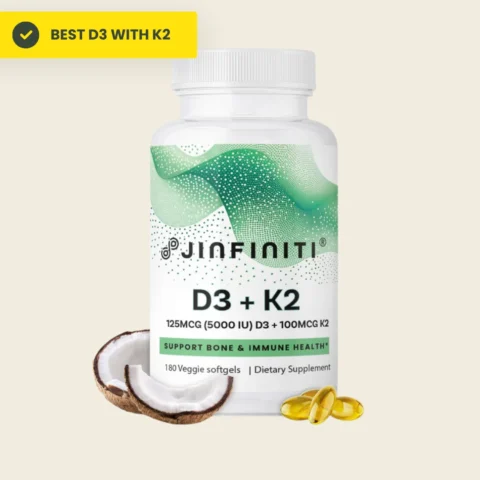
Best for: Adults supplementing for bone health, cardiovascular protection, or immune support who want a complete formula without managing multiple pills.
Jinfiniti Vitamin D3 + K2 delivers 5,000 IU of D3 alongside 100mcg of K2 as MK-7, suspended in a coconut oil base. It’s the only product on this list designed within a broader precision medicine ecosystem that includes biomarker testing to measure whether your levels actually respond.
The dose is appropriate for most adults addressing deficiency or maintaining optimal levels. The MK-7 form means one softgel per day provides a sustained active window, unlike MK-4 formulas that require multiple doses to maintain coverage throughout the day. The coconut oil carrier addresses the fat-soluble absorption issue at the formulation level.
The distinction worth flagging: most D3+K2 products use MK-4 because it’s less expensive to source. MK-7 has a substantially longer half-life. If your formula doesn’t specify which form of K2 it contains, it’s likely MK-4.
Available from: Jinfiniti
Best Softgel Without K2: Doctor’s Best Vitamin D3
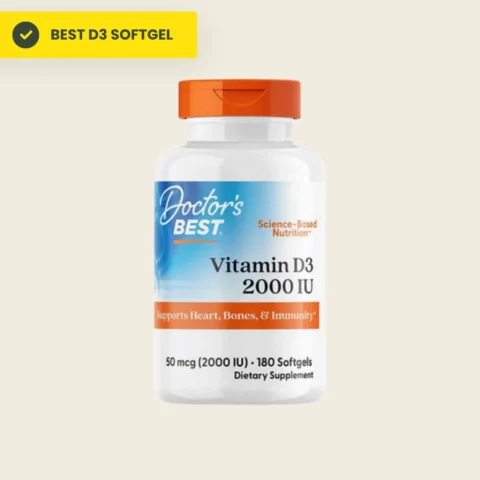
Best for: People maintaining adequate levels who already have K2 covered and prefer a standalone D3 at a moderate dose.
Doctor’s Best Vitamin D3 (2,000 IU / 50mcg) is a clean, widely third-party tested softgel for people who get K2 through dietary sources (fermented foods, natto, aged cheeses) or a separate supplement, and prefer a standalone, lower-dose D3 option.
At 2,000 IU, it’s appropriate for maintenance supplementation in adults without severe deficiency who eat a diet with reasonable K2 exposure. One of the better value-per-dose options in this category.
Available from: Doctor’s Best
Best for Vegans: Naturelo Vegan Vitamin D3

Best for: Vegans and fully plant-based eaters who want D3 without animal-derived ingredients.
Standard D3 supplements are derived from lanolin, a wax extracted from sheep’s wool. Most people don’t think much about this, but for vegans it matters. Naturelo’s Vegan Vitamin D3 uses cholecalciferol sourced from lichen, a plant-based source that produces the same D3 molecule your skin synthesizes from sunlight.
At 2,500 IU, it’s a solid maintenance or mild correction dose for adults without severe deficiency. Lichen-derived D3 has the same bioavailability as lanolin-derived D3, which makes this a genuine equivalent rather than a compromise.
Available from: Naturelo
Best Liquid Form: Thorne Vitamin D-3
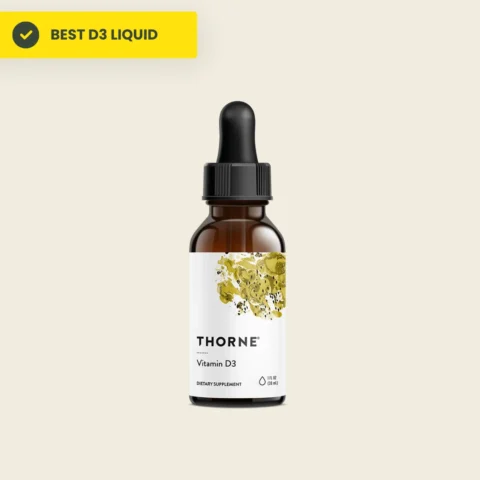
Best for: People who prefer not to swallow capsules, those titrating dose under clinical guidance, or anyone prioritizing NSF Sport certification.
Thorne’s Vitamin D-3 drops are NSF Certified for Sport, meaning they’ve been independently tested for label accuracy, purity, and the absence of banned substances. The liquid format allows precise, incremental dose adjustments.
That’s particularly useful when working with a clinician to bring deficient levels into range. You might start at a higher corrective dose for several weeks, then step down to a maintenance level. Fixed-dose capsules don’t accommodate that easily. Drops do.
Available from: Thorne
Dosing D3 and Why Testing Changes the Equation
The standard recommended daily intake for vitamin D is 600 to 800 IU, with most regulatory bodies setting a tolerable upper limit around 4,000 IU. But individual needs vary considerably based on starting levels, sun exposure, body composition, and how well a particular person absorbs fat-soluble nutrients.
Someone with severely deficient levels may need 5,000 IU or more per day to reach the sufficient range. Someone already in range may maintain on much less. The dose that’s right for you is not something a label can tell you.
As Dr. Jin-Xiong She, founder of Jinfiniti Precision Medicine, explains: “Vitamin D is one of the most consistently deficient micronutrients we see across patient populations. But the important question isn’t just whether you’re deficient. It’s whether your supplement is actually closing that gap. A blood test tells you both, and it’s the only way to dose with any real precision.”
If you’ve been dealing with fatigue that doesn’t respond to obvious fixes, vitamin D status is one of the first micronutrients worth checking. It’s also worth knowing that D3 doesn’t work in isolation. Magnesium is required to convert vitamin D to its active form, and low magnesium can blunt the effect of D3 supplementation even when doses are adequate.
Standard vitamin D blood tests measure serum 25-hydroxyvitamin D (25(OH)D), the main circulating storage form. Most clinicians consider 30 ng/mL the lower threshold of sufficiency. Many longevity-focused researchers suggest optimal function sits closer to 40 to 60 ng/mL. Testing before you start and again after 8 to 12 weeks of supplementation is the straightforward way to find out where you land.
Frequently Asked Questions
What is the best form of vitamin D3?
D3 (cholecalciferol) is the most bioavailable supplemental form of vitamin D and consistently outperforms D2 in raising and maintaining blood levels. Within D3 supplements, oil-based delivery (such as softgels with a coconut oil carrier) improves absorption compared to dry tablet or capsule forms.
Do I need K2 with vitamin D3?
It depends on your dose and diet. At 2,000 IU and above, pairing D3 with K2 (as MK-7) helps ensure that the calcium D3 mobilizes gets directed to bone tissue rather than soft tissue and arterial walls. If your D3 supplement doesn’t include K2, look for it in fermented foods like natto or consider a separate K2 supplement. If you eat very few fermented foods, a combined D3+K2 formula is the more reliable approach.
Can I take too much vitamin D3?
Yes, though toxicity requires sustained supplementation at very high doses, generally well above 10,000 IU daily over extended periods. Symptoms of excess include elevated blood calcium, nausea, and kidney stress. Testing your blood levels is the most reliable way to stay in the sufficient range without overdoing it.
What’s the difference between MK-4 and MK-7?
Both are forms of vitamin K2, but their activity windows differ significantly. MK-4 has a half-life of roughly 6 to 8 hours, which means multiple daily doses are needed for sustained effect. MK-7 remains active for approximately 72 hours, making once-daily dosing genuinely effective. Most clinical research supporting K2 for bone and cardiovascular health uses the MK-7 form.
How do I know if my vitamin D3 supplement is working?
Test. A serum 25-hydroxyvitamin D test measures your current blood level and, when repeated after 8 to 12 weeks of supplementation, confirms whether your dose is having the intended effect. Without that feedback, you’re making decisions based on what the label says rather than what your body is actually doing.
Read More