




NAD+ (nicotinamide adenine dinucleotide) is a coenzyme your cells use to produce energy, repair DNA, and stay healthy as you age.
Most NAD dosage guides hand you a milligram number and call it a day. The problem is that number comes from population averages, and your cells don’t care about averages.
Two people the same age taking the same NAD+ supplement can land in completely different places. One reaches optimal cellular levels in four weeks. The other barely moves the needle.
This guide covers research-backed dose ranges for every form of NAD+ supplementation — plus the one step most people skip that makes the difference between guessing and actually knowing.
Always consult a healthcare provider before starting any new supplement regimen.
What You Should Know
- NAD+ dosage ranges vary widely by form, from 250–900mg daily for oral supplements to 500–1,500mg per IV session
- NAD+ declines between your 20s and your 50s, which means older adults typically need more to reach the same result
- IV and injection therapies deliver NAD+ directly into the bloodstream but face real limitations when it comes to raising levels inside your cells
- The only way to confirm a dose is working is to measure your actual intracellular NAD+ levels before and after supplementation
CLIA-Certified NAD Test Kit
Test your NAD+ levels from home. Find the right dosage for you.
NAD Dosage Chart
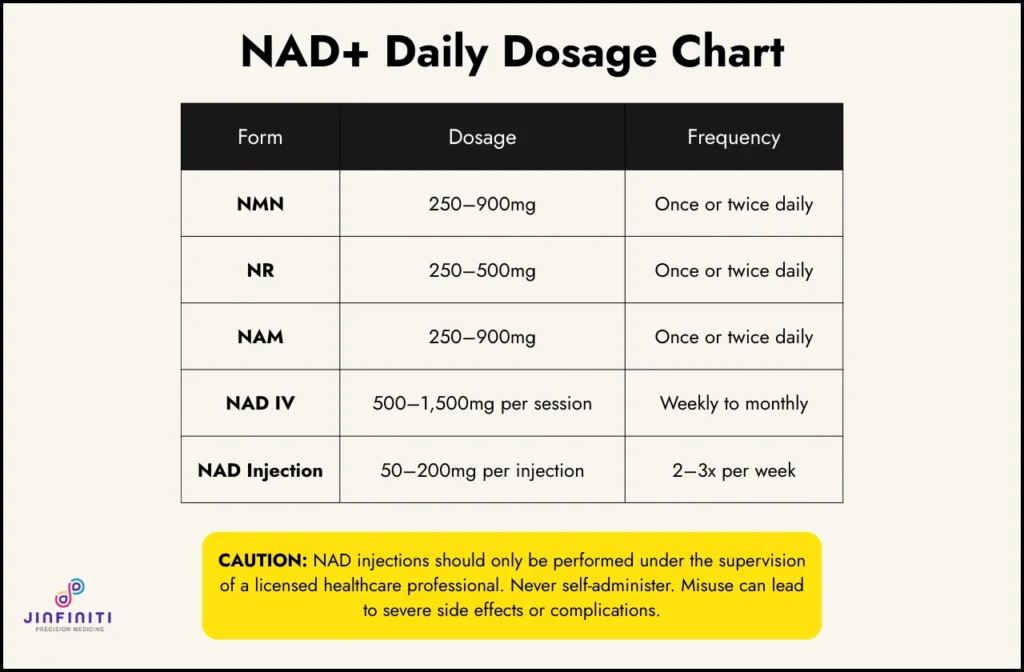
This dosage chart covers research-based ranges for each form of NAD+ supplementation. These are starting points, not prescriptions — where you land in a given range should reflect your baseline levels, age, health goals, and how your body responds.
| Form | Typical Dose Range | Frequency |
|---|---|---|
| NMN (oral) | 250–900mg | Once or twice daily |
| NR (oral) | 250–500mg | Once or twice daily |
| Niacinamide/NAM (oral) | 250–900mg | Once or twice daily |
| NAD IV Therapy | 500–1,500mg per session | Weekly to monthly |
| NAD Subcutaneous Injection | 50–200mg per injection | 2–3x per week |
One number that matters more than any of these ranges: your intracellular NAD+ target. That’s covered below.
The Smarter Way to Dose NAD+
Choosing a dose without knowing your baseline is like adjusting a medication without a blood test. Your NAD+ levels are specific to you — your age, genetics, inflammation load, and lifestyle all shape where you start and how you respond to supplementation.
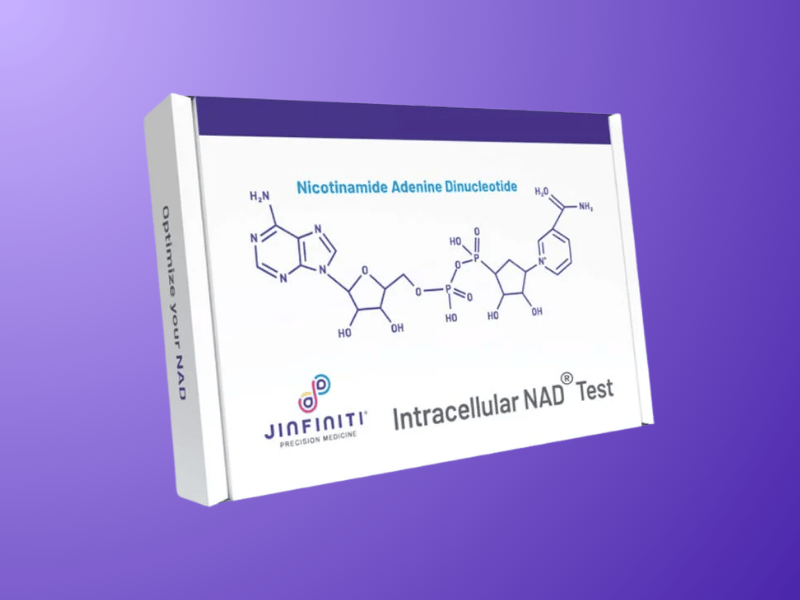
Jinfiniti’s Intracellular NAD® Test measures NAD+ inside your actual cells — the only measurement that tells you what’s happening where it counts. The at-home, finger-prick test is CLIA-certified, returns results in about a week, and includes personalized dosage recommendations based on where your levels actually land.
Test. Know. Dose right.
NAD Dosage Per Day: What Research Shows
Human trials show that NAD precursors can raise NAD+ levels across a fairly wide dose range. The doses in the table above are based on that research.
- NMN (nicotinamide mononucleotide): A systematic review of randomized controlled trials found human NMN doses ranged from 150 to 1,200 mg per day, with no major adverse effects reported. Studies using 250 to 900 mg per day showed meaningful increases in blood NAD+ levels. A separate review in Translational Medicine also found that 250 to 900 mg consistently raised NAD+, with larger doses producing bigger increases.[1][2]
- NR (nicotinamide riboside): In a randomized, double-blind, placebo-controlled trial in adults ages 55 to 79, 500 mg twice daily for six weeks raised NAD+ levels in peripheral blood mononuclear cells by about 60%. In a separate open-label trial, doses from 250 to 2,000 mg per day doubled whole blood NAD+ on average, with no clinically meaningful safety issues reported.[3][4]
- Niacinamide (NAM): Clinical research shows niacinamide is generally well tolerated at doses up to 3 grams per day, even with longer-term use. A single 900 mg dose, which matches the adult tolerable upper limit, measurably increased blood NAD+ levels within hours in healthy adults.[5][6]
What these studies cannot tell you is whether your current NAD+ level is low, normal, or already optimal. That is where testing becomes useful.
Why the Right Dose Is Different for Everyone
The ranges in the table above come from clinical studies on groups of people. Your optimal dose of NAD supplements depends on factors that no group average can account for.
Factors That Affect How Much You Need
Age is the most consistent predictor. NAD+ levels by age follow a predictable decline — by your 50s, you typically have about half the intracellular NAD+ you had at 20. Older adults generally need higher doses to move the needle.
Beyond age, a few other factors shape your individual requirements:
- CD38 enzyme activity: CD38 is an enzyme that breaks down NAD+. It rises with age and inflammation, actively depleting NAD+ stores. Higher CD38 activity means you may need more supplementation just to maintain levels.[7]
- Genetics: Variations in genes like NAMPT — which helps convert nicotinamide into NMN — affect how efficiently your body processes precursors. Some people convert more easily than others.[8]
- Stress and exercise: Intense training, chronic stress, and certain health conditions all increase your body’s NAD+ demand, raising the effective dose you need to see results.[9]
Choosing the Right NAD+ Form
The form you take matters as much as the dose. Each type of NAD therapy has a different absorption mechanism, a different body of evidence behind it, and a different track record for actually raising intracellular NAD+ levels.
Oral Supplements: NMN, NR, and Niacinamide
Oral NAD+ precursors are the most studied and most practical route for healthy aging support and long-term use. NMN (nicotinamide mononucleotide) and NR (nicotinamide riboside) are the two most researched options — both are direct precursors that your body converts into NAD+ inside cells.
Niacinamide (also called nicotinamide or NAM) is the most basic building block. It requires more conversion steps, but it’s well-tolerated at higher doses and meaningfully raises NAD+ levels when dosed appropriately.
Single-ingredient supplements raise NAD+ to a point. But clinical data on NAD boosters consistently shows that multi-ingredient formulas — ones that support NAD+ production through multiple metabolic pathways simultaneously — outperform standalone precursors for reaching and maintaining optimal intracellular levels.
NAD IV Therapy
IV therapy delivers 500–1,500mg per session directly into the bloodstream, typically over two to four hours in a clinical setting. Sessions are spaced weekly to monthly depending on the protocol.
The important caveat: NAD+ is a large molecule, too large to cross cell membranes intact. When it’s delivered intravenously, circulating blood levels rise temporarily — but intracellular levels, the measure that actually reflects what your cells have access to, may not follow. As Dr. Eric Verdin, President of the Buck Institute for Research on Aging, has noted, “NAD+ is too big to enter cells and is mostly broken down into nicotinamide when injected.”
IV therapy is expensive ($300–800 per session), time-consuming, and lacks the controlled trial evidence that oral precursors have behind them. For a full breakdown of how the two approaches compare, see NAD injections vs. oral supplements.
Subcutaneous NAD+ Injections
The typical NAD+ injection dosage per day ranges from 50–200mg per dose, administered two to three times per week. Subcutaneous (under the skin) injections bypass digestion and deliver NAD+ directly into tissue near the bloodstream.
The intracellular limitation applies here too. Clinical data shows that even at daily high doses, subcutaneous injections lag behind a well-formulated oral multi-pathway supplement when it comes to reaching the 40–100μM intracellular target. Injections require medical supervision, carry more logistical complexity, and cost significantly more than oral options over time.
What “Optimal” NAD+ Levels Actually Means
Here’s the piece most dosage guides leave out entirely. A milligram dose is not your goal. An intracellular level is — and that level is the most direct measure of your cellular health.
Dr. Jin-Xiong She, founder of Jinfiniti Precision Medicine and a genomic researcher with over 400 peer-reviewed publications, established the following clinical framework based on intracellular NAD+ measurements across thousands of patients:
| Level | Intracellular NAD+ Range |
|---|---|
| Too High | >100μM |
| Optimal | 40–100μM |
| Suboptimal | 30–40μM |
| Deficient | 20–30μM |
| Severely Deficient | 0–20μM |
“The goal isn’t a specific milligram dose — it’s reaching and sustaining the optimal intracellular range,” says Dr. She. “Two people can take the same supplement at the same dose and end up in very different places. Testing is the only way to know.”
Levels above 100μM appear to offer no additional benefit and may carry risk. Levels below 40μM mean your cells aren’t getting what they need — regardless of which supplement you’re taking or how consistently you take it.
How to Find Your Right Dose
The most reliable approach to NAD+ dosing is a simple two-step process.
Step 1: Test Your Baseline
Test before you start supplementing. This tells you exactly where your levels sit before any intervention. Learn more about what how to test your NAD+ levels involves and what to look for in a reliable test.
A standard blood panel won’t give you this information. Intracellular NAD+ testing specifically measures the NAD+ inside your cells — which is what governs energy production, DNA repair, and the cellular processes that drive your overall health.
Step 2: Start Supplementing and Retest at 3–4 Weeks
A standard starting point with the Vitality NAD+ Booster is two scoops or two lozenges daily (2,000mg of the multi-ingredient formula), split between morning and evening. Retest at three to four weeks.
If levels are still below 40μM, a modest dose increase is typically the next step. If levels land above 100μM, pulling back slightly makes sense. The goal is to find the lowest effective dose that keeps you in the 40–100μM range consistently.
For a detailed look at what to expect from that process, see NMN before and after results.
When to Take NAD+ for Best Results
Timing doesn’t override dose — but it does matter for consistency and comfort.
Morning vs. Evening
Splitting your dose between morning and evening works best for most people. A morning serving aligns with your body’s natural energy production cycle and supports daytime focus and stamina. The evening serving supports overnight cellular repair processes.
If you notice any mild energizing effect from NAD+ supplementation, keep the evening dose earlier in the day rather than close to bedtime. Most people tolerate the split schedule without issue.
Signs Your Dose Needs Adjusting
Subjective experience is useful, but it’s not a substitute for a retest. Persistent fatigue, brain fog, and poor mental clarity are among the most reliable signs that your levels haven’t reached the optimal range yet. That said, there are specific patterns worth paying attention to between testing windows.
- Fatigue persists after four weeks: Levels may still be suboptimal. A dose increase and retest is the right next step.
- Energy improves and then plateaus: Common signal that you’ve moved into the suboptimal range but haven’t reached optimal yet.
- Sleep quality isn’t improving: Poor sleep is one of the most consistent signs of low intracellular NAD+. If this isn’t shifting, your dose may need adjusting.
- No subjective change at all: Don’t increase dose based on feel alone. Test first — some people feel little change even as levels move meaningfully, while others notice improvements before their numbers confirm it.
The retesting window of three to four weeks gives your cells enough time to respond to a changed dose before you draw conclusions.
When Dose Isn’t the Whole Story
A single NAD+ precursor can help, but it may not be enough to get people into the optimal range.
In a functional medicine clinic comparison, 12 patients took a standalone precursor from another brand and tested intracellular NAD+ before and after using Jinfiniti’s CLIA-certified NAD Test. Their levels rose, but none reached the 40 μM optimal threshold.
The same 12 patients then switched to Vitality NAD+ Booster, and all of them reached optimal intracellular NAD+ levels.
The difference is the multi-pathway formula. Vitality pairs NMN and niacinamide, which feed NAD+ through different precursor routes, with creatine monohydrate and D-ribose, which help support cellular energy use.
That pattern also showed up in Jinfiniti’s clinical testing of 26 adults ages 35 to 65. After taking 2,000 mg daily for four weeks, 85% reached optimal intracellular NAD+ levels and NAD+ doubled on average. Vitality is also the only oral NAD+ supplement with clinical data showing stronger intracellular results than subcutaneous NAD+ injections at a much lower cost.
Frequently Asked Questions
What is the best time of day to take NAD supplements?
Morning is the most practical time for most people, since NAD+ supports cellular energy production and some users notice a mild energizing effect. Splitting the daily dose between morning and evening tends to work better than a single serving — the morning dose supports daytime function, while the evening dose supports overnight cellular repair.
How often should you take NAD+?
Daily dosing is the standard for oral NAD+ supplements. Levels need consistent replenishment to stay in the optimal range, and skipping days allows them to drift back down. For IV therapy, sessions are typically spaced weekly to monthly. Subcutaneous injections are usually administered two to three times per week.
What is the best way to take NAD?
Oral supplementation is the most practical and well-evidenced approach for long-term use. Powder and lozenges are the two main formats — powder is easy to adjust by the scoop, while lozenges use sublingual absorption to bypass digestion for faster delivery. IV and injection routes are available but come with higher cost, greater inconvenience, and real limitations around intracellular effectiveness.
How much NAD injection should I take?
The typical subcutaneous NAD+ injection dosage per day is 50–200mg, administered two to three times per week. Loading protocols may use 100–200mg daily for seven to ten days before stepping to a maintenance frequency. IV NAD+ therapy typically runs 500–1,500mg per session. All injection and IV protocols should be overseen by a healthcare provider.
Is NAD therapy safe? What are the side effects?
Oral NAD+ supplements have a strong safety profile across clinical research. The most commonly reported side effects are mild and temporary — occasional nausea, flushing, or light stomach discomfort, particularly when starting at higher doses. IV and injection therapies carry a higher risk of side effects including chest tightness, headache, and nausea, and should only be administered under medical supervision.
Referenced Sources
- Wen J, Syed B, Kim S, Shehabat M, Ansari U, Razick DI, et al. Improved Physical Performance Parameters in Patients Taking Nicotinamide Mononucleotide (NMN): A Systematic Review of Randomized Control Trials. Springer Science and Business Media LLC; 2024. https://doi.org/10.7759/cureus.65961
- Liao G, Xie Y, Peng H, Li T, Zou X, Yue F, et al. Advancements in NMN biotherapy and research updates in the field of digestive system diseases. Springer Science and Business Media LLC; 2024. https://doi.org/10.1186/s12967-024-05614-9
- Biţă A, Scorei IR, Ciocîlteu MV, Nicolaescu OE, Pîrvu AS, Bejenaru LE, et al. Nicotinamide Riboside, a Promising Vitamin B3 Derivative for Healthy Aging and Longevity: Current Research and Perspectives. MDPI AG; 2023. https://doi.org/10.3390/molecules28166078
- Airhart SE, Shireman LM, Risler LJ, Anderson GD, Nagana Gowda GA, Raftery D, et al. An open-label, non-randomized study of the pharmacokinetics of the nutritional supplement nicotinamide riboside (NR) and its effects on blood NAD+ levels in healthy volunteers. Public Library of Science (PLoS); 2017. https://doi.org/10.1371/journal.pone.0186459
- Hwang E, Song S. Possible Adverse Effects of High-Dose Nicotinamide: Mechanisms and Safety Assessment. MDPI AG; 2020. https://doi.org/10.3390/biom10050687
- Ito TK, Sato T, Takanashi Y, Tamannaa Z, Kitamoto T, Odagiri K, et al. A single oral supplementation of nicotinamide within the daily tolerable upper level increases blood NAD+ levels in healthy subjects. Elsevier BV; 2021. https://doi.org/10.1016/j.tma.2021.09.001
- Camacho-Pereira J, Tarragó MG, Chini CCS, Nin V, Escande C, Warner GM, et al. CD38 Dictates Age-Related NAD Decline and Mitochondrial Dysfunction through an SIRT3-Dependent Mechanism. Elsevier BV; 2016. https://doi.org/10.1016/j.cmet.2016.05.006
- Zhang W, Ren H, Chen W, Hu B, Feng C, Li P, et al. Nicotinamide phosphoribosyltransferase in NAD+ metabolism: physiological and pathophysiological implications. Springer Science and Business Media LLC; 2025. https://doi.org/10.1038/s41420-025-02672-w
- Conlon NJ. The Role of NAD+ in Regenerative Medicine. Ovid Technologies (Wolters Kluwer Health); 2021. https://doi.org/10.1097/prs.0000000000009673
