8 Niacinamide Benefits Beyond the Serum Bottle
Niacinamide has become the go-to ingredient for sensitive skin, and for good reason. Clinical trials show real improvements in skin conditions ranging from acne to hyperpigmentation to signs of aging. What most people don’t realize is that niacinamide benefits extend far beyond healthy skin maintenance — all the way down to how your cells produce energy and repair DNA.
What You Should Know
- Niacinamide is one of the direct precursors to NAD+, which your cells use to create energy, repair DNA damage, and regulate metabolism.
- When applied topically at a concentration of 4–5%, it has clinical efficacy at improving fine lines, dark spots, and acne.
- It doesn’t cause flushing like niacin, which makes niacinamide one of the most well-tolerated forms of vitamin B3
- Supplementation can increase blood levels of NAD+, but less efficiently than NMN or NR if your goal is long-term NAD+ optimization.
NMN + Niacinamide Formula
Four ingredients. One formula. Clinically validated.
What Is Niacinamide? A Type of Vitamin B3, Explained
Niacinamide — also called nicotinamide — is the amide form of vitamin B3. Your body creates it when it converts excess niacin or metabolizes tryptophan. It’s well tolerated by most people because, unlike niacin, it doesn’t cause flushing.
At the cellular level, it serves as a direct precursor to NAD+ (nicotinamide adenine dinucleotide), the coenzyme every cell depends on for energy production, DNA repair, and metabolic regulation.
Niacinamide Benefits for Skin
Niacinamide is one of the most studied ingredients in clinical dermatology, with evidence going back decades. Here are the four skin benefits with the strongest research behind them.
1. Stronger Skin Barrier
Your skin’s outermost layer holds together through a combination of proteins and lipids called ceramides. When this barrier weakens, moisture escapes and environmental irritants get in.
Research published in the Journal of Cosmetic Dermatologyconfirmed that topical niacinamide stimulates ceramide synthesis, reduces transepidermal water loss (TEWL), and increases moisture in the stratum corneum (the skin’s outer surface). It also accelerates keratinocyte differentiation, the process by which your skin continuously renews healthy cells.[1]
Skin that gets regular niacinamide holds onto moisture better and handles cold air, harsh cleansers, and pollution with less reactivity.
2. Less Hyperpigmentation
Dark spots and uneven skin tone are among the most common reasons people reach for niacinamide, and the clinical data supports this use at concentrations of 4–5%.
A 12-week double-blind, placebo-controlled trial published in Dermatologic Surgeryapplied 5% niacinamide to half the face in 50 women with signs of facial photoaging. Niacinamide produced measurable reductions in hyperpigmented spots, red blotchiness, and skin sallowness (yellowing) compared to the untreated side. It works by blocking the transfer of melanin from pigment-producing cells to the skin surface, cutting off the process that creates visible dark spots.[2]
A 2025 review published in Medicina confirmed these findings across multiple clinical settings, including melasma and post-inflammatory dark spots, at concentrations of 2–5%.[3]
3. Fewer Breakouts
Niacinamide does not kill acne-causing bacteria. It reduces the inflammation that makes breakouts angrier and slower to heal.
A 2017 review of 10 clinical studies found that 6 of 8 topical niacinamide studies showed a meaningful reduction in acne versus baseline, and both oral supplement studies did too. Niacinamide calms inflammation by suppressing the release of pro-inflammatory signaling molecules, which helps with inflammatory acne, rosacea, and contact dermatitis.[4]
Two open-label studies with 198 and 235 patients respectively found that oral niacinamide produced visible improvement in inflammatory acne, with results comparable to concurrent antibiotic treatment.
4. Reduced Fine Lines and Photoaging
The same Bissett trial found improvements in fine lines, wrinkles, and skin elasticity over the 12-week period, making it easy to compare the treated side of the face directly to the untreated side.
Research in Skin Pharmacology and Physiologyconfirmed that topical niacinamide also helps protect against the DNA damage that accumulates in skin from repeated UV exposure. These protective properties, combined with barrier strengthening and collagen support, explain why niacinamide turns up in so many anti-aging formulations.[5]
Niacinamide Benefits Beyond Skin
The four benefits above come primarily from topical use. Oral niacinamide products work differently, with effects that extend well beyond what you can see or feel at the surface.
5. NAD+ Precursor Activity
Every cell in your body depends on NAD+ (nicotinamide adenine dinucleotide) to produce energy, carry out metabolic reactions, and repair DNA damage. NAD+ levels drop steadily with age, and that decline tracks closely with the functional changes most people associate with getting older.
Niacinamide feeds into what researchers call the salvage pathway, the main route by which cells recycle and replenish their NAD+ supply. Once absorbed, it converts to NMN (nicotinamide mononucleotide) via the enzyme NAMPT, then to NAD+.
A 2021 clinical trial found that a single oral dose of 500mg niacinamide raised blood NAD+ levels measurably within 12 to 48 hours in healthy adults.[6]
As a standalone, niacinamide is less efficient than NMN or NR at raising NAD+. Both of those precursors are structurally closer to NAD+ and require fewer conversion steps. Niacinamide still contributes, and it works especially well when paired with other precursors and cofactors that support the same pathways.
6. DNA Repair Support
One of NAD+’s most important jobs is fueling the enzymes that repair damaged DNA. PARP-1, for example, responds to breaks in your DNA by calling in the cellular repair team. Every cycle of that repair process uses up NAD+, which means your cells’ ability to fix DNA damage is only as good as the NAD+ available to power it.
By contributing to NAD+ levels, niacinamide helps keep that repair capacity running. A landmark randomized controlled trial found that 500mg daily oral niacinamide significantly reduced the incidence of new non-melanoma skin cancers and actinic keratoses (precancerous skin lesions) in high-risk patients.[7]
A separate study by Drago et al. found that 88% of patients on 500mg daily niacinamide saw a reduction in actinic keratosis size, 42% experienced complete regression, and no new lesions developed during the study period. In the placebo group, 91% saw their lesions worsen.[8]
Research in this area is still early, and not every trial has shown the same results across populations. The consistent thread is that niacinamide’s contribution to NAD+ shows up in measurable reductions in UV-related skin damage over time.
7. Anti-Inflammatory Effects
The same anti-inflammatory action that makes niacinamide useful for acne and rosacea operates throughout the body when taken orally. It dials down activity in a key inflammatory signaling pathway, reducing the output of pro-inflammatory molecules across multiple tissues, not just the skin.
The 2025 review in Medicina compiled research showing niacinamide supplementation reduced brain inflammation in animal models of diabetes and Alzheimer’s disease.[3]
In separate human research, oral NR supplementation (another vitamin B3 form) reduced circulating inflammatory markers alongside improved muscle NAD+ levels in older men, pointing to the anti-inflammatory effects of B3 compounds as a class when they raise NAD+.[9]
At 250–500mg daily, niacinamide is well-tolerated. Doses up to 3g/day show a strong safety record, with occasional nausea or mild digestive effects that typically resolve when taken with food.
8. Joint Health Support
Most people taking niacinamide for joint health are doing it for osteoarthritis, and there is a small but notable clinical trial worth knowing.
A double-blind, placebo-controlled trial published in Inflammation Research (Jonas et al., 1996) randomized 72 osteoarthritis patients to niacinamide or placebo for 12 weeks. The niacinamide group showed a 29% improvement in global arthritis impact, compared to a 10% worsening in the placebo group. Joint mobility improved by 4.5 degrees over controls. The niacinamide group also reduced erythrocyte sedimentation rate (an inflammation marker) by 22% and cut their use of standard anti-inflammatory medications by 13%.[10]
The same mechanism at work in skin appears to be at work in joints, with niacinamide reducing inflammatory signaling at the cellular level wherever it lands.
Niacinamide vs. Other NAD+ Precursors
Niacinamide is one of several routes to raising NAD+, but it is not the most direct. It has a longer history, a lower cost, and stronger clinical evidence for skin health than most other NAD+ precursor forms.
NMN and NR raise NAD+ more efficiently because they sit closer to the end of the biosynthesis chain and require fewer steps to get there.
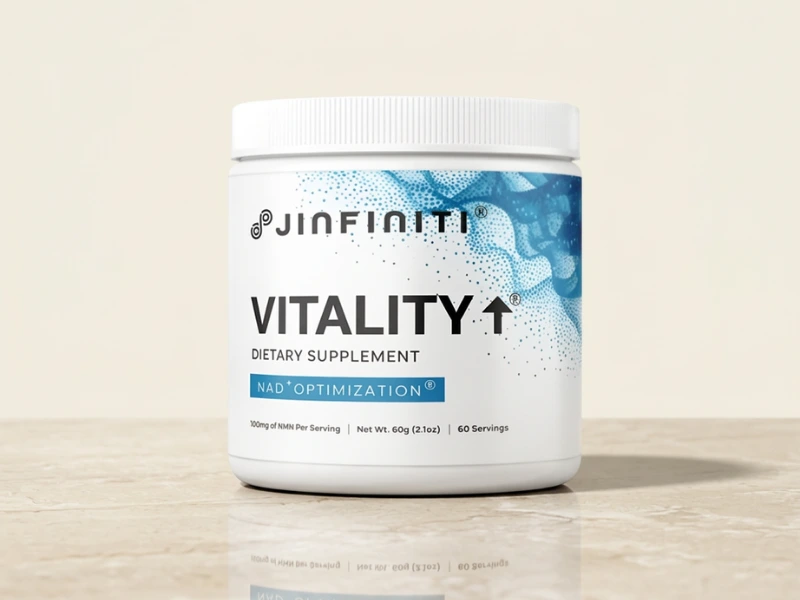
The most practical approach is using them together. Jinfiniti’s Vitality NAD+ Booster combines niacinamide with NMN, creatine monohydrate, and D-ribose, a four-ingredient formula working through multiple metabolic pathways at once. In a clinical setting, 85% of participants reached optimal NAD+ levels (40–100 μM) within four weeks, with an average doubling of baseline NAD+ levels.
“Niacinamide is one of the four ingredients in our Vitality formula for a reason,” says Dr. Jin-Xiong She, founder of Jinfiniti Precision Medicine. “It feeds the salvage pathway, which is how most of your cells replenish NAD+. But whether that actually translates to optimal intracellular levels — that’s something you can only confirm by testing.”
How to Use Niacinamide
For topical use, look for formulas with 4–5% niacinamide. That concentration has the best clinical backing for hyperpigmentation, barrier repair, and anti-aging. It pairs well with retinol, hyaluronic acid, and vitamin C, and is generally well-tolerated for daily morning and evening use.
For oral use, niacinamide is found naturally in meat, fish, eggs, legumes, and whole grains. Clinical studies have used doses from 250mg to 3g/day depending on the application. Because it skips the flushing reaction that comes with niacin, it is one of the easier B3 forms to take consistently.
If you are taking niacinamide supplements to raise NAD+ specifically, niacinamide alone is unlikely to get you to optimal intracellular levels (40–100 μM). The Intracellular NAD+ Test is the only way to know where you stand.
Frequently Asked Questions
Can you use niacinamide every day?
Yes. It is one of the few actives that tolerates daily use without irritating the skin barrier, which is why most clinical trials testing it for skin conditions like acne and hyperpigmentation used it twice daily for 8–12 weeks straight.
Is niacinamide a B vitamin?
Niacinamide is a form of vitamin B3, one of eight water-soluble B vitamins. Because it is water-soluble, excess amounts are excreted rather than stored, which contributes to its strong safety profile at typical doses.
Does niacinamide work for all skin types?
Clinical research has tested it across oily, acne-prone, dry, and aging skin, and it performs consistently across all of them. People with very sensitive skin should patch test first, but niacinamide is better tolerated than most actives with comparable benefits.
Does niacinamide help with fine lines and wrinkles?
Yes, with topical use at 4–5%. A 12-week clinical trial found measurable reductions in fine lines and wrinkles, improved elasticity, and reduced skin yellowing. It works more gradually than retinol but causes far less irritation.[2]
Can you add niacinamide to an existing skin care routine?
It layers cleanly with hyaluronic acid, vitamin C, retinol, SPF, and peptides. Apply it after lighter serums and before moisturizer. The older concern about combining it with vitamin C has not held up in more recent research.
Are there risks to taking niacinamide at high doses?
At 250–500mg/day, the safety record is strong. Doses up to 3g/day are generally well-tolerated, with occasional mild digestive effects. Above 3.5g/day, some studies have documented liver enzyme elevation and headache. If you are considering higher therapeutic doses, monitor liver health with a healthcare provider.[11]
Can niacinamide affect liver health?
At standard doses it poses no known risk to liver health. The concern arises above 3.5g/day, where elevated liver enzymes have been documented in some research. This is well above typical supplementation levels, and unlike niacin, niacinamide does not carry liver risk within its normal therapeutic range.
Does niacinamide affect blood sugar or help with diabetes?
Early research explored niacinamide for protecting insulin-producing cells in type 1 diabetes, with mixed results. For type 2 diabetes, animal studies have shown improved blood sugar markers, but human evidence at meaningful doses is still limited. It is not a substitute for any prescribed diabetes treatment.
Referenced Sources
- Gehring W. Nicotinic acid/niacinamide and the skin. Wiley; 2004. https://doi.org/10.1111/j.1473-2130.2004.00115.x
- Bissett DL, Oblong JE, Berge CA. Niacinamide. Ovid Technologies (Wolters Kluwer Health); 2005. https://doi.org/10.1111/j.1524-4725.2005.31732
- Camillo L, Zavattaro E, Savoia P. Nicotinamide: A Multifaceted Molecule in Skin Health and Beyond. MDPI AG; 2025. https://doi.org/10.3390/medicina61020254
- Walocko FM, Eber AE, Keri JE, AL-Harbi MA, Nouri K. The role of nicotinamide in acne treatment. Wiley; 2017. https://doi.org/10.1111/dth.12481
- Wohlrab J, Kreft D. Niacinamide – Mechanisms of Action and Its Topical Use in Dermatology. S. Karger AG; 2014. https://doi.org/10.1159/000359974
- Ito TK, Sato T, Takanashi Y, Tamannaa Z, Kitamoto T, Odagiri K, et al. A single oral supplementation of nicotinamide within the daily tolerable upper level increases blood NAD+ levels in healthy subjects. Elsevier BV; 2021. https://doi.org/10.1016/j.tma.2021.09.001
- Chen AC, Martin AJ, Choy B, Fernández-Peñas P, Dalziell RA, McKenzie CA, et al. A Phase 3 Randomized Trial of Nicotinamide for Skin-Cancer Chemoprevention. Massachusetts Medical Society; 2015. https://doi.org/10.1056/nejmoa1506197
- Drago F, Ciccarese G, Cogorno L, Calvi C, Marsano LA, Parodi A. Prevention of non-melanoma skin cancers with nicotinamide in transplant recipients: a case-control study. JLE; 2017. https://doi.org/10.1684/ejd.2017.3025
- Biţă A, Scorei IR, Ciocîlteu MV, Nicolaescu OE, Pîrvu AS, Bejenaru LE, et al. Nicotinamide Riboside, a Promising Vitamin B3 Derivative for Healthy Aging and Longevity: Current Research and Perspectives. MDPI AG; 2023. https://doi.org/10.3390/molecules28166078
- Jonas WB, Rapoza CP, Blair WF. The effect of niacinamide on osteoarthritis: A pilot study. Springer Science and Business Media LLC; 1996. https://doi.org/10.1007/bf02252945
- Knip M, Douek IF, Moore WPT, Gillmor HA, McLean AEM, Bingley PJ, et al. Safety of high-dose nicotinamide: a review. Springer Science and Business Media LLC; 2000. https://doi.org/10.1007/s001250051536
Read More