Liposomal NAD: The Truth About Absorption
You’ve probably seen them. Those sleek bottles promising “revolutionary liposomal NAD+” with claims about absorption so good it sounds like science fiction. The price tag? Often double or triple what you’d pay for standard NAD supplements.
But here’s the uncomfortable question nobody in the supplement aisle wants to answer: Does wrapping NAD+ in tiny lipid bubbles actually work, or are you paying premium prices for premium marketing?
The science tells a story that most manufacturers would rather you didn’t hear.
Quick Takeaways
- Direct NAD+ supplementation faces a fundamental problem: the molecule is too large and charged to cross cell membranes effectively
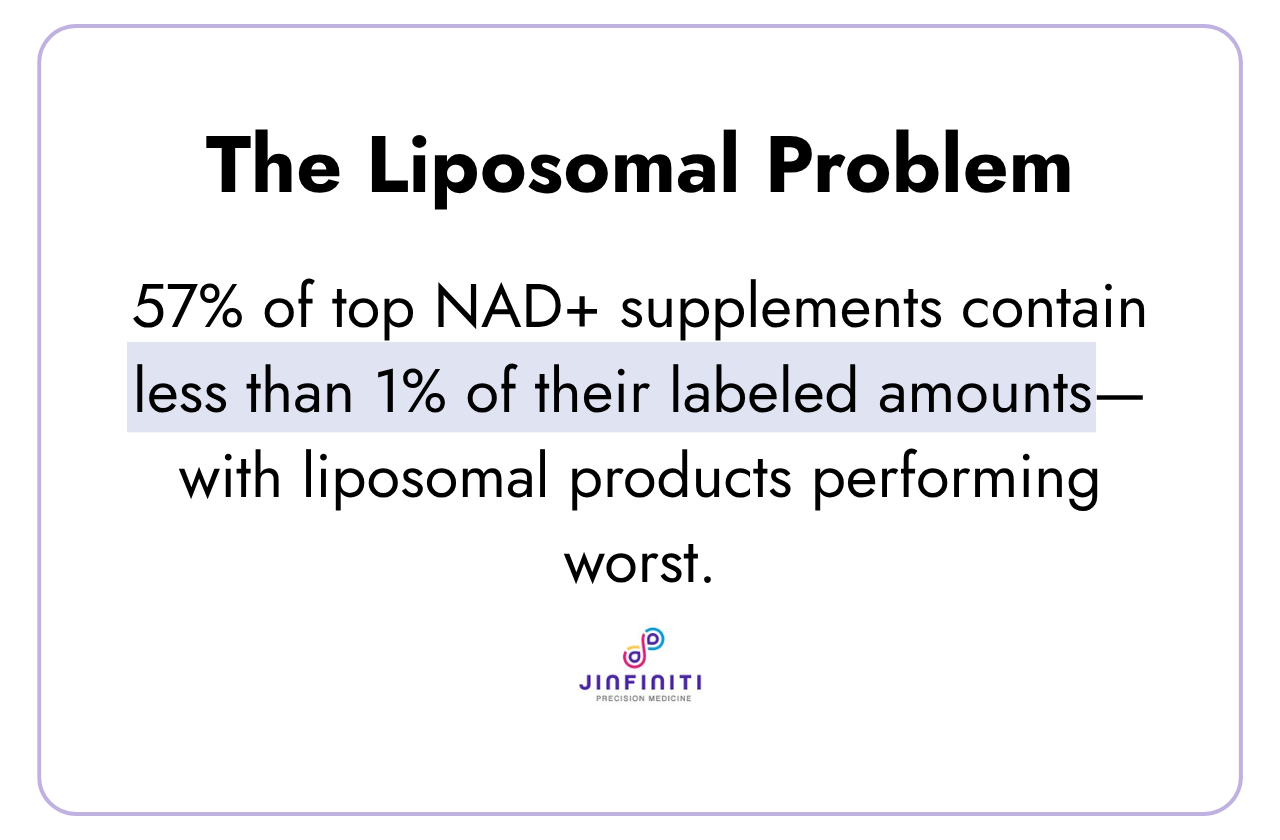
- Independent testing found 57% of top NAD+ supplements contained less than 1% of their labeled amounts, with liposomal products performing particularly poorly
- Manufacturing processes typically break down liposomal structures in powder and capsule forms, rendering the “liposomal” claim meaningless
- NAD+ precursors like NMN and NR have substantial clinical evidence showing they actually raise cellular NAD+ levels
Why Can’t You Just Take NAD+ Directly?
NAD+ (nicotinamide adenine dinucleotide) is a coenzyme your body uses for cellular health and longevity. It fuels hundreds of different enzymes, provides the energy to keep you going, and supports the mechanisms responsible for DNA repair.
The catch? Your body won’t let it in through the front door.
NAD+ faces multiple biological barriers that prevent effective supplementation:
- Size and charge: NAD+ molecules carry two negatively charged phosphate groups and clock in at more than twice the molecular weight of their smaller precursor cousins. This combination creates an insurmountable barrier at the cell membrane.
- Membrane penetration: As one scientific review explains, NAD+ simply cannot passively pass through cellular membranes due to its size and charged nature[1].
- Stability problems: NAD+ breaks down rapidly when exposed to moisture, light, or heat. An FDA briefing document notes that NAD+ is unlikely to remain stable in capsule form under normal storage conditions.
- Digestive breakdown: Your digestive system’s acidic environment finishes off whatever managed to survive the bottle.
Dr. Eric Verdin, President of the Buck Institute for Research on Aging, puts it bluntly: “NAD+ is too big to enter cells and is mostly broken down into nicotinamide when injected. Oral precursors like NMN or NR are a better bet for most people.”
Think of it like trying to push a beach ball through a chain-link fence. The structure just doesn’t cooperate.
The Liposomal Technology Promise
What could go wrong with liposomal delivery systems? Liposomes encapsulate your active ingredient in microscopic phospholipid spheres. They’re little bubbles with a double lipid layer. Your cells’ membranes are made of the same stuff.
On paper, this all sounds great. Liposomes shield compounds from digestion and readily fuse with cells to release their cargo.
Studies on vitamin C back this up for some nutrients. In one 2024 clinical trial, liposomal vitamin C had a 27% greater peak concentration and 21% higher total exposure than regular vitamin C[2].
For other nutrients that have a tough time getting absorbed, liposomal technology can definitely provide an advantage. The real question is: Does it help with NAD+?
And does it even matter if the root absorption issue is still there?
The Problem With Liposomal NAD Products
This is where the slick marketing meets manufacturing reality. Liposomal NAD+ has two problems.
Manufacturing breakdown
First, liposomes are delicate structures. Tablet and capsule manufacturing uses harsh compression, heat, and drying. They break those fragile structures apart.
Dry or powder-based liposomes are particularly vulnerable, according to industry analysts. These formulations break up during the manufacturing process, losing the very structural integrity that made liposomes useful in the first place.
The stability paradox
Second, NAD+ is exceptionally unstable and breaks down very quickly in water. Liquid liposomal products need water to keep the liposomal structure stable, but that same water destroys the NAD+ inside.
You’re left with a lose-lose situation: liquid products maintain liposomal structure but destroy the active ingredient. Powder products preserve the ingredient but destroy the liposomes.
Even injectable NAD+ faces challenges. A recent pilot study found that NAD+ IVs didn’t elevate blood NAD+ until 24 hours after infusion, and then only by about 2% compared to baseline. The study also revealed elevated white blood cell counts in recipients, suggesting an inflammatory immune response as the body interprets extracellular NAD+ as a danger signal[3].
“The supplement industry has gotten very good at selling delivery systems that sound impressive on paper but fail in practice,” says Dr. Jin-Xiong She, founder of Jinfiniti Precision Medicine. “What matters isn’t the delivery vehicle. It’s whether the molecule can actually enter your cells and convert to NAD+ where it’s needed. No amount of fancy encapsulation solves the problem if you’re supplementing with the wrong form.”
What Independent Supplement Testing Found
The numbers are sobering. Independent verification reveals widespread quality control failures:
- SuppCo testing: Tested 11 products labeled as “liposomal” NAD+. Eight softgels contained no detectable NAD+ whatsoever. The remaining three contained sunflower oil or lecithin—components used to make liposomes—but testing revealed no functional liposomal structures.
- Amazon bestsellers: A broader analysis found that 57% of the top 21 NAD+ supplements sold on Amazon contained less than 1% of the NAD+ stated on their labels. Eleven products showed no detectable NAD+ at all.
- High-dose claims: Among products in liposomal form claiming 1,500mg of active ingredient per serving, multiple returned “non-detectable” results.
You’re not getting what you’re paying for—and you’re definitely not getting what the label promises.
The Better Alternative: NAD+ Precursors
The scientific consensus points to a different approach: skip direct NAD+ supplementation and use precursors your cells can actually absorb.
Nicotinamide riboside (NR) and nicotinamide mononucleotide (NMN) are smaller molecules that enter cells through specific transporters, then convert to NAD+ inside where it’s needed.
Clinical evidence for NR:
- One randomized study showed participants taking 100mg daily experienced a 22% increase in whole blood NAD+ after two weeks, while those taking 1,000mg saw levels rise by 142%[4]
- Another study demonstrated that NR supplementation increased NAD+ levels in the human brain[5]—the first evidence that oral supplementation could cross the blood-brain barrier
- NR has extensive human clinical trial data backing its safety and efficacy[6]
Clinical evidence for NMN:
- An 8-week clinical trial in healthy middle-aged adults found 250mg daily was well-tolerated and effectively boosted NAD+ biosynthesis[7]
- Research in postmenopausal women with prediabetes showed NAD+ levels increased approximately 50% in certain blood cells with the same 250mg daily dose[8]
- NMN sits one enzymatic step closer to NAD+ in the biosynthetic pathway[9]
The difference? These precursors actually work.
What Dr. Jin-Xiong She Recommends
At Jinfiniti, the approach centers on measurement rather than guesswork.
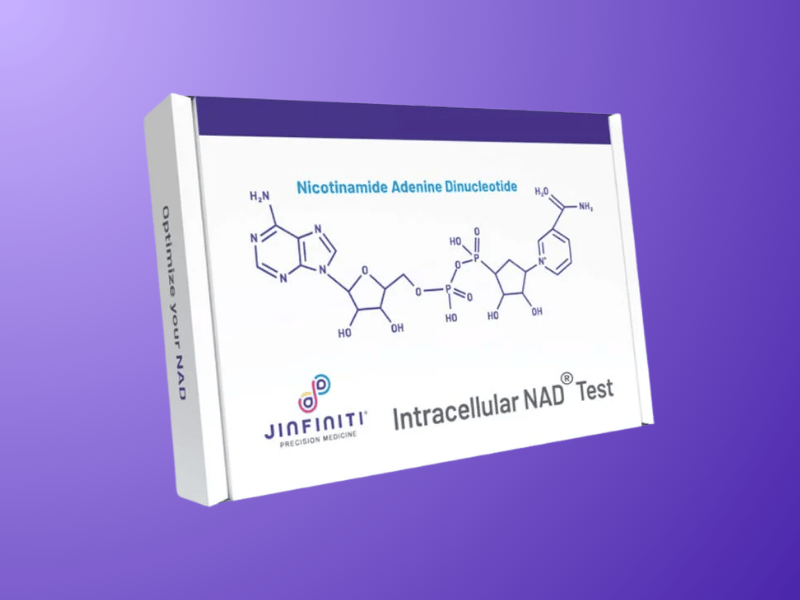
“We see clients spending hundreds of dollars on products that promise the moon but deliver nothing measurable,” Dr. She explains. “That’s why we developed the Intracellular NAD® Test so people can actually see if their supplement is working or if they’re flushing money down the drain.”
This embodies Jinfiniti’s TAO philosophy: Test your baseline levels, Act with targeted supplementation, and Optimize by retesting to confirm improvement. It’s the difference between hoping a supplement works and knowing it does.
Our Vitality ↑® NAD+ Booster takes a multi-pathway approach, combining NMN with niacinamide, creatine monohydrate, and D-ribose in a clinically validated formulation. Rather than relying on a single precursor, this combination works through multiple metabolic pathways to raise NAD+ levels more effectively than standalone ingredients.
Clinical data backs this up: 85% of participants reached optimal NAD+ levels (40-100μM) within four weeks, with an average 100% increase in NAD+ levels.
CLIA-Certified NAD Test Kit
Test your NAD+ levels from home.
How to Choose Real NAD+ Support
When shopping for NAD+ supplementation, look for these evidence-based criteria:
- Skip “liposomal NAD+” products unless the manufacturer provides third-party verification of both liposomal structure and active ingredient content. Most can’t.
- Avoid liquid or water-based formulations: The molecules break down too rapidly in aqueous environments to remain effective by the time you consume them.
- Choose NAD precursors: Look for NMN or NR instead of direct NAD+. These smaller molecules have clinical evidence showing they actually raise cellular NAD+ levels.
- Demand third-party testing: With over half of tested products failing to contain their labeled amounts, independent verification by ConsumerLab, USP, or NSF International isn’t optional—it’s necessary.
- Start with evidence-based doses: 250-500mg daily of NR or NMN. Studies show benefits at these levels, and higher doses don’t necessarily provide proportional improvements.
- Test your levels: Measuring your NAD+ levels removes the guesswork and confirms whether your investment is actually working.
If you have underlying health conditions or take medications, consult with a healthcare professional before starting any new supplement.
Bottom Line
The marketing around liposomal NAD+ might sound good, but the reality is less appealing. Liposomes are destroyed during manufacturing. Liquid formulations are unable to hold their ingredients in solution. Testing by independent labs is revealing that most products do not contain what is stated on their label.
The solution to the challenges that liposomal NAD+ manufacturers are facing is not more hype, but instead a focus on clinically proven NAD+ precursors that the body can absorb and convert to NAD+ in the places you need it most.
You can combine this with testing that you can use to measure your results. This is the one thing that liposomal products simply cannot deliver: tangible evidence that your supplementation regimen is working as it should.
Referenced Sources
- Vinten KT, Trętowicz MM, Coskun E, van Weeghel M, Cantó C, Zapata-Pérez R, et al. NAD+ precursor supplementation in human ageing: clinical evidence and challenges. Springer Science and Business Media LLC; 2025. https://doi.org/10.1038/s42255-025-01387-7
- Purpura M, Jäger R, Godavarthi A, Bhaskarachar D, Tinsley GM. Liposomal delivery enhances absorption of vitamin C into plasma and leukocytes: a double-blind, placebo-controlled, randomized trial. Springer Science and Business Media LLC; 2024. https://doi.org/10.1007/s00394-024-03487-8
- Hawkins J, Idoine R, Kwon J, Shao A, Dunne E, Hawkins E, et al. Randomized, placebo-controlled, pilot clinical study evaluating acute Niagen®+ IV and NAD+ IV in healthy adults. Cold Spring Harbor Laboratory; 2024. https://doi.org/10.1101/2024.06.06.24308565
- Trammell SAJ, Schmidt MS, Weidemann BJ, Redpath P, Jaksch F, Dellinger RW, et al. Nicotinamide riboside is uniquely and orally bioavailable in mice and humans. Springer Science and Business Media LLC; 2016. https://doi.org/10.1038/ncomms12948
- Nanga RPR, Wiers CE, Elliott MA, Wilson NE, Liu F, Cao Q, et al. Acute nicotinamide riboside supplementation increases human cerebral NAD+ levels in vivo. Wiley; 2024. https://doi.org/10.1002/mrm.30227
- Freeberg KA, Udovich CC, Martens CR, Seals DR, Craighead DH. Dietary Supplementation With NAD+-Boosting Compounds in Humans: Current Knowledge and Future Directions. Oxford University Press (OUP); 2023. https://doi.org/10.1093/gerona/glad106
- Yamaguchi S, Irie J, Mitsuishi M, Uchino Y, Nakaya H, Takemura R, et al. Safety and efficacy of long-term nicotinamide mononucleotide supplementation on metabolism, sleep, and nicotinamide adenine dinucleotide biosynthesis in healthy, middle-aged Japanese men. Japan Endocrine Society; 2024. https://doi.org/10.1507/endocrj.ej23-0431
- Yoshino M, Yoshino J, Kayser BD, Patti GJ, Franczyk MP, Mills KF, et al. Nicotinamide mononucleotide increases muscle insulin sensitivity in prediabetic women. American Association for the Advancement of Science (AAAS); 2021. https://doi.org/10.1126/science.abe9985
- 9. Yoshino J, Baur JA, Imai S ichiro. NAD+ Intermediates: The Biology and Therapeutic Potential of NMN and NR. Elsevier BV; 2018. https://doi.org/10.1016/j.cmet.2017.11.002
Read More