Urolithin A: Benefits, Dosage and Risks You Should Know
Your gut microbiome may be the secret to healthy aging. And it’s not a new probiotic you’re paying a small fortune for at the grocery store.
Meet Urolithin A, a compound that forms an important link between dietary intake, gut bacteria activity, and cellular aging processes. It’s made by gut bacteria when they metabolize something found in pomegranates, walnuts and berries.
Why should you care? Because it turns on a cellular recycling process that gets rid of damaged mitochondria and replaces them with new, healthy ones.
Highlights
- Only about 40% of people can naturally produce enough Urolithin A from food, making supplementation valuable for many
- Clinical studies show 500-1000 mg daily improves muscle strength by 12% and increases exercise endurance by 15% within four months
- Urolithin A works by activating mitophagy, the process that removes damaged mitochondria and builds new ones
- Research has shown excellent safety with no serious side effects in trials lasting up to four months
What is Urolithin A?
Urolithin A is a metabolite formed when certain gut bacteria break down ellagitannins and ellagic acid. These polyphenols are found in foods such as pomegranates, walnuts, raspberries, and strawberries.
The body can’t directly absorb ellagitannins. Instead, when you eat foods containing them, certain bacteria in your gut modify these compounds through multiple steps until they’re converted to Urolithin A.
The issue here? Studies suggest that only about 40% of people have the right gut bacteria to efficiently convert these compounds[1]. Aging also affects this. The proportion of people able to produce Urolithin A falls from 61% in younger adults to just 39% in those over 60 years old.
How Does Urolithin A Work in Your Body?
Mitochondria (your cells’ energy factories) are damaged over time and they stop working as well as they should. Urolithin A activates mitophagy, a cleanup process that removes broken mitochondria and triggers new ones to replace them[2].
Here’s how that works:
- Activates AMPK (the cellular energy sensor that kickstarts cleanup)
- Blocks mTOR (the “brakes” on this cleanup process)
- Boosts PINK1/Parkin pathway (tags damaged mitochondria for removal)
- Triggers PGC-1α (master switch for building new mitochondria)
Note that this is a much more complicated and potent approach than simply acting as an antioxidant. Urolithin A removes damaged mitochondria AND stimulates the creation of new ones–a two pronged approach to cellular energy.
5 Benefits of Urolithin A
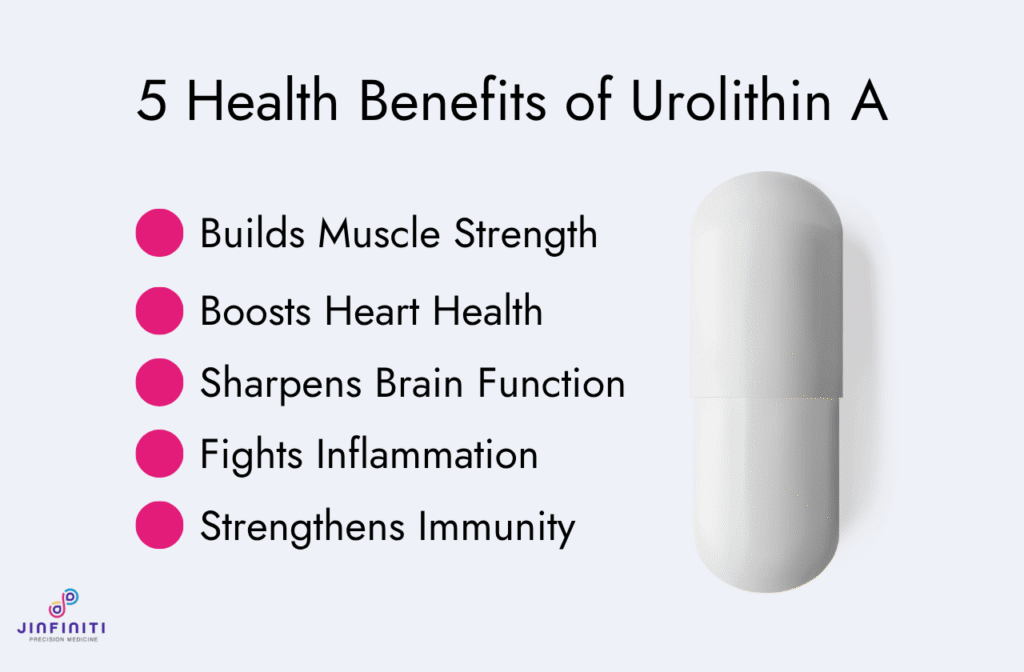
1. Supports Muscle Strength and Endurance
A study published in Cell Metabolism found that middle-aged adults taking 500 mg of Urolithin A daily experienced a 12% increase in hamstring muscle strength after four months[3]. Those taking 1000 mg saw similar improvements plus a 15% increase in total cycling distance.
In older adults aged 65 to 90, researchers tested 1000 mg daily for four months. Participants showed significant improvements in muscle endurance, with an average increase of 95.3 contractions in hand muscles and 41.4 contractions in leg muscles compared to minimal changes in the placebo group.
The researchers noted that improvements came from enhanced mitochondrial efficiency. Better mitochondria mean more energy available for muscle contractions.
These aren’t just lab numbers. Participants demonstrated real improvements in physical tasks, with enhanced aerobic endurance measured by peak oxygen consumption.
2. Supports Heart Health
New studies continue to emerge on Urolithin A and cardiovascular health. In models of heart failure in preclinical trials, two months of supplementation led to improvements in multiple measures of cardiac health[4].
UA improved ejection fraction, which is a measure of your heart’s ability to pump blood. It also improved diastolic function, which is the relaxation phase between heartbeats that allows your heart’s chambers to fill with blood.
There was also a notable finding with ceramides, which are lipids that have been validated as predictors of cardiovascular disease risk. Urolithin A supplementation was shown to significantly lower plasma ceramide levels in the subjects.
In aged mice, supplementation was shown to preserve ejection fraction and maintain skeletal muscle strength, while mice on control diets of standard fare lost muscle capacity. This is thought to be related to its effects on mitochondria and support healthy heart aging.
3. Enhances Brain Function and Memory
A 2024 study in Alzheimer’s & Dementia demonstrated that long-term Urolithin A treatment significantly enhanced learning, memory, and olfactory function in mice modeling the disease[5]. After five months of treatment, mice showed improved spatial learning, better working memory, and enhanced recognition memory.
The research revealed approximately 50% reduction in amyloid beta plaques in the prefrontal cortex. These plaques are a hallmark of the disease. The treatment also decreased levels of phosphorylated tau proteins and reduced neuroinflammation markers.
“Urolithin A can act as a potent anti-inflammatory and antioxidant agent to help clear amyloid beta, which prevents the onset of cognitive deficits associated with pathological amyloid beta deposition,” explained Dr. Thomas M. Holland from the RUSH Institute for Healthy Aging.
The cognitive benefits persisted even after stopping treatment, demonstrating lasting neuroprotective effects. The researchers noted that Urolithin A promotes lysosomal acidification and improves lysosomal function, helping restore cellular clearance mechanisms.
4. Reduces Inflammation Throughout the Body
In middle-aged adults taking 500 mg daily, IL-1β levels decreased significantly. Those taking 1000 mg experienced reductions in three inflammatory markers: C-reactive protein, interferon-gamma, and tumor necrosis factor-alpha.
Chronic inflammation contributes to nearly every age-related disease, from heart disease to cognitive decline. Plasma levels of acylcarnitines and ceramides, biomarkers associated with inflammation and metabolic dysfunction, were also significantly reduced.
Dr. Jin-Xiong She, founder of Jinfiniti Precision Medicine, notes that “cellular inflammation often stems from mitochondrial dysfunction. When your cellular powerhouses aren’t working efficiently, they generate inflammatory signals. Compounds that support mitochondrial quality control address inflammation at its source.”
5. Strengthens Immune System Response
Urolithin A increased circulating naïve CD8+ T cells in a recent study[2]. These cells naturally decline in number with age and the ones observed after taking Urolithin A also exhibited less signs of exhaustion.
Immune cells were directly challenged with E. coli particles in test tubes. Cells from those supplementing with Urolithin A were able to clear the bacteria more effectively. Again this shows a real functional improvement in immune health.
Cellular energy is a requirement for a robust immune system. T cells and other immune cells need healthy mitochondria in order to fight back against pathogens. Urolithin A is helping you preserve immune function as you age by supporting healthy mitochondrial function.
At-Home Longevity Blood Test
Measure what matters for healthy aging and longevity.

Can You Get Urolithin A from Food?
This is where it gets complicated. The short answer is that you can’t directly obtain Urolithin A from food.
There are foods that contain its precursor compounds called ellagitannins. But your body needs to metabolize the ellagitannins into Urolithin A using your gut bacteria in a multi-step process.
The richest dietary sources of ellagitannin precursors are:
- pomegranates (250 to 900 mg per serving)
- walnuts (750 mg per 100g),
- raspberries (65 mg per 100g),
- strawberries (22.3 mg per 100g)
- almonds (54.7 mg per 100g)
Research has identified three distinct urolithin metabotypes in the population[6].
- Metabotype A (25 to 80% of people) produces Urolithin A conjugates as the final metabolite
- Metabotype B (10 to 50%) produces additional urolithins alongside Urolithin A
- Metabotype 0 (5 to 25%) cannot produce urolithins at all
A revealing study of 100 volunteers in Chicago found that only 12 produced detectable Urolithin A at baseline[1]. Even after consuming pomegranate juice rich in ellagitannin precursors, only 40% had significant Urolithin A levels in their blood within 24 hours.
The efficiency of conversion depends entirely on having the right bacteria, particularly species from the Gordonibacter and Enterocloster families[7].
Direct Urolithin A supplementation provides approximately six times better absorption compared to dietary sources.
How Much Urolithin A Should You Take?
Clinical studies found benefits for 250 to 500 mg daily for general cellular health, including muscle strength.
The 500 mg daily dose improved hamstring muscle strength by 12% and lowered IL-1β inflammation markers in middle-aged adults[3].
The higher 1000 mg daily doses have improved a more comprehensive panel of inflammatory markers, muscle endurance, immune and cardiovascular support. A study of older adults (65 to 90 years) saw improved muscle endurance at 1000 mg after two months[8].
Clinical research supports a safe range of 250 to 1000 mg daily for adults. The right amount for you depends on your goals.
If you’re only looking for mitochondrial health benefits, then 250 to 500 mg is likely sufficient. If you’re targeting improvements in specific muscle function, endurance, inflammation, and immune benefits, a dose in the 500 to 1000 mg range is more effective.
Regulatory agencies have also recognized the safety of Urolithin A products within this range, as the FDA has granted Generally Recognized As Safe status to the product formulation[9].
Clinical studies haven’t addressed timing. Study participants have received daily doses, but they’re not limited to a specific time. In addition, food does not impact bioavailability, so it is fine to take it with or without meals.
Is Urolithin A Safe?
Urolithin A is well-tolerated. One randomized, double-blind, placebo-controlled trial published in JAMA Network Open gave 1000 mg per day for four months to healthy older adults without any serious adverse events[8].
The small number of adverse events reported (16 in Urolithin A group and 15 in the placebo group) were not statistically different between groups. Extensive safety testing of vital signs, blood chemistry, and organ function revealed no significant changes.
Side effects are generally mild and transient. At high doses, some people have experienced bloating, nausea, or diarrhea. Mild muscle discomfort is the most common reported side effect. Headaches are very rare.
In preclinical research at doses hundreds of times higher than would ever be consumed by humans, no adverse effects were noted.
Who Should Avoid Urolithin A?
Skip Urolithin A if you fall into these categories:
- Pregnant or breastfeeding — insufficient safety data
- Children and adolescents — not studied in younger populations
- Liver or kidney conditions — consult a healthcare provider first
- On medications affecting cellular pathways — may interact; seek medical advice
- Considering long-term use — safety data only extends to four months
How Does Urolithin A Compare to Other Longevity Supplements?
| Supplement | Primary Mechanism | Bioavailability | How It Differs from Urolithin A |
|---|---|---|---|
| Resveratrol | Sirtuin activation, antioxidant | Poor (20%) | No mitophagy activation |
| Pterostilbene | Sirtuin activation, antioxidant | Good (80%) | No mitophagy activation |
| NAD+ Precursors | Boosts NAD+ levels | Good | Focuses on energy production, not mitochondrial cleanup |
A 2024 study found Urolithin A and nicotinamide riboside improve mitochondrial function through distinct mechanisms, suggesting they may work complementarily rather than as substitutes[10].
Dr. Brian Kennedy noted on Dr. Peter Attia’s podcast: “The mouse data is really good on Urolithin A. We have targets we haven’t published yet,” suggesting additional mechanisms beyond mitophagy.
🧬 MORE LONGEVITY
- Your cellular powerhouses need the right fuel. Discover the best mitochondrial health supplements that support energy production at the source.
- Not all longevity supplements have solid research behind them. See which longevity supplements are backed by evidence and worth your investment.
- Want direct cellular energy support? Learn everything about ATP supplements, from proper dosing to what results you can expect.
Bottom Line
Urolithin A is one of the few longevity compounds with more than one randomized, placebo-controlled trial in humans. The studies show actual functional benefits: 12% increases in muscle strength, improved endurance, less inflammation, and very encouraging neuroprotective effects.
As it activates mitophagy, Urolithin A targets a fundamental mechanism of aging. If you’re looking for evidence-based interventions to support healthy aging, Urolithin A is one of the most promising around.
The trick is getting a good quality product, taking it consistently for months on end, and working with your doctor to include it in your overall health plan.
Referenced Sources
- Singh A, D’Amico D, Andreux PA, Dunngalvin G, Kern T, Blanco-Bose W, et al. Direct supplementation with Urolithin A overcomes limitations of dietary exposure and gut microbiome variability in healthy adults to achieve consistent levels across the population. Springer Science and Business Media LLC; 2021. https://doi.org/10.1038/s41430-021-00950-1
- Denk D, Singh A, Kasler H, Alcober Boquet L, D’Amico D, Gorol J, et al. Impact of urolithin A supplementation, a mitophagy activator on mitochondrial health of immune cells (MitoIMMUNE): A randomized, double-blind, placebo-controlled trial in healthy adults.. American Society of Clinical Oncology (ASCO); 2024. https://doi.org/10.1200/jco.2024.42.16_suppl.e14562
- Singh A, D’Amico D, Andreux PA, Fouassier AM, Blanco-Bose W, Evans M, et al. Urolithin A improves muscle strength, exercise performance, and biomarkers of mitochondrial health in a randomized trial in middle-aged adults. Elsevier BV; 2022. https://doi.org/10.1016/j.xcrm.2022.100633
- Liu S, Faitg J, Tissot C, Konstantopoulos D, Laws R, Bourdier G, et al. Urolithin A provides cardioprotection and mitochondrial quality enhancement preclinically and improves human cardiovascular health biomarkers. Elsevier BV; 2025. https://doi.org/10.1016/j.isci.2025.111814
- Hou Y, Chu X, Park J, Zhu Q, Hussain M, Li Z, et al. Urolithin A improves Alzheimer’s disease cognition and restores mitophagy and lysosomal functions. Wiley; 2024. https://doi.org/10.1002/alz.13847
- García‐Villalba R, Giménez‐Bastida JA, Cortés‐Martín A, Ávila‐Gálvez MÁ, Tomás‐Barberán FA, Selma MV, et al. Urolithins: a Comprehensive Update on their Metabolism, Bioactivity, and Associated Gut Microbiota. Wiley; 2022. https://doi.org/10.1002/mnfr.202101019
- Pidgeon R, Mitchell S, Shamash M, Suleiman L, Dridi L, Maurice CF, et al. Diet-derived urolithin A is produced by a dehydroxylase encoded by human gut Enterocloster species. Springer Science and Business Media LLC; 2025. https://doi.org/10.1038/s41467-025-56266-2
- Liu S, D’Amico D, Shankland E, Bhayana S, Garcia JM, Aebischer P, et al. Effect of Urolithin A Supplementation on Muscle Endurance and Mitochondrial Health in Older Adults. American Medical Association (AMA); 2022. https://doi.org/10.1001/jamanetworkopen.2021.44279
- Vini R, Azeez JM, Remadevi V, Susmi TR, Ayswarya RS, Sujatha AS, et al. Urolithins: The Colon Microbiota Metabolites as Endocrine Modulators: Prospects and Perspectives. Frontiers Media SA; 2022. https://doi.org/10.3389/fnut.2021.800990
- Madsen HB, Navarro C, Gasparini E, Park JH, Li Z, Croteau DL, et al. Urolithin A and nicotinamide riboside differentially regulate innate immune defenses and metabolism in human microglial cells. Frontiers Media SA; 2024. https://doi.org/10.3389/fnagi.2024.1503336
Read More