IM8 vs AG1: Ingredients, Testing, Price, and Which Daily Powder Makes Sense
Written on . Posted in Supplements, Nutrition.
If you have ever stared at a tub of green powder thinking, “Is this nutrition… or just expensive lawn clippings?” you are definitely not alone. IM8 and AG1 both promise a simpler way to cover foundational nutrients in one daily scoop.
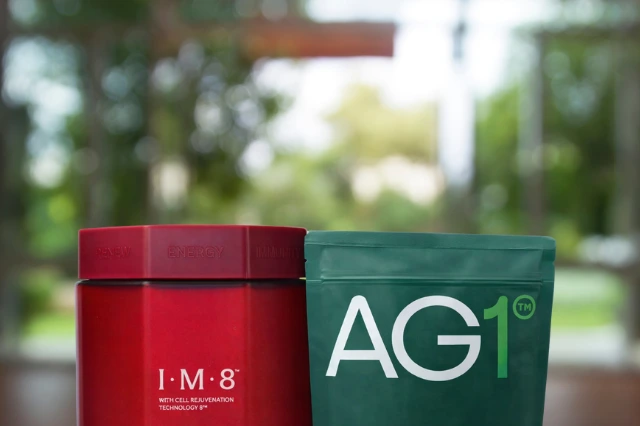
They are in the same aisle, but they are not the same kind of product. IM8 leans “all in one plus extras” (hydration, joint support, heart support). AG1 leans “daily foundation” (vitamins, minerals, superfoods, adaptogens, gut support).
Below is a practical comparison, written for people who want fewer opinions and more signal.
What You Should Know
- Both IM8 and AG1 are daily drink mixes that can help cover common nutrient gaps, but neither replaces a diet built on whole foods.
- If you care about banned substance testing for sport, both brands list NSF Certified for Sport status.
- IM8 is more “label forward” on many nutrients, while AG1 often summarizes ingredient buckets as complexes.
- Your best “which one” answer usually comes from your routine and your labs, not from marketing.
Medical note: This article is for education, not medical advice. If you are pregnant, nursing, under 18, on prescription meds, or managing a medical condition, talk with your clinician before starting a new supplement.
IM8 vs AG1: At-a-Glance Comparison
| Category | IM8 Daily Ultimate Essentials | AG1 (Athletic Greens) |
|---|---|---|
| What it is | All-in-one drink mix with vitamins/minerals plus hydration, joint, heart, gut complexes | Foundational daily drink with vitamins/minerals plus superfoods, adaptogens, gut support |
| Ingredient count | 92 ingredients (brand stated) | 75+ ingredients (brand stated) |
| Calories per serving | 40 | ~50 (varies by formula/serving) |
| Probiotics | 10 billion CFU (label listed) | 7.2 billion CFU (brand stated) |
| Certification | NSF Certified for Sport (listed) | NSF Certified for Sport (listed) |
| Taste profile | Acai and mixed berries style | Pineapple-vanilla style (Original), plus other flavor options |
| Storage | Shelf stable sachets | Often recommended to refrigerate after opening (live cultures) |
| Price range | Premium tier | Premium tier |
What Is IM8?
IM8’s flagship product is Daily Ultimate Essentials, an all-in-one powder marketed as a way to replace a long list of separate supplements. It includes a broad vitamin and mineral panel, then layers in several “support complexes” such as:
- Hydration electrolytes
- Joint and muscle support (including MSM)
- Heart support (including CoQ10)
- Digestive enzymes
- Probiotics plus postbiotics
IM8 also highlights clinical research in its marketing for Daily Ultimate Essentials. If you like products that try to cover a lot of categories in one scoop, that is the core IM8 pitch.
What Is AG1?
AG1 is positioned as a daily “foundational nutrition” drink. It blends:
- Vitamins and minerals
- Prebiotics and probiotics
- “Greens and superfoods”
- Herbal extracts and adaptogens
- Digestive enzymes
AG1 also emphasizes its manufacturing and testing standards, and it publishes a research narrative around its “Next Gen” formula.
What These Powders Can and Cannot Do
A daily all-in-one powder can be helpful when your real life looks like this:
- Breakfast is optional.
- Vegetables happen in bursts, not daily.
- Travel and training disrupt routines.
- You take “a few things” and want to simplify.
A powder is not a substitute for:
- Protein adequacy
- Fiber adequacy (most powders provide some, but not a full day)
- Omega-3 intake
- Sleep, sunlight, and stress management (sadly, no scoop solves those)
Think of IM8 and AG1 as a nutritional safety net, not a nutrition plan.
CLIA-Certified Biomarker Panel
See what your body actually needs.

Ingredient Transparency: How Easy Is It to Evaluate the Formula?
IM8
IM8 provides a detailed Supplement Facts panel and ingredients library for many vitamins and minerals, plus named complexes with amounts. That makes it easier to answer practical questions like:
- Are the B vitamins high-dose or modest?
- Is there meaningful magnesium, or a “label sprinkle” amount?
- Are key add-ons (like MSM or CoQ10) present in recognizable doses?
On the current label, IM8 includes items such as:
- Vitamin C listed at 900 mg
- MSM listed at 1,000 mg
- CoQ10 listed at 100 mg
- A probiotic complex listed at 10 billion CFU
That is useful if you want to sanity-check dosing.
AG1
AG1 lists many ingredients, but for certain categories it often communicates totals as “buckets” (for example, a total grams amount for superfoods or herbal extracts). That approach can still be reasonable, yet it makes it harder to evaluate whether specific botanicals are present at doses used in published studies.
If you are the kind of person who reads labels like a detective reads a ransom note, IM8 will likely feel easier to audit.
Vitamins and Minerals: Similar Foundation, Different Emphasis
Both products aim to cover the common “nutrient gap” basics, especially if your diet is inconsistent. In most all-in-one powders, the headline value is not one miracle ingredient. The value is a steady baseline.
Where differences show up:
- Dose levels: Some formulas lean high-dose on certain vitamins. That can matter if you are already taking a multivitamin.
- Forms: More bioavailable forms can improve tolerance and uptake for some nutrients.
- Overlap with your stack: If you already take magnesium, vitamin D, omega-3, or a multivitamin, you can end up doubling up.
Quick caution: Both IM8 and AG1 include vitamin K forms in some versions. If you take warfarin or other anticoagulants, you should only change vitamin K intake with clinician guidance.
Gut Support: Probiotics, Prebiotics, and Enzymes
Both IM8 and AG1 include probiotics and digestion-related ingredients. That can be helpful, or it can be the reason you quit on day three.
What tends to happen in the real world:
- If you are low-fiber and suddenly add a prebiotic-rich powder, you may feel bloated for a week or two.
- If you are sensitive to inulin, chicory root, sugar alcohols, or certain mushroom extracts, symptoms can show up fast.
IM8’s gut angle
IM8 lists a probiotic complex at 10 billion CFU, plus postbiotics and digestive enzymes. If your main goal is digestive support, that is the part to focus on.
AG1’s gut angle
AG1 emphasizes clinically studied probiotic strains and also suggests refrigeration after opening due to live cultures. If you have used probiotic products before and tolerate them well, AG1 can fit smoothly.
Tip: Start with a half serving for several days if you are sensitive, then increase.
🧬 MORE SUPPLEMENT GUIDES
- Reviewing Andrew Huberman’s Supplement Routine (includes a breakdown of AG1 and when it actually makes sense)
- 15 Best Longevity Supplements (Ranked by Evidence) (a science-first view of what moves the needle)
- The 6 Best NAD Supplements (if your goal is cellular energy and healthy aging)
Energy, Performance, and Recovery: What’s Realistic
Both brands market “energy.” In supplement reality, energy usually improves when one of these is true:
- You were low on a key nutrient (iron, B12, folate, vitamin D, magnesium).
- Your gut tolerance improves and you absorb food better.
- Your routine becomes more consistent, so sleep and hydration improve.
Neither powder is a stimulant product. If you want a caffeine-like effect, these are not designed for that.
Where IM8 may stand out
IM8 includes hydration electrolytes and adds ingredients like MSM and CoQ10. People who train, sweat heavily, or run low-carb diets sometimes notice hydration support more quickly than they notice “micronutrients.”
Where AG1 may stand out
AG1’s edge is the “daily foundation” habit plus its broad mix of superfoods and adaptogens. Some people report steadier digestion and fewer cravings when they commit to it daily.
Quality and Safety: Testing Matters More Than Ingredient Count
The supplement aisle has a trust problem. Quality varies and “natural” does not automatically mean “clean.” Two quality signals matter most:
- Third-party certification (not just “we test in-house”).
- Transparent manufacturing standards (GMP, traceability, contaminant testing).
NSF Certified for Sport
Both IM8 and AG1 list NSF Certified for Sport. This certification is designed to reduce the risk of banned substances and requires testing for contaminants and label verification.
If you compete in tested sport, NSF Certified for Sport is one of the few labels that actually changes your risk profile.
Manufacturing and traceability
AG1 states it is manufactured in a TGA-registered facility in New Zealand and describes full batch manufacturing records and traceability as part of its quality program.
IM8 positions itself as third-party tested and also lists NSF Certified for Sport status. If you want to go deeper than badges, look for batch testing details and contaminant standards (heavy metals, pesticides, microbes).
Heavy metals and contaminants
Greens powders can concentrate plant material, and with it, whatever was in the soil. That is why contaminant testing (heavy metals, pesticides, microbes) matters. If a brand offers batch-level testing or clear contaminant standards, it is worth paying attention.
What About Clinical Evidence?
This is the part that gets messy, fast, because these are multi-ingredient products. When a powder contains dozens of vitamins, minerals, botanicals, enzymes, and microbes, it becomes hard to prove which piece did what.
A good way to think about evidence for “all-in-one” powders is that it usually comes in three layers:
- Ingredient-level evidence (vitamin D supports blood levels, magnesium supports adequacy, certain strains support gut outcomes, etc.)
- Product-level trials (a study on the actual formula people are buying)
- Real-world experience (tolerance, routine adherence, “do I actually keep doing this?”)
IM8 markets results from a 12-week randomized, controlled clinical trial conducted by the San Francisco Research Institute, and the headline numbers they share (energy, gut health, sleep, focus) are presented as participant-reported outcomes. IM8 also has a registered trial listing but the results have yet to be published..
That is a positive signal, but it is worth reading with the right “decoder ring”: until the full methods and results are publicly available (ideally peer-reviewed), treat it as company-sponsored early evidence, not the final word.
AG1 positions its “Next Gen” formula as having been evaluated in multiple randomized, placebo-controlled trials, focused on things like nutrient biomarkers and gut-related outcomes.
There is also at least one peer-reviewed placebo-controlled trial exploring AG1’s effects on the gut microbiome and clinical safety markers. Popular longevity influencer Bryan Johnson called the study into question in a recent Facebook post.
AG1 also published a “Foundational Nutrition” paper. That kind of review can be useful context, but it is not the same thing as a trial proving the product improves outcomes. Pay attention to author affiliations and disclosures, because nutrition reviews can be influenced by funding and conflicts of interest.
Taste, Mixability, and Convenience
Taste is not a minor detail. Taste is compliance.
- AG1 tends to be described as pineapple-vanilla “greens,” not grassy, with multiple flavor options depending on region.
- IM8 leans acai and mixed berry.
Convenience differences:
- IM8 sachets can be easy for travel and consistent dosing.
- AG1 often includes travel packs on subscription tiers and may require refrigeration after opening.
If you will not measure scoops or you travel often, sachets can win on friction alone.
Price and Value: What Are You Actually Paying For?
Both are premium products. That is the honest truth.
Typical pricing (what you will usually see)
Pricing changes, bundles appear, and promos come and go. Still, here is the general shape:
- AG1 commonly lists $79 for a subscription pouch (30 servings) and $99 for a one-time purchase.
- IM8 Daily Ultimate Essentials commonly lists from $89 on subscription pricing, with multi-month options that change the effective per-month cost.
If you want a cleaner comparison, convert everything to cost per serving using your exact plan.
What you are really buying
When you evaluate value, compare them to what you would otherwise buy:
- Multivitamin
- Probiotic
- Greens blend
- Electrolytes
- Digestive enzymes
- “Extras” (adaptogens, mushrooms, CoQ10, joint support)
If you already own half of that stack, an all-in-one may not save money. It may save decisions.
A useful lens: cost per day is not the only number. Ask, “Does this replace things I already take?” If the answer is yes, premium pricing can still make sense. Ask, “Does this replace things I already take?” If the answer is yes, premium pricing can still make sense.
AG1 vs IM8: Pros and Cons (Who Each Is Best For)
Here is the quick, practical version. No poetry, just tradeoffs.
| Product | Pros | Cons | Best for |
|---|---|---|---|
| IM8 Daily Ultimate Essentials | More “label-forward” dosing for many nutrients and several complexes; includes hydration electrolytes plus add-ons like MSM and CoQ10; travel-friendly sachets; NSF Certified for Sport positioning | Bigger “kitchen sink” formula can overlap with your existing stack; higher-dose vitamins may not suit everyone (especially if you already take a multivitamin); fewer taste options | People who want one product to cover foundation plus hydration/recovery-style add-ons, and who prefer clearer label detail |
| AG1 (Athletic Greens) | Strong “daily foundation” habit; widely used; flavor options (by region); manufacturing/quality narrative; NSF Certified for Sport positioning | Less transparency on exact dosing for some botanicals (often grouped as blends); some users prefer refrigerating after opening; taste is distinctive and not universal | People who want a consistent, simple daily baseline and like the AG1 taste/format |
Quick Picks
- Choose IM8 if you want hydration + extras baked in (and you like the idea of sachets and a more “auditable” label).
- Choose AG1 if you want a foundational daily habit with a long track record and you are fine with more ingredients being grouped into blends.
Who Should Skip Both?
Skipping both can be the smartest move if:
- You have a strong whole-food routine and only need one or two targeted nutrients
- You are managing a medical condition where supplement interactions matter
- You get digestive symptoms from prebiotics, probiotics, or adaptogens
In those cases, the better path is usually:
- Get basic labs, then
- Add targeted supplements to correct what is actually off
For example, if “energy” is your real goal, it helps to confirm whether you are dealing with a nutrient issue, a thyroid issue, iron status, blood sugar swings, or low intracellular NAD. (Our guide on testing your NAD+ levels is a good starting point for the NAD conversation.)
That is where at-home panels like our AgingSOS Ultimate Panel (48 biomarkers) and the Intracellular NAD test can turn guesswork into a plan.
If your data suggests NAD support is a fit, a targeted formula like Jinfiniti Vitality NAD+ Booster can be a cleaner next step than stacking dozens of ingredients “just in case.”
As Dr. Jin-Xiong She, founder of Jinfiniti Precision Medicine, puts it: “Supplements can support the plan, but biomarkers tell you what the plan should be.”
If your goal is energy, resilience, and healthy aging, consider pairing any supplement habit with real measurement.
A Smarter Way to Decide: Use a 5-Step Checklist
- Define the job. Nutrient gaps? Gut support? Travel routine? Training recovery?
- Check overlap. List what you already take. Look for duplicates.
- Prioritize certification. If you are an athlete, look for NSF Certified for Sport.
- Start small. Half servings reduce digestive surprises.
- Measure outcomes. If you care about results, use labs and track symptoms, sleep, and training.
FAQ
Is IM8 better than AG1?
“Better” depends on what you need. IM8 is easier to evaluate on the label and adds hydration and joint/heart extras. AG1 is a simpler foundational habit with strong brand infrastructure and a long track record.
Can I take IM8 or AG1 with a multivitamin?
You can, but you may double up on certain nutrients. If you already take a multivitamin, consider using a half serving or pausing the multi while you test tolerance and results.
Do these powders help with bloating?
Sometimes. Some people feel better digestion with probiotics and enzymes. Others feel worse at first due to prebiotics and fiber. Start low and increase gradually.
Are IM8 and AG1 safe?
Most healthy adults tolerate them, but safety depends on your meds, conditions, and sensitivity. If you are pregnant, nursing, under 18, immunocompromised, or on prescription meds, check with a clinician.
Should athletes use greens powders?
If you do, choose products with strong third-party testing and certification, especially if you compete in tested sport.
The Bottom Line
IM8 and AG1 are both premium “daily foundation” powders with third-party certification for sport. Your best choice hinges on two things:
- Transparency and extras (IM8) versus habit simplicity and broad foundation (AG1)
- Your personal tolerance, goals, and the rest of your routine
If you want a shortcut that cuts through the noise, do this: pick one, commit for 30 days, track how you feel, and confirm with labs.
Read More