How Long Does Creatine Stay in Your System After You Stop?
Written on . Posted in Creatine, Supplements.
Reports on how long it takes to clear creatine out of your system range from hours to months. Both are correct. But they’re referring to two entirely different processes.
The problem is that people confuse blood clearance with muscle stores. And blood plasma and muscles work on different time scales.
Creatine clears your blood stream in less than 24 hours. But it takes your muscles 4-8 weeks to fully deplete. And that’s why your strength doesn’t immediately vanish when you go off creatine.
What You Should Know
- Creatine clears from your bloodstream within 24 hours but remains stored in muscles for 4 to 8 weeks after you stop
- Your muscle stores decline gradually, not immediately, so performance benefits persist for weeks
- Individual factors like muscle mass and training intensity affect how long creatine stays active in your system
- You don’t need to cycle off creatine for safety reasons since continuous use is well-tolerated
How Long Creatine Stays in Your System
Creatine clearance in your blood is completely different from creatine clearance in your muscles.
Blood Clearance Happens Fast
When you take creatine, it enters your bloodstream within an hour. Peak blood concentration hits around 1 to 2 hours after you swallow it.
From there, clearance is quick:
- Half-life: 2.5 to 3 hours in your plasma (the time it takes for half the amount to clear)
- Complete blood clearance: 12 to 24 hours after your last dose
- Urinary excretion: About 46% of ingested creatine exits through urine within 24 hours[1]
- Creatinine clearance: Around 21 hours (creatinine is the waste product your body converts creatine into)
This rapid blood clearance matters for blood work timing and knowing when creatine stops circulating through your system.
Muscle Storage Lasts Much Longer
What happens in your muscles is completely different and far more relevant to your performance.
About 95% of creatine in your body gets stored in skeletal muscle tissue as phosphocreatine (creatine bound to phosphate). This stored form acts as a quick energy reserve during high-intensity activity, helping regenerate ATP when your muscles need rapid bursts of power.[2]
Your muscles hold onto this creatine tightly. When you stop supplementing, muscle stores decline slowly over 4 to 8 weeks before returning to your natural baseline.
This extended retention explains why you don’t suddenly lose strength or size the day after your last dose. The performance benefits you’ve built persist for weeks as your muscles gradually use up their elevated stores.
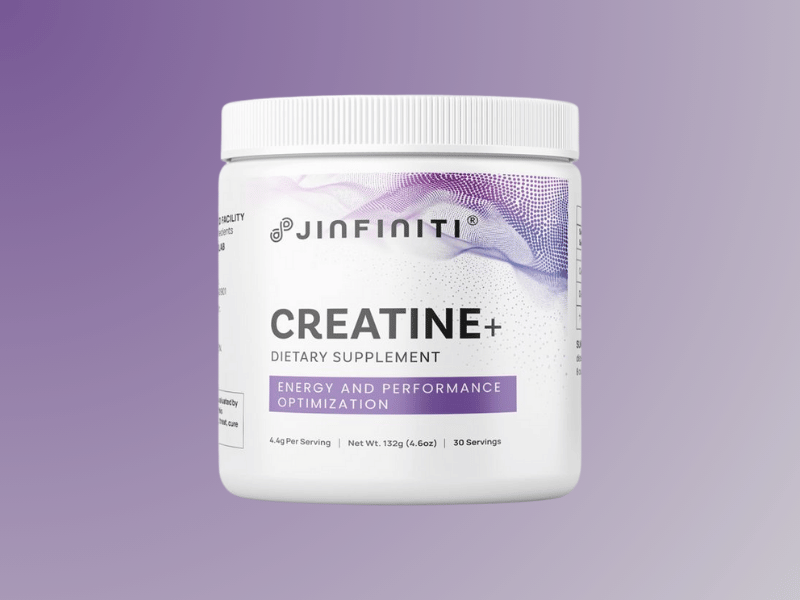
Dr. She’s Creatine Formula
Pure creatine with ATP for total body performance.
The Creatine Washout Period: What Science Shows
A 2004 study from the University of Massachusetts tracked exactly what happens during a creatine washout period.
The 30-Day Washout Study
The 2004 study published in the Journal of Strength and Conditioning Research examined a male athlete who took 20 grams per day for 5 days (a typical loading phase), then stopped completely for 30 days.[3]
Here’s what the study found:
- Muscle phosphocreatine jumped 45% above baseline during loading
- After 30 days without creatine, levels only dropped 22%
- Muscle stores remained 23% higher than pre-supplementation after a full month
- Plasma and urine creatine returned to normal within 30 days
- Body weight stayed elevated (+2.0 kg throughout the washout period)
The researchers noted that “the washout period for muscle creatine to return to baseline levels may be longer than 30 days in some individuals.”
What This Means for You
If you stop taking creatine after regular use, you’re looking at a minimum of 4 to 6 weeks before muscle stores normalize. Many people need closer to 8 weeks.
The longer you’ve been supplementing, the more muscle saturation you achieve, which can extend retention time even further.
Your performance benefits decline gradually during this period, not overnight. You might notice a small drop in your ability to push through the last rep of a heavy set, but the change happens slowly.
Your body continues producing creatine naturally at about 1 to 2 grams of creatine per day, so you never fully deplete. You just return to pre-supplementation levels.
Why Does Creatine Stay Longer in Some People?
People clear creatine at different rates. Several factors determine how long elevated muscle stores persist after you stop.
Muscle Mass Makes a Big Difference
People with more muscle tissue can store significantly more creatine. A 200-pound bodybuilder has substantially higher storage capacity than a 150-pound recreational athlete.[2]
Higher muscle mass typically extends retention time because there’s simply more creatine to clear. Someone with 180 pounds of lean body mass might maintain elevated levels for 8 weeks, while someone with 140 pounds might return to baseline in 5 to 6 weeks.
This storage capacity explains why athletes and people who lift regularly see longer-lasting effects after stopping supplementation.
Your Activity Level Matters
High-intensity training depletes creatine stores faster than moderate exercise. Sprinters, powerlifters, and CrossFit athletes burn through phosphocreatine rapidly during training.[4]
If you stop supplementing with creatine but keep training hard, your muscles use up stored creatine more quickly. Someone doing heavy squats three times per week will deplete stores faster than someone training at lower intensity.
On the flip side, if you reduce training volume or stop exercising entirely, your muscles use less creatine per day. This slower depletion can actually extend how long elevated levels persist.
How Long You’ve Been Supplementing
First-time users often see faster initial clearance compared to people who’ve been supplementing for months or years.
Long-term supplementation allows your muscle cells to adapt and maintain higher saturation levels. When you stop after extended use, these cellular adaptations (changes in how your muscles store and use creatine) can keep levels elevated longer.
Someone who’s been taking creatine supplements for 6 months will likely retain elevated stores longer than someone who only supplemented for 3 weeks.
What Happens to Your Body When You Stop Taking Creatine
The changes after stopping creatine happen gradually over several weeks, not suddenly. Here’s the typical timeline:
Weeks 1-2:
- Minimal noticeable changes in strength or performance
- Muscle stores remain substantially elevated
- Training feels normal
Weeks 3-4:
- Slight decreases in strength and power output for high-intensity efforts
- Most noticeable during heavy lifting or sprinting
- The difference is detectable but not dramatic
Weeks 5-8:
- Muscle creatine levels approach your natural baseline
- Performance on explosive movements may drop 5 to 10% compared to fully-saturated state
- Water weight normalizes (you’ll likely lose 2 to 5 pounds)
There’s no “crash” or withdrawal symptoms. Your body handles the transition seamlessly since it never stopped producing its own creatine.
Any muscle mass you gained from training remains, assuming you keep working out. The size you built from increased training volume doesn’t disappear just because creatine levels drop.
🧬 MORE CREATINE INSIGHTS
- If you’re mixing your morning dose with coffee, learn how caffeine affects creatine absorption.
- Learn how creatine capsules compare to powder for absorption speed.
- Some people experience headaches when taking creatine. Find out why.
Do You Need to Cycle Off Creatine?
Short answer: no.
The idea that you need to cycle off creatine comes from old bodybuilding forums that confused creatine protocols with steroid cycles. They’re not remotely similar.
The International Society of Sports Nutrition reviewed decades of research and concluded that creatine monohydrate is safe for continuous use. Their position stand confirms that supplementation at doses up to 30 grams per day for 5 years shows no adverse effects in healthy individuals.[2]
Your body doesn’t become “dependent” on supplemental creatine. Natural production continues even when you’re taking supplements daily.
Continuous supplementation at 3 to 5 grams per day keeps muscle saturation at optimal levels, which maximizes the performance benefits you’re taking it for in the first place.
The only valid reason to stop is personal preference or if you want to experience what your baseline performance feels like without it. If you’re looking for effective creatine options, choose products with proven absorption and purity.
Does Creatine Show Up on Blood Tests?
Creatine supplementation can affect certain blood test results, though it’s not harmful.
The main concern is creatinine levels on a metabolic panel. Since creatine monohydrate (the most common supplement form) converts to creatinine in your body, supplementation naturally increases this marker on kidney function tests.
This elevation is normal in healthy individuals taking creatine. It doesn’t indicate kidney problems.
If you’re getting blood work:
- Mention your creatine use to your doctor
- They can interpret elevated creatinine in context
- Prevents false assumptions about kidney dysfunction
For athletic drug testing:
- Creatine itself isn’t banned by any major sports organization
- It’s a legal, naturally-occurring compound
- Some programs check for creatinine dilution (to detect masking of other substances)
- Normal creatine use with proper hydration won’t trigger dilution flags
“Your individual baseline reveals what works for your body,” says Dr. Jin-Xiong She, founder of Jinfiniti Precision Medicine. “There’s no cookie-cutter value for creatine clearance and retention. Everybody does it differently, depending on muscle mass, activity, and genetics. Testing takes the guesswork out.”
The Final Scoop
Two timelines matter when creatine leaves your system: blood clearance takes 24 hours, muscle washout takes 4 to 8 weeks.
The muscle timeline is what affects your performance. Benefits don’t vanish overnight because your muscles hold onto stored phosphocreatine for weeks after you stop.
Individual factors create significant variation in clearance rates. More muscle mass, higher training intensity, and longer supplementation history all extend retention time.
You don’t need to cycle off creatine for health or effectiveness reasons. Continuous supplementation is safe and keeps your muscles fully saturated.
When you do stop, expect gradual changes over several weeks, not a sudden performance drop. Your body returns to its natural baseline smoothly, and any muscle you built through training stays with you.
Referenced Sources
- Burke D, Smith-Palmer T, Holt LE, Head B, Chilibeck P. The Effect of 7 Days of Creatine Supplementation on 24‐Hour Urinary Creatine Excretion. Journal of Strength and Conditioning Research 2001;15:59–62.
- Kreider RB, Kalman DS, Antonio J, Ziegenfuss TN, Wildman R, Collins R, et al. International Society of Sports Nutrition position stand: safety and efficacy of creatine supplementation in exercise, sport, and medicine. Informa UK Limited; 2017. https://doi.org/10.1186/s12970-017-0173-z
- RAWSON ES, PERSKY AM, PRICE TB, CLARKSON PM. EFFECTS OF REPEATED CREATINE SUPPLEMENTATION ON MUSCLE, PLASMA, AND URINE CREATINE LEVELS. Ovid Technologies (Wolters Kluwer Health); 2004. https://doi.org/10.1519/00124278-200402000-00024
- Graef JL, Smith AE, Kendall KL, Fukuda DH, Moon JR, Beck TW, et al. The effects of four weeks of creatine supplementation and high-intensity interval training on cardiorespiratory fitness: a randomized controlled trial. Informa UK Limited; 2009. https://doi.org/10.1186/1550-2783-6-18
Read More