NAD Injections Side Effects: Common Reactions and Red Flags
NAD injections (and NAD IV therapies) are marketed as a fast track to higher NAD+, but the delivery method can come with a very specific kind of discomfort. Think cramping, nausea, flushing, and a “this is intense” sensation that often improves as soon as the infusion slows or stops.
This guide breaks down what side effects are common, what’s a red flag, and how to lower risk if you choose to proceed. The big idea is simple: test your NAD+ level first, because the safest intervention is the one you actually need.
What You Should Know
- Most NAD injection side effects are dose and timeframe related, and improve when dosing slows.
- Chest pressure, rapid heartbeat, or severe nausea are common reasons clinics reduce infusion rate.
- Injections and IVs add procedure risks (infection, vein irritation) that oral options avoid.
- Testing your baseline NAD level helps you pick the safest, most effective next step.
CLIA-Certified NAD Test Kit
Test your cellular NAD+ levels from home.
What Counts as an “NAD Injection” (and Why Side Effects Vary)
People use “NAD injections” to mean a few different things, and the side effects can look different depending on the route.
SubQ vs IM vs IV: three routes, three experiences
- SubQ (subcutaneous): injected into the fatty layer under the skin. Often described as “less dramatic” than an IV, but still capable of causing nausea, flushing, or fatigue.
- IM (intramuscular): injected into muscle. Tends to sting more at the site and can leave soreness.
- IV (intravenous): infused into a vein over time. This route is most associated with infusion related symptoms like cramping and chest pressure.
If you want a broader primer on the pros, cons, and costs, see our NAD injections guide.
NAD+ vs NAD precursors (why the molecule matters)
NAD+ is a large molecule, and human data suggests it can be rapidly processed in the bloodstream during IV infusion.[1]
Oral supplements usually use precursors (building blocks) like NMN and NR that your cells convert into NAD+. That difference helps explain why oral strategies often feel gentler day to day.
To see how NMN and NR compare, read NMN and NR compared.
Common NAD Injection Side Effects (and How to Manage Them)
Most side effects fall into two buckets: infusion related symptoms (often speed dependent) and local injection site reactions.
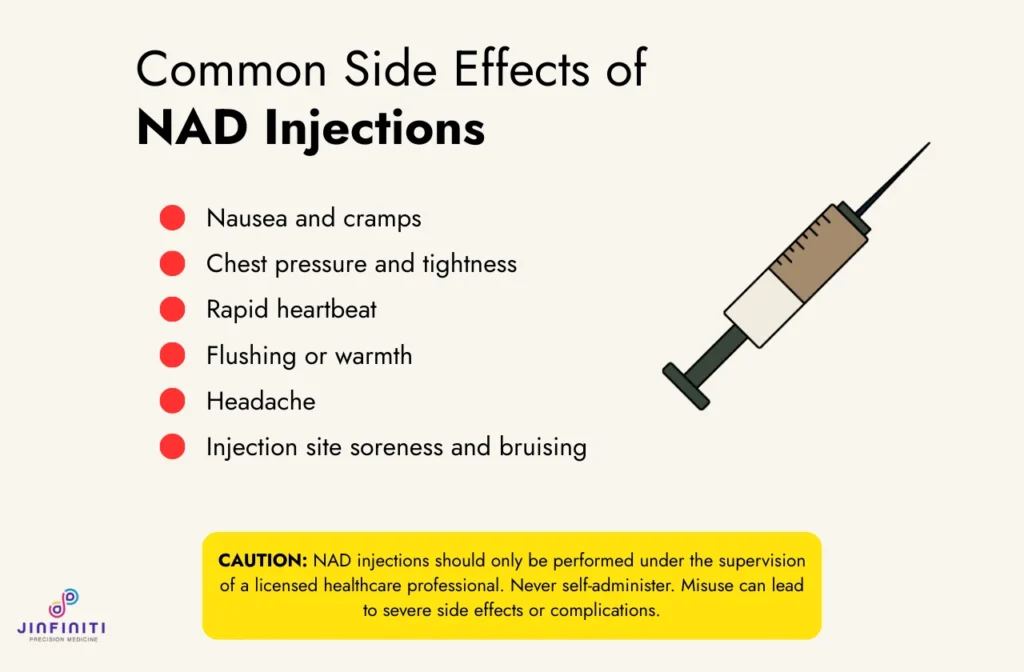
Common side effects
| Side effect | When it shows up | Why it happens (plain English) | What may help | When to stop and seek care |
|---|---|---|---|---|
| Nausea or stomach cramps | During IV, especially faster rates | Smooth muscle and autonomic response to rapid infusion | Slow the infusion, sip water, rest | Persistent vomiting, severe pain, dehydration |
| Chest pressure or tightness | During IV | Sensation often linked to rate and physiologic stress response | Slow or pause infusion | Chest pain, shortness of breath, fainting |
| Rapid heartbeat or “wired” feeling | During IV | Stress response, rate sensitivity | Slow infusion, deep breathing, monitoring | Palpitations with dizziness or chest pain |
| Flushing or warmth | During or shortly after | Blood vessel response | Pause, cool room, hydration | Swelling of lips/face, hives, wheezing |
| Headache | Same day | Dehydration, blood pressure changes, stress response | Fluids, rest | Worst headache of your life, neuro symptoms |
| Fatigue the next day | 6–24 hours | Stress load, sleep disruption, hydration shifts | Prioritize sleep, electrolytes | Severe weakness, confusion |
| Injection site soreness | 0–48 hours | Local tissue irritation | Warm compress, gentle movement | Spreading redness, pus, fever |
| Bruising | Same day | Small blood vessel injury | Pressure after injection, avoid heavy lifting | Large expanding bruise, severe pain |
A real world tolerability review of NAD+ IV reported that people commonly experienced moderate to severe gastrointestinal symptoms, increased heart rate, and chest pressure during infusion.[2]
One line from the paper captures what clinics see in practice:
“Participants that received NAD+ IV reported moderate to severe gastrointestinal symptoms, increased heart rate, and chest pressure.” (Frontiers, 2026) Symptoms resolved when the infusion ended.
Managing infusion discomfort
Clinics often adjust side effects by adjusting rate, dose, and monitoring.
- Start lower than your ego wants. The goal is tolerability first.
- Ask about infusion speed. Faster infusions tend to feel rougher.
- Hydrate before and after. Dehydration makes everything louder.
- Track symptoms in real time. If nausea spikes, tell the clinician immediately.
Here’s a useful mental rule: if the plan relies on “push through it,” the plan needs editing.
Managing injection site reactions
For SubQ or IM shots, local discomfort is common.
- Keep the area clean and avoid scratching.
- Use a warm compress for soreness.
- Watch for spreading redness, warmth, or drainage.
If you develop fever, expanding redness, or increasing pain, treat it like an urgent medical issue.
Adverse Reactions and Red Flags: When to Stop
A little discomfort is one thing. A true adverse reaction is another.
Seek urgent medical care if you have
- Chest pain, shortness of breath, fainting, or confusion
- Swelling of the lips, tongue, or face
- Hives, wheezing, or trouble breathing
- High fever or rapidly worsening injection site redness
- Severe one sided leg swelling or calf pain (possible clot)
If you have any cardiac history, clotting risk, or complex medical conditions, do not treat NAD injections like a casual wellness add on.
Procedure Risks That Aren’t “NAD Side Effects”
Even if the NAD itself were perfectly tolerated, injections and IVs come with their own risks.
Infection risk is about technique
Safe injection practice depends on sterile technique. CDC guidance emphasizes using aseptic technique and a new sterile syringe and needle for each injection.
If a clinic cannot clearly explain their sterile process, that’s your answer.
Compounding and quality control matter
Some clinics add ingredients to IV bags or compound products in house. The FDA has warned about adverse events associated with drug products compounded under insanitary conditions in medical office settings.
Ask directly where the product comes from and how sterility is ensured.
Vein irritation and thrombophlebitis
Any IV catheter can irritate a vein. In some cases that inflammation is tied to clot formation, a condition called thrombophlebitis.
Most people never experience this, but the risk is unique to needles and IVs.
🧬 More NAD Reading
- Curious about absorption claims? Read liposomal NAD and absorption.
- Want context for “normal” levels? See NAD levels by age.
- Shopping smarter? Browse our best NAD supplements guide.
Who Should Be Extra Cautious with NAD Injections
This is the section where “talk to your clinician” stops being boilerplate and becomes practical.
Consider extra caution if you
- Are pregnant or breastfeeding
- Take blood thinners or have a bleeding disorder
- Have uncontrolled high blood pressure or unstable heart rhythm
- Have immune suppression or a history of frequent infections
- Have a history of severe allergies or anaphylaxis
If your clinic is willing to treat these as non issues, find a more careful clinic.
Do NAD Injections Actually Raise Intracellular NAD?
This is the part most marketing skips. Your goal is not “NAD in a bag.” Your goal is NAD inside cells.
Human data on IV NAD+ suggests it can be rapidly removed from plasma during infusion and metabolized into other compounds. That doesn’t prove injections never help, but it does mean the relationship between infusion and intracellular NAD is not guaranteed.[1]
That uncertainty is why we recommend measuring intracellular NAD directly instead of assuming.
Test First: The Simplest Way to Reduce Risk
If you don’t know your baseline, you don’t know if you’re correcting a deficiency or chasing a feeling.
Dr. She’s NAD level ranges (quick reference)
| Category | Intracellular NAD (μM) | What it usually implies |
|---|---|---|
| Optimal | 40–100 | Generally the “target zone” for cellular support |
| Suboptimal | 30–40 | May benefit from a structured plan |
| Deficient | 20–30 | Often worth addressing intentionally |
| Severely deficient | 0–20 | Consider more careful follow up and retesting |
| Too high | >100 | More is not always better, and may not add benefit (consider homocysteine testing with your clinician) |
Dr. Jin-Xiong She, PhD, puts it simply:
“If you can’t measure your NAD, you’re guessing at both need and dose.”
To learn the practical steps, see how to test your NAD levels.
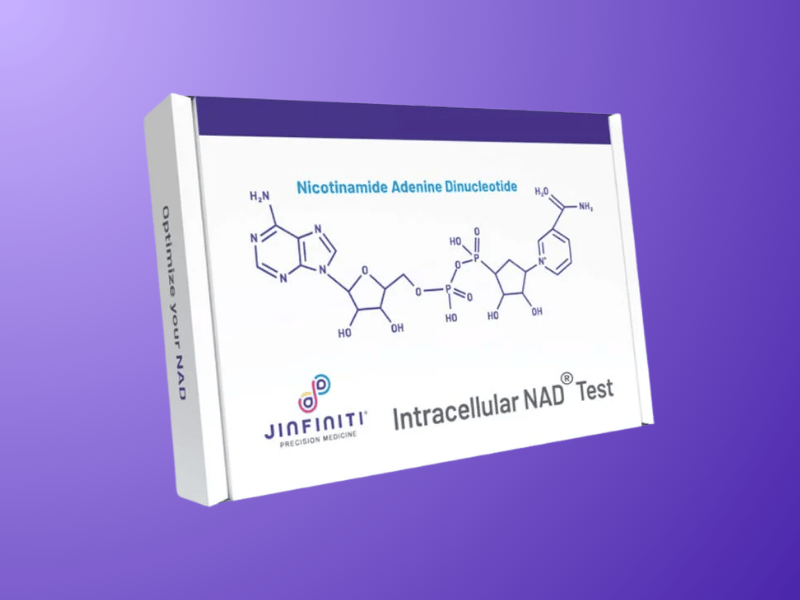
If you want a baseline plus clinical grade reporting, our Intracellular NAD® Test measures NAD from an at home finger prick sample.
Oral Supplementation: A Safer First Line for Most People
For most people, oral NAD precursor supplementation is the easiest way to start, because you can titrate slowly and stop easily.
Human safety data is stronger for oral precursors
In a randomized controlled trial, nicotinamide riboside (NR) at 2,000 mg per day for 12 weeks showed no serious adverse events and supported safety labs.[3]
A randomized, double blind trial of NMN at 1,250 mg daily for 4 weeks in healthy adults also evaluated repeated dosing safety.[4]
That doesn’t mean oral is perfect for everyone. It does mean the evidence base is clearer and the risk profile is generally simpler.
A practical upgrade: multi pathway oral support
Our Vitality ↑® NAD+ Booster combines NMN, niacinamide, creatine monohydrate, and D ribose in a multi pathway formula.
In our clinical data, 22 of 26 participants (85%) reached optimized NAD levels in 4 weeks, and average NAD levels doubled (using our intracellular NAD testing approach). (See the clinical results PDF summary in the Vitality materials.)
If you want a guide to dosing logic, our NAD dosage and frequency guide is a helpful companion.
NAD Injections vs Oral NAD: Side Effects and Safety Compared
If you’re choosing between routes, the most useful comparison is “risk and control,” not hype.
| Approach | How It Works | Downsides | Dosing Control | First Step |
|---|---|---|---|---|
| NAD IV | Rapid infusion into bloodstream | Cramping, nausea, chest pressure, heart rate changes; procedure risks | Infusion rate and monitoring, but harder to self adjust | Test baseline, then decide if it’s worth it |
| NAD injections (SubQ or IM) | Bolus dose into tissue | Site pain, bruising, infection risk | Dose size, but limited monitoring | Test baseline and start conservative |
| Oral precursors (NMN, NR, blends) | Give cells building blocks | Mild GI symptoms at higher doses in some people | Easy titration and stopping | Start low, retest and adjust |
| Lifestyle (sleep, exercise, diet) | Support NAD metabolism indirectly | Takes time, needs consistency | Fully under your control | Pair with testing for feedback |
If you want more context, our guide on NAD injections vs oral supplements lays out the bigger picture.
A Simple Plan to Manage Side Effects and Reduce Risk
Here’s the approach we use internally because it keeps you out of guessing games.
- Test: Get a baseline intracellular NAD level.
- Act: Start with oral support first (or lifestyle foundations) unless there’s a clear clinical reason to escalate.
- Optimize: Retest after a few weeks and adjust dose based on data.
If you want the whole workflow in one bundle, the NAD Optimization® Starter Package pairs two NAD tests with Vitality and a consultation.
Frequently Asked Questions
Questions pop up fast with this topic. Here are the ones we see most.
Are NAD injections FDA approved?
NAD is a molecule your body makes naturally, but “NAD injection therapy” is not a single FDA approved standardized treatment the way a prescription drug is. Delivery, sourcing, and protocols vary by clinic.
How long do NAD injection side effects last?
Infusion related symptoms often calm down as soon as the infusion stops or slows. Site soreness from injections can last 1–2 days.
What’s the most common reason people feel awful during an NAD IV?
In the tolerability review, NAD+ IV was linked with GI symptoms, increased heart rate, and chest pressure, which often led to longer infusion times.
Can I do NAD shots at home?
While home administration is possible with a prescription, it requires strict adherence to sterile techniques and verified sourcing. Improper self-injection increases the risk of localized infection, vascular issues, and incorrect dosing. It is highly recommended to receive your first few doses in a clinical setting to monitor for adverse reactions.
Is oral NAD “as good” as injections?
Oral precursors have more human safety data and are easier to dose and stop. If your goal is intracellular NAD optimization, testing makes the decision much clearer.
Should I take niacin instead?
Niacin can raise NAD, but it comes with its own side effect profile (including flushing) and dosing nuance. If you’re considering it, see our niacin dosage guide.
Referenced Sources
- Grant R, Berg J, Mestayer R, Braidy N, Bennett J, Broom S, et al. A Pilot Study Investigating Changes in the Human Plasma and Urine NAD+ Metabolome During a 6 Hour Intravenous Infusion of NAD+. Frontiers Media SA; 2019. https://doi.org/10.3389/fnagi.2019.00257
- Reyna K, Heinzen G, Patel N, Ritter M, Siojo A, Legere H, et al. Intravenous infusion of nicotinamide adenine dinucleotide (NAD+) versus nicotinamide riboside (NR): a retrospective tolerability pilot study in a real-world setting. Frontiers Media SA; 2026. https://doi.org/10.3389/fragi.2026.1652582
- Dollerup OL, Christensen B, Svart M, Schmidt MS, Sulek K, Ringgaard S, et al. A randomized placebo-controlled clinical trial of nicotinamide riboside in obese men: safety, insulin-sensitivity, and lipid-mobilizing effects. Elsevier BV; 2018. https://doi.org/10.1093/ajcn/nqy132
- Fukamizu Y, Uchida Y, Shigekawa A, Sato T, Kosaka H, Sakurai T. Safety evaluation of β-nicotinamide mononucleotide oral administration in healthy adult men and women. Springer Science and Business Media LLC; 2022. https://doi.org/10.1038/s41598-022-18272-y
Read More