eGFR Blood Test: What It Means, Normal Range, and Next Steps
Reading your lab report and wondering “what does eGFR mean?” Trust us, you’re not alone. It stands for estimated glomerular filtration rate and it’s one of the primary numbers clinicians look at to understand how well your kidneys are filtering your blood.
It’s also a number that gets misunderstood quickly. eGFR is an estimate derived from your other lab values. A single “low” value does not definitively mean you have chronic kidney disease.
What You Should Know
- eGFR is a calculated estimate of kidney filtration, not a direct measurement.
- “Normal” depends on your age, trends over time, and whether there’s kidney damage on urine testing.
- One low eGFR can be temporary from illness, dehydration, or medications.
- The most helpful next test is usually a repeat eGFR plus a urine albumin-to-creatinine ratio (uACR).
CLIA-Certified Biomarker Panel
Test your eGFR with other markers of kidney function.

What is eGFR in a Blood Test?
eGFR stands for estimated glomerular filtration rate, which is a way to approximate how much blood your kidneys filter each minute. The “glomeruli” are tiny filtering units inside your kidneys, and the “filtration rate” describes how efficiently they clear waste and extra fluid.
Most routine kidney panels do not “measure GFR” directly. Instead, your lab report lists an eGFR number that’s calculated from other values in your blood sample.
When people search “eGFR meaning” or “what is eGFR in blood test,” the simplest answer is this: it’s a quick snapshot of kidney filtration that helps flag reduced kidney function early.
How eGFR Is Calculated (and Why It’s an Estimate)
Your eGFR is usually calculated from serum creatinine level, plus factors like age and sex. Creatinine is a waste product made when your body uses creatine for energy, so it tends to rise when filtration slows.[1]
That calculation is useful, but it has blind spots. Anything that changes creatinine without changing filtration can nudge your eGFR up or down.
Creatinine: Helpful, but Easy to Skew
Creatinine is influenced by muscle mass, diet, supplements, and even last night’s workout. That’s why two people with the same kidney function can show different creatinine values.
If you’ve ever wondered whether supplements can confuse lab results, our guide to creatine vs creatinine breaks down what’s normal and what’s not.
CKD-EPI and the 2021 Update You May See on Your Report
Many laboratories now report eGFR using the 2021 CKD-EPI creatinine equation, which removed race from the calculation. A 2021 paper helped validate newer approaches, and some people saw their reported eGFR shift slightly after their lab switched formulas.[2]
If your report says “eGFR CKD-EPI,” it usually refers to the equation used, not a separate test.
When Cystatin C Can Make eGFR More Accurate
If creatinine is likely to mislead (very high muscle mass, low muscle mass, older age, or unusual diets), clinicians sometimes add cystatin C. Cystatin C is a protein produced by your cells at a steadier rate, and it can improve accuracy when creatinine is “noisy.”
If you want a plain-English deep dive, see our guide to cystatin C levels and normal ranges.
Normal eGFR Range (and Why Age Matters)
People often search “eGFR normal range” hoping for one clean cutoff. The reality is messier, because eGFR tends to decline as you get older, even in otherwise healthy adults.
Most labs flag an eGFR below 60 as “low,” but interpretation depends on your trend and whether there’s evidence of kidney damage. The National Kidney Foundation explains this age and context issue well, and even offers a handy eGFR calculator for professionals.
eGFR Test Results and Next Steps
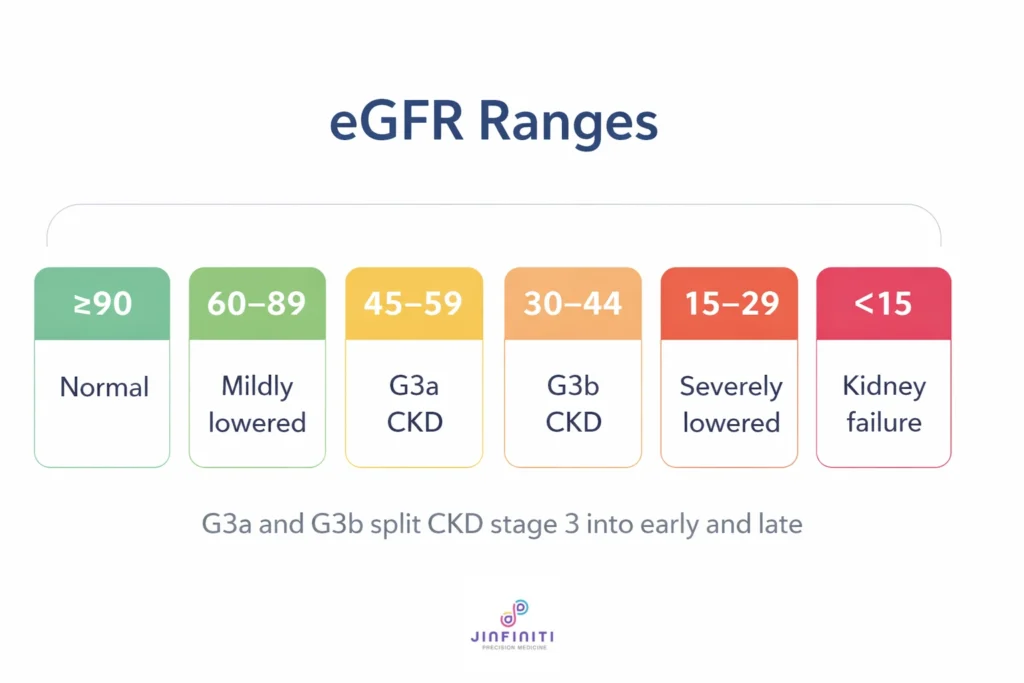
Here’s a practical way to interpret common eGFR ranges (assuming the result is confirmed and not from an acute illness).
| eGFR (mL/min/1.73m²) | What it can mean | What’s usually checked next |
|---|---|---|
| ≥90 | Often normal filtration | Look for kidney damage on urine testing if there are risk factors (diabetes, high blood pressure) |
| 60–89 | Mildly reduced or age-related decline | Repeat labs and check urine albumin (uACR) if risk factors are present |
| 45–59 | Moderately reduced filtration | Confirm persistence, check uACR, review meds, assess blood pressure and diabetes control |
| 30–44 | More significant reduction | Same as above, with closer follow-up and possible nephrology input |
| 15–29 | Severe reduction | Urgent evaluation and specialist care is common |
| <15 | Kidney failure range | Specialist-led care and planning is typical |
That “1.73m²” is a standardized body surface area used for comparison across people, which is why eGFR is not a perfect individualized measurement.
Low eGFR: Common Causes (Not All Are Chronic Kidney Disease)
Seeing “eGFR low” on your results can feel like a siren. The key question is whether this is a one-time dip or a persistent pattern.
A single low number can happen when your body is under temporary stress, even if your kidneys are structurally fine.
Temporary Reasons eGFR Can Drop
These are some of the most common “false alarms” that can lower eGFR on a laboratory test:
- Dehydration or poor fluid intake before the blood draw.
- Recent vomiting, diarrhea, fever, or other acute illness.
- Some medications, especially NSAIDs (like ibuprofen) in higher or frequent doses.
- Intense exercise shortly before testing.
- Recent creatine supplementation that raises creatinine without true damage in healthy people (context matters).
If any of these were true for you, repeating the test once you’re back to baseline is often more informative than spiraling over a single report.
Ongoing Causes of Reduced eGFR
When eGFR stays low, the most common long-term drivers are metabolic and vascular. The big ones include diabetes, high blood pressure, and underlying kidney diseases.
That’s one reason kidney results are often interpreted alongside blood sugar and inflammation markers, such as HbA1c and CRP.
eGFR Stages and How CKD Is Actually Diagnosed
It’s tempting to map one lab result to one diagnosis. Kidney guidelines do not work that way.
Chronic kidney disease is defined by either reduced eGFR or evidence of kidney damage that persists for at least 3 months.
Why Urine Albumin Matters as Much as eGFR
Kidney risk is staged using both eGFR and albuminuria (protein leakage into urine). A urine albumin-to-creatinine ratio (uACR) helps detect kidney damage even when eGFR is still “normal.”[3]
A urine albumin-to-creatinine ratio (uACR) is a key companion test because it changes long-term risk and follow-up decisions.
If you’re trying to connect related labs, it can also help to understand what albumin levels in blood can suggest about overall health and inflammation (even though urine albumin is the kidney-specific piece).
What To Do If Your eGFR Is Low
The best next step is usually not a supplement or a cleanse. It’s a clearer answer.
A repeat test plus the right companion labs often tells you whether you’re seeing a temporary fluctuation or a real trend.
A Simple Next-Step Checklist
- Repeat creatinine and eGFR when you’re well hydrated and not acutely ill.
- Add urine albumin-to-creatinine ratio (uACR) to look for kidney damage.
- Review medications with your clinician, especially frequent NSAID use.
- Check blood pressure and long-term glucose control (often with HbA1c).
- Consider cystatin C if creatinine-based eGFR doesn’t fit your body type or situation.
When It’s Worth Calling a Clinician Quickly
Seek prompt medical advice if you see a rapid drop from your usual results, if your eGFR is very low, or if you have symptoms like swelling, shortness of breath, confusion, or very low urine output.
Those scenarios can signal an acute kidney problem that needs immediate evaluation.
How To Support Kidney Health (Without Guessing)
Kidney protection is mostly boring, which is good news. The habits that help are the same ones that reduce cardiovascular and metabolic risk.
Here’s what tends to matter most, based on guideline-level consensus.
- Keep blood pressure in a healthy range and treat hypertension when present.
- Control blood sugar if you have prediabetes or diabetes, since high glucose drives kidney damage over time.
- Avoid frequent high-dose NSAIDs unless a clinician advises otherwise.
- Aim for a balanced diet and adequate hydration, especially around testing.
- Don’t “protein panic” without context. Protein targets should be personalized if CKD is confirmed.
If you’re tracking uric acid because of kidney stones or gout risk, our guide to uric acid test ranges can help you interpret that number alongside kidney function.
A Practical Perspective from Dr. Jin-Xiong She
Dr. Jin-Xiong She, PhD (genomic medicine researcher and founder of Jinfiniti), often reminds patients that kidney numbers need context.
“Your kidneys don’t wake up one morning and decide to ‘be low.’ If eGFR drops, your job is to find out whether it’s a temporary stress signal or a persistent pattern, then act on the cause.”
That’s also why Jinfiniti leans on the Test, Act, Optimize approach. You measure first, you respond based on data, and you retest to confirm what’s working.
If You Want a Bigger Health Picture
eGFR is a kidney-focused number, but it rarely exists in isolation. Blood pressure, glucose control, inflammation, and cardiovascular risk all push on kidney outcomes over time.
If you want to track kidney-relevant markers alongside a broader set of longevity biomarkers, the AgingSOS Essential Panel includes common kidney function markers like creatinine and cystatin C as part of a multi-system view.
All testing is processed through Jinfiniti’s high-complexity CLIA laboratory in Augusta, Georgia, which matters when you’re making health decisions based on lab results.
Frequently Asked Questions
What is eGFR in a blood test?
eGFR is an estimate of kidney filtration calculated from blood markers like creatinine plus age and sex.
What is a normal eGFR?
Many healthy adults fall above 90, but “normal” depends on age and whether there’s kidney damage on urine albumin testing.
Is eGFR 60 bad?
An eGFR below 60 is often flagged as low, yet CKD usually requires persistence for at least 3 months or evidence of kidney damage.
Can dehydration cause low eGFR?
Yes. Dehydration can raise creatinine temporarily, which lowers the calculated eGFR until you rehydrate and recover.
What does “eGFR CKD-EPI” mean?
It typically refers to the equation your lab used to calculate eGFR.
How often should eGFR be checked?
It depends on your risk factors and prior results. If a result is abnormal, repeating eGFR and adding uACR is a common next step.
What’s the difference between eGFR and GFR?
GFR is the concept (true filtration rate). eGFR is a calculated estimate used in routine laboratory testing.
Should I worry if creatinine is normal but eGFR is low?
Sometimes labs calculate eGFR in a way that creates borderline values, especially in older adults. Trends and urine albumin often matter more than one isolated number.
What tests help confirm chronic kidney disease?
A repeat eGFR plus urine albumin-to-creatinine ratio is foundational, along with evaluation of underlying causes.
Can you improve your eGFR levels?
Yes, especially if a low result was driven by dehydration, acute illness, or a medication effect. Long-term improvement depends on the underlying cause and risk-factor control.
Referenced Sources
- Mula-Abed WAS. Estimated Glomerular Filtration rate (eGFR): A Serum Creatinine-based Test for the Detection of Chronic Kidney Disease and its Impact on Clinical Practice. Oman Medical Journal; 2012. https://doi.org/10.5001/omj.2012.87
- Inker LA, Eneanya ND, Coresh J, Tighiouart H, Wang D, Sang Y, et al. New Creatinine- and Cystatin C–Based Equations to Estimate GFR without Race. Massachusetts Medical Society; 2021. Available from: https://doi.org/10.1056/nejmoa2102953
- Inoue K, Streja E, Tsujimoto T, Kobayashi H. Urinary albumin-to-creatinine ratio within normal range and all-cause or cardiovascular mortality among U.S. adults enrolled in the NHANES during 1999–2015. 2021.
Read More