Can a Vitamin Deficiency Cause Dark Circles Under the Eyes?
You’ve tried sleeping more. You’ve tried the expensive eye creams. You’ve convinced yourself it’s just genetics, or aging, or the fact that you’ve been staring at screens since 2008. And still, the dark circles under the eyes are there every morning.
For a lot of people, that explanation is frustrating precisely because it’s incomplete. Sleep deprivation is the story we tell, but persistent dark circles — the kind that stick around even when you’re well-rested — can be a visible signal of something happening beneath the skin.
Specifically, certain vitamin and mineral deficiencies have been clinically linked to periorbital hyperpigmentation (the medical term for dark discoloration under the eyes), and the mechanisms are real, if still being studied.
The short answer to which deficiency is most to blame isn’t simple. But it’s worth knowing.
The Short Summary
- Persistent dark circles that don’t improve with sleep may be pointing to a vitamin or mineral deficiency rather than a lifestyle issue.
- Iron deficiency is the most clinically documented nutritional cause, present in roughly half of patients with periorbital hyperpigmentation in some studies.
- Vitamins B12, K, C, and D are each associated with dark circles — but through different mechanisms, and with varying levels of research support.
- The most reliable path forward is testing your nutrient levels rather than guessing which supplement to add.
CLIA-Certified Blood Panel
Uncover deficiencies with a complete blood test from home.

Why the Skin Under Your Eyes Is So Fragile
Before jumping to deficiencies, it helps to understand what makes this particular area of your face so sensitive to internal changes.
The skin beneath the eyes is among the thinnest on the entire body — significantly thinner than skin on the cheeks or forehead. It has very little subcutaneous fat to buffer what lies underneath, and the capillary network directly beneath it is dense.
When circulation is compromised, oxygenation is low, or collagen is depleted, the result is visible: dilated blood vessels, pooled blood, and increased pigmentation all show up more easily here than anywhere else on the face.
What Makes Periorbital Skin So Vulnerable
A 2019 clinical assessment published in Clinical, Cosmetic and Investigational Dermatology confirmed that under-eye dark circles correlate with measurably thinner skin, higher hemoglobin index (a marker of vascular prominence), and a higher melanin index — all pointing to both vascular and pigmentary contributors rather than just one single cause.[1]
That’s the important thing to know: dark circles are rarely due to one thing alone. Which means identifying the most correctable cause matters more than defaulting to the nearest eye cream.
Vitamin and Mineral Deficiencies Linked to Dark Circles Under the Eyes
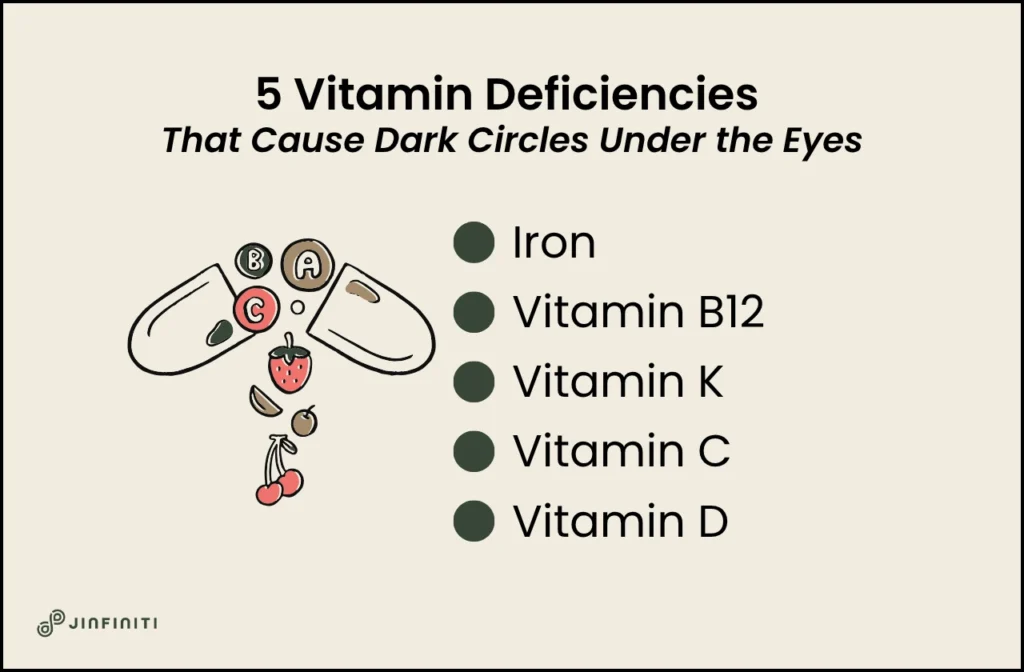
The research on nutritional causes of periorbital hyperpigmentation is still catching up to how common the condition actually is. Still, several deficiencies have meaningful clinical and mechanistic support.
1. Iron: The Strongest Clinical Link
Iron is essential for producing hemoglobin — the protein in red blood cells that carries oxygen to every tissue in your body, including the delicate skin around your eyes. When iron levels are low, tissues don’t receive adequate oxygen, small blood vessels dilate to compensate, and skin becomes paler overall. Under thin periorbital skin, that combination makes dark underlying vessels far more visible.
The clinical data here is more robust than for any other nutrient. A 2014 study of 200 patients with periorbital hyperpigmentation found that 50% had iron deficiency anemia — and many of those patients reported that their dark circles improved significantly once the anemia was treated. Iron deficiency is worth ruling out early, particularly in women during reproductive years, vegetarians and vegans, and anyone with heavy menstrual periods.[2]
One important nuance: iron deficiency anemia is distinct from simply having low-normal iron stores. Standard blood panels may not catch early functional iron depletion. A full iron panel — including ferritin — gives a more complete picture.
2. Vitamin B12: Pigmentation and Skin Cell Renewal
Vitamin B12 plays a central role in red blood cell production, nerve health, and the renewal of skin cells. When B12 is deficient, the skin can lose its normal turnover rate and develop increased pigmentation — including in the periorbital area.
A cross-sectional study of patients with periorbital pigmentation found a significant association between dark circles and low B12 levels, noting that B12 supplementation could serve as an adjunctive treatment in affected patients.[3]
The connection makes mechanistic sense: slowed cell turnover allows pigmented cells to accumulate, and decreased red blood cell production compounds the oxygenation problem.
B12 deficiency is particularly common in vegans, older adults (absorption decreases with age), and people taking metformin long-term. It’s also worth noting that niac — a form of vitamin B3 — has separately been studied for its effects on skin pigmentation and barrier function, though its relationship to periorbital hyperpigmentation specifically is still emerging.
3. Vitamin K: Blood Pooling Beneath the Eyes
Vitamin K is perhaps the most specifically targeted nutrient when it comes to dark circles. It plays a key role in blood clotting and vascular integrity — and when K levels are low, blood is more prone to pooling in the small capillaries beneath the eyes rather than clearing efficiently.
A study on topical application of phytonadione (vitamin K), retinol, and vitamins C and E found that the combination, applied twice daily, produced meaningful reductions in dark circle intensity — with vitamin K’s vascular effects considered a key mechanism.[4]
While this was a topical study rather than a supplementation trial, it supports the idea that vitamin K status has a direct bearing on periorbital blood dynamics.
Vitamin K comes in two main dietary forms: K1 (found in leafy greens) and K2 (found in fermented foods and animal products). K2 in its MK-7 form stays active in the body significantly longer than other forms — a relevant distinction when evaluating whether supplementation would be meaningful.
4. Vitamin C: Collagen and Capillary Strength
Vitamin C is required for collagen synthesis — the structural protein that gives skin its thickness and resilience. Under the eyes, adequate collagen is what prevents the vascular network from showing through. When vitamin C is deficient, periorbital skin thins and capillary walls weaken, making blood vessels more visible and more prone to minor leakage.
The direct evidence linking vitamin C deficiency to dark circles is still emerging rather than definitive. The mechanistic case is plausible and supported by vitamin C’s well-established role in skin biology — but direct clinical trials isolating vitamin C deficiency as a cause are limited.
5. Vitamin D: An Association Worth Monitoring
Low vitamin D has been noted more frequently in women over 40 with persistent dark circles, and some clinical observation suggests a possible connection. The mechanism isn’t fully established — vitamin D receptors are present in skin tissue and vitamin D plays a role in skin cell differentiation, but the direct periorbital link hasn’t been proven in controlled trials.
This is an area where the evidence is still insufficient for confident claims. What can be said: widespread vitamin D deficiency affects an estimated 50 to 70% of adults, and addressing it has enough supporting evidence across other health domains that testing is reasonable regardless of whether dark circles are your primary concern.[5]
Dark Circles Are Multifactorial and One Fix Rarely Works

Here’s where the picture gets more honest. Even in studies focused specifically on nutritional causes, periorbital hyperpigmentation is consistently described as multifactorial — meaning genetics, chronic sun exposure, allergies, vascular anatomy, hormonal changes, and nutritional gaps all interact.
One study found that family history was positive in over 60% of patients with the condition, meaning some degree of structural predisposition is common.[2]
This doesn’t mean nutrition doesn’t matter. It means that correcting a deficiency will help more for some people than others, and that addressing underlying inflammation alongside specific nutrient gaps gives a more complete picture than targeting any single variable.
If your dark circles appeared or worsened over time, rather than being a lifelong constant, that’s a better signal that an internal cause — including nutrient deficiency — is playing a role.
How to Know If a Deficiency Is Causing Dark Circles
The difference between guessing and knowing is a blood test.
Most standard panels include hemoglobin and basic B12 — but they often miss ferritin (the storage form of iron that depletes before anemia becomes clinically apparent), detailed vitamin D levels, or comprehensive micronutrient profiles.
If you suspect a deficiency is contributing to what you’re seeing, asking specifically for a full iron panel with ferritin, serum B12, 25-hydroxyvitamin D, and a comprehensive metabolic panel gives you a more useful starting point than standard routine labs.
For a broader picture of where your nutrient status actually stands, at-home testing panels have made comprehensive biomarker assessment significantly more accessible — without requiring a specialist referral for each individual marker.
“A visible symptom like dark circles is almost always downstream of something measurable,” says Dr. Jin-Xiong She, founder of Jinfiniti Precision Medicine. “The question we always ask is: what is actually driving this? You don’t fix the symptom without understanding the root cause — and you don’t find the root cause without measuring.”
The AgingSOS® Advanced Panel measures 28 biomarkers including full nutrient status, inflammatory markers, and cellular health indicators — giving a comprehensive baseline that goes beyond what standard blood work typically captures. For those who want to understand the full picture before making any supplementation decisions, it’s a more useful starting point than addressing one nutrient at a time.
What to Do Once You Know the Cause
Identifying the deficiency is step one. What comes next depends on what you find — and a conversation with your clinician before starting any supplementation is always the right first move.
| Deficiency | Dietary Sources | Supplementation Notes |
|---|---|---|
| Iron | Red meat, lentils, spinach, fortified cereals | Supplement only with confirmed deficiency; iron overload is also problematic |
| Vitamin B12 | Meat, fish, eggs, dairy | Particularly important for vegans, older adults, metformin users |
| Vitamin K | Leafy greens (K1), fermented foods, animal products (K2) | K2 (MK-7 form) has superior bioavailability and longer activity |
| Vitamin C | Citrus, bell peppers, strawberries, broccoli | Dietary priority first; topical forms also studied for periorbital use |
| Vitamin D | Sunlight, fatty fish, fortified foods | Pair with K2 for proper calcium metabolism; absorption varies widely |
Vitamins D3 and K2 are a particularly well-studied combination — D3 supports calcium absorption, while K2 directs that calcium appropriately to bones rather than soft tissues. Taking them together is mechanistically sound, and products pairing both in bioavailable forms address two common deficiencies with one approach.
If mineral gaps are part of the picture, absorption quality matters as much as dose. Chelated mineral forms — bound to amino acids for better uptake — are significantly more bioavailable than standard mineral salts, and dual-form magnesium (glycinate plus malate) addresses both sleep quality and cellular energy support simultaneously.
Frequently Asked Questions
Which vitamin deficiency is most commonly linked to dark circles?
Iron deficiency has the strongest clinical evidence, appearing in roughly half of patients with periorbital hyperpigmentation in published studies. Vitamin B12 deficiency has the next strongest association, particularly through its effect on skin pigmentation and red blood cell production. Vitamins K, C, and D each have plausible mechanistic links, though the direct clinical evidence is more limited.
Can taking supplements fix dark circles?
Supplements can help if a documented deficiency is the underlying cause. They’re unlikely to produce visible change if the root cause is structural (thin skin, genetics, anatomical shadowing) or primarily vascular without a nutritional driver. Testing before supplementing is the most reliable path to knowing whether it’s worth trying.
How long does it take for dark circles to improve once a deficiency is treated?
This varies by deficiency and severity. Iron deficiency anemia typically takes 6–8 weeks of treatment before hemoglobin levels normalize meaningfully — visible skin changes may follow. B12 replenishment timelines depend on the severity and form of supplementation. Realistic expectation: several months of consistent treatment before drawing conclusions.
Are dark circles always caused by a vitamin deficiency?
No. Dark circles are multifactorial, and nutritional deficiency is one of several possible causes. Genetics, aging, skin thinning, vascular anatomy, allergies, and chronic sun exposure all contribute in different proportions for different people. If your dark circles have been present since childhood or run in your family, a structural or genetic component is more likely. If they appeared or worsened over time, an internal cause — including nutrition — deserves investigation.
What blood tests should I ask for if I suspect a nutritional deficiency?
Ask your clinician for a complete blood count (CBC), a full iron panel including serum ferritin, serum B12, 25-hydroxyvitamin D, and a comprehensive metabolic panel. These go beyond what most routine labs include and give a more complete picture of nutrient status. If you want a broader baseline assessment, comprehensive biomarker panels can measure many of these simultaneously alongside inflammatory and metabolic markers.
Read More