DHEA-S Test: What It Measures and What Your Results Mean
The DHEA-S test measures dehydroepiandrosterone sulfate (DHEA-S), the most abundant steroid hormone circulating in your bloodstream. Healthcare providers use the test diagnose conditions ranging from adrenal tumors to polycystic ovary syndrome (PCOS), often well before symptoms become severe.
While most hormone tests require fasting or careful timing, the DHEA-S test works on your schedule. No empty stomach needed. No specific time window. Just a simple blood sample that indicates how well your adrenal glands are working and if your hormone production is out of balance.
What You Should Know
- The DHEA-S test measures adrenal hormone production and serves as a precursor to testosterone and estrogen
- The test requires no fasting, and timing doesn’t matter since levels stay stable throughout the day
- Results help diagnose adrenal disorders, PCOS, hormonal imbalances, and puberty-related issues
- Reference ranges decline with age, dropping to just 10-20% of peak levels by your 70s
What is the DHEA-S Test?
The DHEA-S test measures the level of dehydroepiandrosterone sulfate in your blood. This steroid hormone comes primarily from your adrenal glands, the small glands sitting on top of your kidneys.
DHEA-S is the sulfated, more stable form of DHEA. Small amounts also come from the ovaries in women and testes in men.
Your body converts DHEA-S into sex hormones like testosterone and estrogen. Think of it as raw material your cells transform into the hormones you need.
What makes DHEA-S an excellent biomarker is its stability. Unlike cortisol, which fluctuates throughout the day, DHEA-S levels remain steady with no diurnal variation. This consistency makes testing straightforward and reliable.
The Journal of Clinical Endocrinology & Metabolism notes: “DHEA-S is a promising marker of hypothalamic-pituitary-adrenal axis function. Additionally, DHEA-S has a long half-life, lacks diurnal variation, and can be measured with widely available assays, which makes it an attractive potential diagnostic test.”[1]
DHEA-S levels peak during young adulthood, between ages 20-30. After that, they decline at a steady rate of about 2-3% per year. By age 70-80, your levels may be only 10-20% of what they were at their peak.
CLIA-Certified Longevity Testing
Measure your DHEA-S with our Ultimate Longevity Panel.

Why Your Doctor Orders a DHEA Sulfate Test
Healthcare providers order the DHEA sulfate test when they suspect adrenal gland problems or an imbalance of hormones.
Specifically, the test can diagnose adrenal tumors (adenomas or carcinomas), Cushing syndrome, Addison disease (primary adrenal insufficiency), and congenital adrenal hyperplasia.
It also helps diagnose women who have too many male hormones. About 20 to 30% of women with PCOS have high DHEA-S levels even though their other androgens are normal.[2]
The most common symptoms that lead women to be tested are:
- Body or facial hair growth (hirsutism)
- Severe acne
- Male-pattern baldness/thinning of hair on crown of head
- Irregular or missed menstrual periods
- Trouble becoming pregnant
In children, the DHEA-S test helps diagnose premature adrenarche. This condition shows up when signs of puberty like pubic or underarm hair appear earlier than expected, typically before age 6-8.
Dr. Robert Rosenfield, Professor Emeritus at the University of Chicago and a leading authority on adrenal development, describes adrenarche as “the maturational increase in adrenal androgen production that normally begins in early childhood. It results from changes in the secretory response to ACTH that are best indexed by dehydroepiandrosterone sulfate (DHEA-S) rise.”[3]
The test also helps distinguish between different causes of Cushing’s syndrome. Low DHEA-S typically suggests adrenal Cushing’s from a single adrenal adenoma, while normal DHEA-S levels point toward pituitary Cushing’s disease.
The Test Procedure: What to Expect
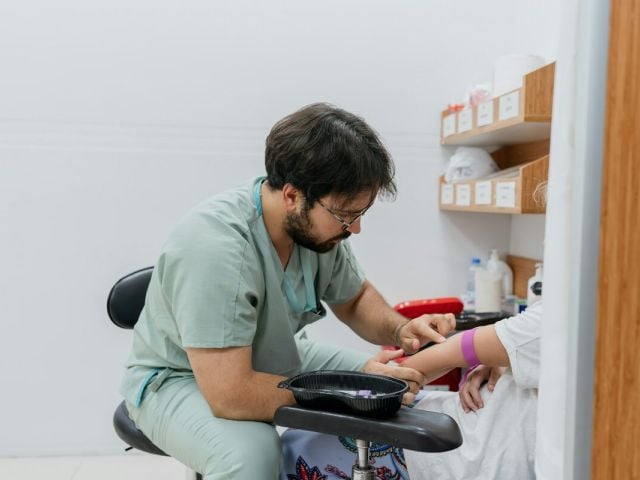
The DHEAS test is a quick blood draw (usually under five minutes) with no fasting required, so you can eat normally and book it anytime. DHEA-S levels stay stable throughout the day, unlike cortisol.
A few things can skew results:
- High-dose biotin (over 5 mg/day) may falsely raise levels, so pause it 8–12 hours beforehand (regular multivitamin amounts are fine)[4]
- Nicotine can increase DHEA-S, and some medications or supplements may raise or lower it, so review what you take with your healthcare provider[5]
Labs typically measure DHEA-S by immunoassay (often 1–4 hours for results), while some use LC-MS/MS for higher accuracy. It’s also commonly ordered with other hormone tests like testosterone, estrogen, cortisol, ACTH, or SHBG.
Understanding Your DHEA-S Blood Test Results
DHEA-S reference ranges vary significantly based on your age and biological sex. Your results must be interpreted within the context of these age-specific ranges.
Reference Ranges by Age and Sex
Women:
| Age Group | Range (μg/dL) |
|---|---|
| 20-29 years | 65-380 |
| 30-39 years | 45-270 |
| 40-49 years | 32-240 |
| 50-59 years | 26-200 |
| 60-69 years | 13-130 |
Men:
| Age Group | Range (μg/dL) |
|---|---|
| 20-29 years | 280-640 |
| 30-39 years | 120-520 |
| 40-49 years | 95-530 |
| 50-59 years | 70-310 |
| 60-69 years | 42-290 |
Men typically maintain higher DHEA-S levels than women throughout their lifespan. Both sexes experience similar patterns of decline after peak levels in the third decade of life.
Reference ranges can differ slightly between laboratories due to different testing methods and reference populations. Always compare your results to the specific range provided by your testing lab.
What Do High DHEA-S Levels Mean?
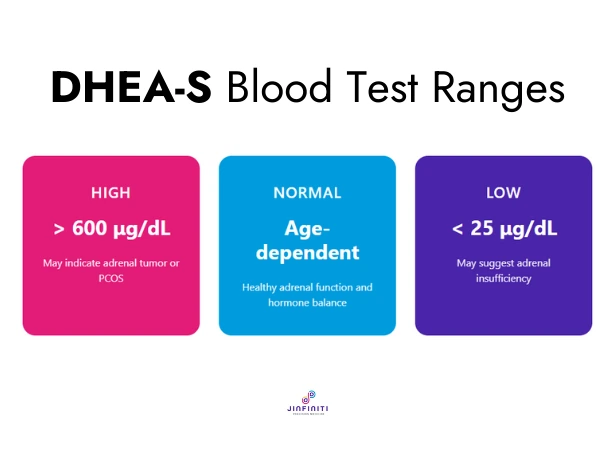
If your DHEA-S result is high, it usually means one thing: your adrenal glands are making extra androgen hormones.
A DHEA-S level above 600 μg/dL strongly suggests an androgen-secreting adrenal tumor. Studies report that over 90% of patients with these tumors have elevated DHEA-S, often far above that cutoff.
What high hormone levels can point to:
- Adrenal carcinoma (cancer): Often causes very high DHEA-S because the tumor may not convert hormones into other androgens like testosterone.
- Benign adrenal adenoma: Can raise testosterone too, and may cause a moderate DHEA-S rise.
In PCOS, DHEA-S is elevated in a smaller number of patients. Around 20-30% of women with PCOS have high DHEA-S even when other androgen tests look normal. In one study of 643 young PCOS patients, 33% had elevated DHEA-S (above 3 μg/mL) and also had higher testosterone and androstenedione.[2]
Researcher Dr. Andrea Dunaif (Mount Sinai) has described PCOS as “a major metabolic disorder and a leading risk factor for type 2 diabetes mellitus,” with hyperandrogenism (high androgens) as a defining feature.
In children, DHEA-S around 40 to 130 μg/dL can mean premature adrenarche (early adrenal hormone activity). Dr. Rosenfield notes these kids often grow faster and have advanced bone age, but that usually does not limit adult height.[3]
CAH (congenital adrenal hyperplasia) often shows markedly elevated DHEA and DHEA-S, especially in 21-hydroxylase deficiency, the most common form.
What Do Low DHEA-S Levels Mean?
Low DHEAS levels usually means your adrenal glands are making less of their androgen hormones.
The most serious possibility is adrenal insufficiency, where the adrenal glands don’t make enough hormones. This can be:
- Primary adrenal insufficiency (Addison’s disease)
- Secondary adrenal insufficiency (problems in the pituitary or hypothalamus affecting adrenal signaling)
One study by Dr. Irina Bancos and colleagues found that when people had baseline cortisol under 5 μg/dL and DHEA-S under 25 μg/dL, 72.2% were correctly diagnosed with adrenal insufficiency.[1]
Dr. Bancos also notes an important point for women: because the adrenal glands are a major source of androgens, adrenal insufficiency in women is typically linked to marked androgen deficiency.[6]
Some forms of Cushing’s syndrome (excess cortisol) can come with low DHEA-S. In particular, unilateral adrenal adenomas causing Cushing’s often produce low DHEA-S, which can help differentiate an adrenal cause from a pituitary cause.
Low DHEA-S has been linked with a range of chronic conditions, including:
- diabetes
- osteoporosis
- dementia
- chronic fatigue syndrome
- inflammatory disorders
DHEA-S naturally declines with age. Many older adults have levels near the bottom of the reference range (or slightly below). In that context, a low result may reflect normal aging, not disease.
🧬 MORE BIOMARKER TESTING
- Oxidative stress accelerates hormone decline. Check your body’s defense system with total antioxidant capacity testing.
- Blood sugar control affects hormone balance. You can track long-term glucose exposure with a glycated serum protein test.
- Inflammation disrupts adrenal function. Measure cardiovascular risk and methylation status with homocysteine testing.
When DHEA-S Testing Matters Most
DHEA-S is most useful when you interpret it with other hormones, especially morning (baseline) cortisol.
Dr. Irina Bancos’s research supports a simple two-step approach that makes adrenal insufficiency screening faster and more efficient:
Step 1: Check baseline cortisol
- Cortisol ≥ 10 μg/dL: adrenal insufficiency is ruled out in 98.8% of patients.
Step 2: Use DHEA-S when cortisol is borderline or low
- Cortisol 5 to 9.9 μg/dL: adrenal insufficiency was rare, and only 1.3% had it when DHEA-S ≥ 60 μg/dL.
- Cortisol < 5 μg/dL + DHEA-S < 25 μg/dL: about a 72.2% chance of adrenal insufficiency.
Because this narrows down who truly needs more testing, it can reduce the need for cosyntropin stimulation tests in many cases, saving time and cost.
When to Consider Getting Tested
DHEA-S testing tends to be most helpful for:
- women with unexplained hormonal symptoms
- anyone with suspected adrenal dysfunction
- people with chronic fatigue plus other hormonal changes
“Hormone testing only gives you a glimpse into what’s going on inside your cells,” says Jin-Xiong She, PhD, founder of Jinfiniti Precision Medicine. “We have our clients get a full panel of biomarker tests to paint a complete picture of cellular health, in addition to their hormones, and that’s where we see the most success.”
Jinfiniti’s CLIA-Certified AgingSOS Ultimate Panel measures DHEA-S alongside markers of inflammation, oxidative stress, metabolic function, and cellular aging. This broader view aligns with the Test, Act, Optimize approach we use in precision medicine.
The Bottom Line
Testing your DHEA-S offers insight into your adrenal glands and hormone function. DHEA-S levels stay relatively stable throughout the day, and testing is easy.
Results must be interpreted within age-specific reference ranges and in context with your symptoms and other test findings. High levels of DHEA-S can indicate adrenal tumors, PCOS or congenital adrenal hyperplasia. Low levels could signal adrenal insufficiency or some cases of Cushing’s syndrome.
Your DHEA-S level is just one piece of your complete health picture. Discuss your results with your healthcare provider, who can interpret them alongside your medical history and symptoms to determine the best next steps.
Frequently Asked Questions
What are the symptoms of DHEA deficiency?
Low DHEA often shows up as chronic fatigue that doesn’t improve with rest. You might notice decreased muscle mass, reduced bone density, or low libido.
Women may experience vaginal dryness, irregular periods, or difficulty getting pregnant. Depression, brain fog, and difficulty handling stress are also common signs. Many people with low DHEA also struggle with unexplained weight gain, especially around the midsection.
How can I increase DHEA naturally?
Quality sleep is one of the most effective ways to support healthy DHEA production. Your adrenal glands need 7-9 hours of consistent sleep to function optimally.
Regular exercise, particularly resistance training and high-intensity interval training, can help maintain DHEA levels. Managing chronic stress through meditation, yoga, or other relaxation techniques protects your adrenal function. Eating enough protein, healthy fats, and micronutrients like zinc and magnesium gives your body the raw materials it needs for hormone production.
Some people benefit from DHEA supplements, though you should test your levels first and work with a healthcare provider.
What does DHEA do for women?
DHEA serves as the primary source of androgens (male hormones) in women. Your body converts it into testosterone and estrogen as needed.
This matters for maintaining muscle mass, bone density, and healthy libido. DHEA also supports vaginal health, skin elasticity, and energy levels. Women with low DHEA often experience reduced sexual desire, vaginal dryness, and accelerated signs of aging.
After menopause, when ovarian hormone production drops, DHEA becomes even more important as your body’s main androgen source.
What are the benefits of DHEA for men?
Men’s bodies convert DHEA into testosterone, making it valuable for maintaining muscle mass and strength. Healthy DHEA levels support bone density, which becomes increasingly important with age.
DHEA also plays a role in metabolic health, helping regulate insulin sensitivity and body composition. Some research suggests it may support cardiovascular health and cognitive function. While testosterone gets more attention, DHEA provides the raw material your body uses to make testosterone naturally.
Men with low DHEA often notice decreased energy, reduced muscle mass, and difficulty recovering from exercise.
Referenced Sources
- Han AJ, Suresh M, Gruber LM, Algeciras-Schimnich A, Achenbach SJ, Atkinson EJ, et al. Performance of Dehydroepiandrosterone Sulfate and Baseline Cortisol in Assessing Adrenal Insufficiency. The Endocrine Society; 2024. https://doi.org/10.1210/clinem/dgae855
- Carmina E, Longo RA. Increased Prevalence of Elevated DHEAS in PCOS Women with Non-Classic (B or C) Phenotypes: A Retrospective Analysis in Patients Aged 20 to 29 Years. MDPI AG; 2022. https://doi.org/10.3390/cells11203255
- Rosenfield RL. Normal and Premature Adrenarche. The Endocrine Society; 2021. https://doi.org/10.1210/endrev/bnab009
- Motahari H, Thumma S, Menon L. Biotin Supplementation Creates the Misleading Diagnosis of Secondary Adrenal Insufficiency. The Endocrine Society; 2021. https://doi.org/10.1210/jendso/bvab048.242
- Van Voorhees EE, Dennis MF, McClernon FJ, Calhoun PS, Buse NA, Beckham JC. The Association of Dehydroepiandrosterone and Dehydroepiandrosterone Sulfate With Anxiety Sensitivity and Electronic Diary Negative Affect Among Smokers With and Without Posttraumatic Stress Disorder. Ovid Technologies (Wolters Kluwer Health); 2013. https://doi.org/10.1097/JCP.0b013e3182968962
- Bancos I, Hahner S, Tomlinson J, Arlt W. Diagnosis and management of adrenal insufficiency. Elsevier BV; 2015. https://doi.org/10.1016/S2213-8587(14)70142-1
Read More