




The Short Answer
- A good NMN supplement can raise NAD+, but quality varies and labels can mislead.
- Look for 98%+ purity, a batch certificate, a clear dose in mg and sealed packaging.
- Most human trials used 250 to 900 mg a day.
- Test your NAD+ before you start and at four to six weeks to confirm it’s working.
Your cart has three NMN jars in it. One is cheaper, one says “pharmaceutical grade”, and one has a sciencey font. The best NMN supplement is the one with a verified purity and dose that measurably raises your NAD+. You can check the first part on the label and the certificate, and the second part with a simple before-and-after test.
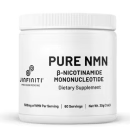
Our NMN supplements, including Pure NMN and Vitality↑®, are third-party tested in every batch, and our Intracellular NAD+ Test shows whether yours is working. Test before you start, then retest at four to six weeks to see your own result.
Is an NMN Supplement Worth Taking?
For raising NAD+, the evidence says yes. NMN is a form of vitamin B3 that your cells turn into NAD+, a molecule they need to make energy and repair DNA. NAD+ levels tend to fall with age, and several controlled human trials show NMN supplements bring blood levels back up.
For what happens after that, the evidence is more modest. In an 80-person, 60-day trial, people on NMN raised blood NAD+ and walked farther in a six-minute test. A 2025 review of trials in older adults found no clear change in grip strength or muscle mass. So NMN is a reasonable, measurable step for healthspan, the years you spend in good health, rather than a fix for aging.
How to Pick the Best NMN Supplement: Six Label Checks
Most quality problems with NMN are visible before you buy, if you know where to look. Run any product through these six checks, ours included.
Purity of 98% or Higher
Purity tells you how much of the powder is actually NMN. Aim for 98% or higher, confirmed by a lab method called HPLC (high-performance liquid chromatography), which separates the NMN from everything else in the sample. A purity claim on the front of the jar means little without a test result behind it.
A Certificate of Analysis for Your Batch
A certificate of analysis (CoA) is the lab report for a specific batch. A useful one lists the NMN percentage, the test method, heavy metals, microbes, the date and a batch number that matches your jar. If the brand only shares a generic CoA, or won’t share one, move on.
The NMN Dose per Serving
Check the Supplement Facts panel for NMN in milligrams per serving. Some labels list the capsule’s total weight on the front, which includes fillers, so a “1,000 mg” capsule may hold far less NMN. If the NMN sits inside a “proprietary blend” with no amount, you can’t compare it with the doses used in trials.
Beta-NMN on the Label
NMN comes in two mirror-image forms, and the one your body uses is beta-NMN (β-NMN). Human trials have used the beta form. A label that names β-NMN is telling you the maker knows the difference, which is a small but useful sign.
Packaging and Storage
NMN breaks down faster when it’s warm and damp, so packaging matters more than most labels admit. Look for an opaque, airtight container, ideally with a desiccant packet or a nitrogen flush. Store it somewhere cool and dry; a sunny windowsill is a great place for basil and a poor one for NMN.
Price per Gram
NMN is expensive to make well, which explains why NMN costs what it does. If one product costs a fraction of the others, ask for its batch certificate before you buy. Compare the price per gram of actual NMN, not the price per jar or per capsule.
NMN Powder vs Capsules vs Sublingual vs Liposomal
The form changes how you take NMN more than how much reaches your cells. No human trial has shown one form clearly beats the others for raising NAD+, so pick the one you’ll take every day.
| Form | How you take it | Good for | Things to know |
|---|---|---|---|
| Powder | Mixed in water or held under the tongue | Flexible dosing, lowest cost per gram | Needs a scoop and a dry place to store |
| Capsules | Swallowed with water | Convenience and travel | Check NMN mg, not capsule weight |
| Sublingual (lozenge or powder under the tongue) | Dissolved in the mouth | People who’d rather not swallow capsules | Absorption advantage isn’t proven in people |
| Liposomal | Liquid or capsule with a fat coating | People who prefer liquids | Higher price; human evidence is limited |
If you’re torn between the first two, our guide to sublingual NMN vs capsules walks through the trade-offs.
How Much NMN to Take a Day
Human trials have tested NMN from 250 to 1,250 mg a day, and they don’t point to one right dose for everyone. Our NMN dosage guide has more detail.
250 mg a Day
250 mg is the most studied dose. Trials at this level found higher blood NAD+ and, in women with prediabetes, better insulin response in muscle after 10 weeks. It’s a sensible place to start if you’re new to NMN.
600 to 900 mg a Day
In the 80-person trial, blood NAD+ rose at every dose and was highest in the 600 and 900 mg groups. That suggests a mid-range dose covers most people, and a bigger scoop isn’t automatically a better one.
1,000 mg and Above
Doses this high are mostly used in short safety and comparison studies. A four-week trial of 1,250 mg a day in 31 healthy adults found no changes beyond normal variation in blood or urine tests. Talk with your clinician before you go this high.
Pure NMN or an NMN Formula
Once you’ve picked a quality product, the next choice is NMN on its own or NMN with other ingredients. Jinfiniti makes both, alongside our other NAD+ supplements and test kits, and here’s who each one suits.
Single-Ingredient NMN
A pure powder gives you full control over the dose. Our Pure NMN Powder is 99.5%+ pure, third-party tested in every batch and gives 500 mg per scoop. It suits people who already know their NAD+ level and want to adjust one variable at a time.
NMN With Supporting Ingredients
A formula adds ingredients that feed NAD+ through other routes. Vitality↑® NAD+ Booster pairs 500 mg of NMN per scoop with niacinamide, D-ribose and creatine. In Jinfiniti’s own four-week study of 26 adults taking two scoops a day, 22 reached the 40 to 100 µM range Dr. She uses as his optimal target.
How to Know Your NMN Supplement Is Working
Feeling better is real, but it’s hard to separate from a good week of sleep. A number is easier to trust, and it only takes two tests.
- Test first. An intracellular NAD+ test gives your starting level in µM. Dr. She’s framework sets 40 to 100 µM as optimal.
- Take one product every day, at the same dose and time, for at least four weeks. Blood NAD+ tends to rise over the first two weeks, then level off.
- Retest at four to six weeks. If you’re under 40 µM, adjust the dose or switch products, then test again.
“The label tells you what’s in the jar,” says Dr. Jin-Xiong She. “Only a test tells you what’s in your cells. I’d rather someone use a modest dose they’ve measured than a big dose they’re guessing about.”
NAD+ is one marker among many that shape how you age. If you’d like a fuller view, our longevity blood panels include intracellular NAD+ along with heart, metabolic and inflammation markers such as ApoB, HbA1c and hs-CRP.
NMN Side Effects and Who Should Avoid It
NMN has a good short-term safety record. The main questions are about long-term use and specific groups.
Common NMN Side Effects
Side effects in trials have been mild and uncommon. A 2026 review of NMN trials found no rise in side effects or in the liver enzymes ALT and AST at 250 to 2,000 mg a day. When people do notice something, it’s usually stomach upset or a headache.
Who Should Avoid NMN or Check First
Talk with your clinician before starting NMN if any of these apply:
- You’re pregnant or breastfeeding, since there’s no safety data
- You have a history of cancer, because NAD+ also supports fast-growing cells in lab studies
- You take diabetes medicines, since NMN may change how your body responds to insulin
- You take several prescription medicines and want to check for interactions
Most trials lasted weeks to months, so long-term data is still thin. Under Dr. She’s framework, levels above 100 µM aren’t likely to add benefit, which is another reason to test rather than keep raising the dose. Talk with your clinician about dose if you take any prescription medicine.
How Jinfiniti Can Help
You want an NMN supplement you can trust, and proof that it’s raising the NAD+ inside your cells.
Our NMN range includes Pure NMN at 99.5%+ purity and Vitality↑®, with 500 mg of NMN per scoop.
Pair your NMN with the Intracellular NAD+ Test, then retest at four to six weeks to see your result.
Frequently Asked Questions
Why do some people stop taking NMN?
The most common reasons are cost and not noticing a difference. Many people never measure their NAD+, so they can’t tell whether the product worked. A before-and-after test helps you decide whether to keep going, change the dose or stop.
Is NMN legal to buy in the US?
Yes. In September 2025 the FDA concluded that NMN is lawful in dietary supplements, reversing its 2022 position. That decision is why NMN products are widely sold again in the US.
What time of day should you take NMN?
Most people take it in the morning, and there’s no strong evidence for one time. In a 12-week trial of 108 older adults, an afternoon dose showed the biggest gains in a sit-to-stand test, but placebo groups improved too.
How long does NMN take to work?
Blood NAD+ starts rising within days and tends to level off after about two weeks. Any changes in how you feel, if they come, usually take longer. Retest your NAD+ at four to six weeks to see where you’ve settled.
Is NMN better than NR?
Neither has clearly won. In a 2026 trial, 1,000 mg a day of either one raised blood NAD+ by a similar amount. Our comparison of NR vs NMN covers the head-to-head trials in more detail.
🧬 Related Reading
- NMN vs NAD: What’s the Difference, and Which Should You Take?
- 11 Promising Benefits of NMN Supplements
- What to Expect Before and After Taking NMN Supplements
References
- Yi L, Maier AB, Tao R, et al. The efficacy and safety of β-nicotinamide mononucleotide (NMN) supplementation in healthy middle-aged adults: a randomized, multicenter, double-blind, placebo-controlled, parallel-group, dose-dependent clinical trial. GeroScience. 2023;45(1):29-43. doi:10.1007/s11357-022-00705-1
- Prokopidis K, Moriarty F, Bahat G, et al. The effect of nicotinamide mononucleotide and riboside on skeletal muscle mass and function: a systematic review and meta-analysis. Journal of Cachexia, Sarcopenia and Muscle. 2025;16(3):e13799. doi:10.1002/jcsm.13799
- Yoshino M, Yoshino J, Kayser BD, et al. Nicotinamide mononucleotide increases muscle insulin sensitivity in prediabetic women. Science. 2021;372(6547):1224-1229. doi:10.1126/science.abe9985
- Fukamizu Y, Uchida Y, Shigekawa A, et al. Safety evaluation of β-nicotinamide mononucleotide oral administration in healthy adult men and women. Scientific Reports. 2022;12(1):14442. doi:10.1038/s41598-022-18272-y
- Yang W, Huang J, Tang Z, et al. Safety and metabolism-related outcomes of oral nicotinamide mononucleotide supplementation in adults: a systematic review and meta-analysis. Nutrients. 2026;18(14):2251. doi:10.3390/nu18142251
- Kim M, Seol J, Sato T, et al. Effect of 12-week intake of nicotinamide mononucleotide on sleep quality, fatigue, and physical performance in older Japanese adults: a randomized, double-blind placebo-controlled study. Nutrients. 2022;14(4):755. doi:10.3390/nu14040755
- Christen S, Redeuil K, Goulet L, et al. The differential impact of three different NAD+ boosters on circulatory NAD and microbial metabolism in humans. Nature Metabolism. 2026;8(1):62-73. doi:10.1038/s42255-025-01421-8