





The Short Answer
- NAD+ is the molecule your cells use; NMN is a building block your cells turn into NAD+.
- By mouth, NMN has much stronger human evidence for raising NAD+ than NAD+ capsules do.
- IV NAD+ works differently, costs far more and can cause stomach upset or chest pressure.
- Test your NAD+ level before you choose, then retest after four to six weeks.
NMN vs NAD is the choice on most supplement shelves right now. One bottle says NAD+ in big letters, the one beside it says NMN, and the clinic down the road offers NAD+ drips. For most people taking a supplement by mouth, NMN is the better way to raise NAD+. NAD+ capsules have little human evidence, while NMN has several controlled trials behind it.
Our Intracellular NAD+ Test shows how much NAD+ is inside your cells right now, from a finger prick at home. Test before you choose between NMN and NAD+, then retest to see whether your choice is working.
NMN vs NAD at a Glance
Both names show up on the same labels. One is the fuel your cells burn, and the other is what your cells build it from.
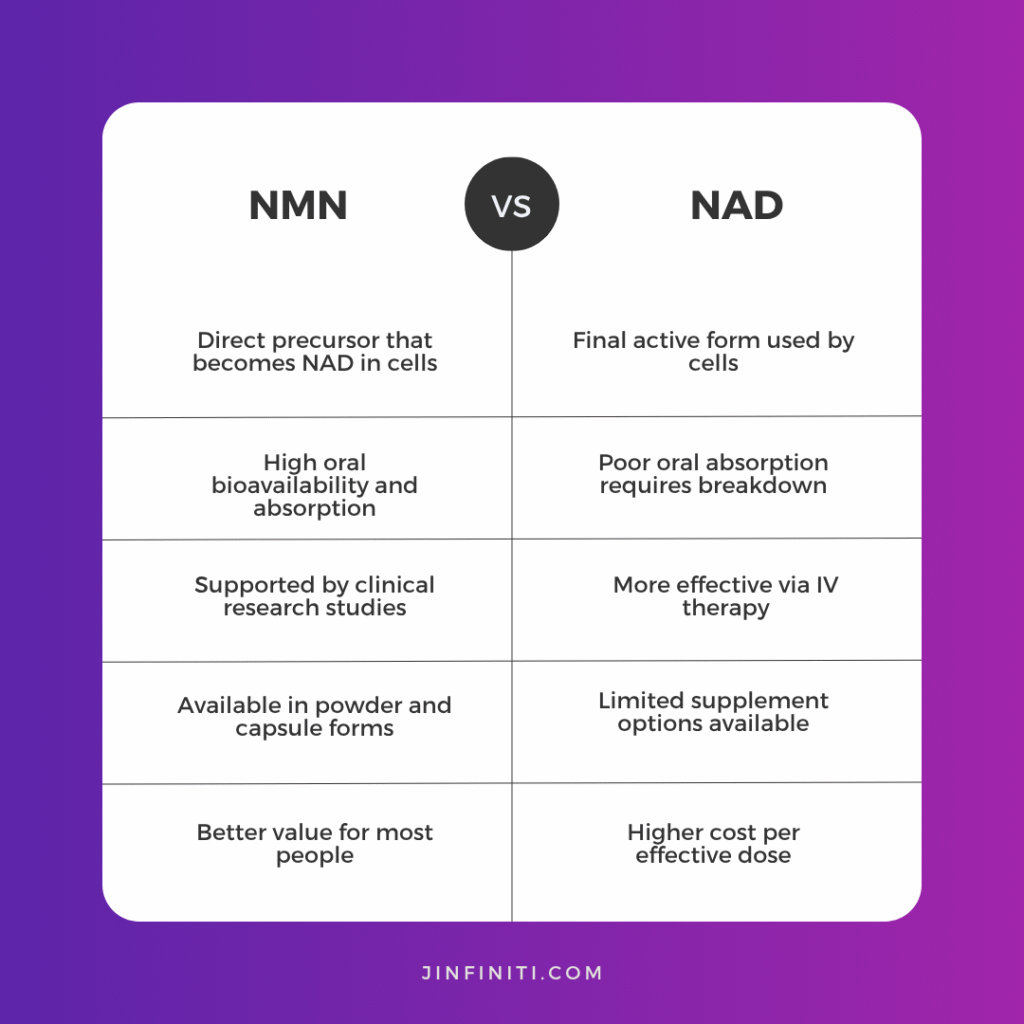
| NMN (nicotinamide mononucleotide) | NAD+ (nicotinamide adenine dinucleotide) | |
|---|---|---|
| What it is | A precursor, or building block | The active coenzyme your cells use |
| Size | About half the size of NAD+ | Large, two linked units |
| Taken by mouth | Raises blood NAD+ in several human trials | Little human evidence; much is broken down in the gut |
| Other routes | Powder, capsules, under the tongue | IV drips, injections, nasal sprays |
| Doses in human trials | 250 to 1,250 mg a day | IV doses vary widely by clinic |
| Typical cost | A monthly supplement | IV sessions cost far more per dose |
| How to check it worked | Intracellular NAD+ test | Intracellular NAD+ test |
What Are NMN and NAD+?
They’re two stops on the same road. Your cells make NAD+ from smaller pieces, and NMN is the last piece before NAD+ itself.
NAD+ (Nicotinamide Adenine Dinucleotide)
NAD+ is a coenzyme, a helper molecule that enzymes need to do their job. Your cells use it to turn food into energy, repair damaged DNA and run proteins called sirtuins that are linked to healthy aging. Levels tend to fall as you get older, which is why NAD+ comes up so often in longevity research.
NMN (Nicotinamide Mononucleotide)
NMN is a form of vitamin B3 that your cells convert into NAD+ in a single step. You’ll find tiny amounts in broccoli, avocado and edamame, though you’d need a truly heroic salad to match a supplement dose. Inside the cell, an enzyme called NMNAT adds the final piece and NMN becomes NAD+.
Why Oral NAD+ Struggles to Reach Your Cells
Size is the first problem. NAD+ weighs about twice as much as NMN, and your gut tends to break it into smaller pieces before it’s absorbed. Those pieces can still feed NAD+ production, so you’re paying NAD+ prices for what your body treats as precursors.
Evidence is the second problem. We couldn’t find a controlled human trial showing that oral NAD+ capsules raise blood NAD+ in healthy adults. NMN, by comparison, has been tested in several. If you already own a jar of NAD+ capsules, a before-and-after test is the fairest way to see what they’re doing for you.
What Human Studies Show for NMN
NMN’s evidence is strongest for raising NAD+ itself and more modest for anything beyond that.
Blood NAD+ Levels
In a 60-day trial of 80 healthy middle-aged adults, blood NAD+ rose at 300, 600 and 900 mg a day, with the highest levels at 600 and 900 mg. A 12-week trial in 30 adults found 250 mg a day raised whole-blood NAD+ with no safety concerns. NMN makers were involved in both trials.
Walking and Sleep
The same 80-person trial found people on NMN walked farther in six minutes than those on placebo. In a 12-week trial of 60 older adults, 250 mg a day kept walking speed steady and improved sleep scores. The main goal of that trial didn’t change, so treat the sleep result as a lead worth watching.
Blood Sugar and Insulin
One trial stands out. Women with prediabetes who took 250 mg of NMN a day for 10 weeks saw their muscles respond better to insulin. It was a small group in a narrow population, so it doesn’t mean NMN lowers blood sugar for everyone.
Can You Take NMN and NAD Together?
You can, but there’s rarely a reason to. NMN becomes NAD+ inside your cells, so stacking oral NAD+ on top mostly adds cost. The same goes for pairing NMN with NR: you’ll get a clearer answer by changing one thing at a time.
If you’re getting IV NAD+ at a clinic and also take NMN at home, tell your clinician about both. Then test your intracellular NAD+ before and a few weeks after, so you can see whether the combination is getting you anywhere the NMN alone wouldn’t.
NMN vs NAD+ IV and Injections
Clinics sell NAD+ drips and shots as the fast route, but the human research on them is thin and the trade-offs are real.
IV NAD+
An IV drip puts NAD+ straight into your bloodstream, usually over one to several hours. In a six-hour infusion pilot study, plasma NAD+ didn’t rise for the first two hours, because the body cleared it as fast as it arrived. A 2026 review of clinic records found IV NAD+ often caused stomach upset and chest pressure, with each infusion averaging about 97 minutes.
NAD+ Injections
Injections under the skin deliver smaller doses at home or in a clinic. There are no controlled trials of NAD+ injections measuring intracellular levels in healthy adults. If you use them, a before-and-after test is the only way to know what they’re doing for you.
Oral NMN
Oral NMN is the cheapest and best-studied of the three. It takes days to weeks to raise NAD+ instead of hours, and it doesn’t need a needle or an afternoon in a recliner. That’s why most NAD+ supplements made for daily use at home are precursors like NMN. Our guide to NAD IV side effects covers what people report after drips.
How to Tell Which One Is Working for You
The trial averages matter less than your own result, because people respond differently to the same dose. A simple loop answers the NMN vs NAD question for your body in about six weeks.
Measure Your Intracellular NAD+ First
Get a baseline before you change anything. Our guide to testing NAD+ levels explains how the finger-prick test works. Dr. She’s framework sets the optimal range at 40 to 100 µM, so your first result tells you whether you need to raise your level at all.
Retest After Four to Six Weeks on One Option
Pick one route, take it daily, then retest at four to six weeks. Most people choosing an oral option start with NMN in the 250 to 600 mg range; our NMN dosage guide covers the details. In Jinfiniti’s own four-week study of 26 adults taking our NMN-based Vitality↑® NAD+ Booster, 22 reached 40 to 100 µM.
Dr. Jin-Xiong She sees the same pattern in practice: “Most people who come to us have tried something already. What they haven’t done is measure it. Once you see your NAD+ number before and after, the NMN or NAD+ question usually answers itself.”
NAD+ is one part of how you age, not the whole picture. If you want to see it alongside heart, metabolic and inflammation markers, our longevity blood panels include intracellular NAD+ with 40+ or 50+ biomarkers, depending on the panel.
NMN and NAD+ Side Effects and Safety
NMN looks safe in short trials. A 2026 review of NMN trials found no rise in side effects or in the liver enzymes ALT and AST at 250 to 2,000 mg a day. Mild stomach upset and headache are the most common complaints.
IV NAD+ is a different story. Infusing it too quickly often causes nausea, cramping or a tight chest, which is why clinics run drips slowly. Either way, these groups should check with a clinician first:
- People who are pregnant or breastfeeding
- Anyone with a history of cancer, since NAD+ also supports fast-growing cells in lab studies
- People taking diabetes or blood pressure medicines
- Anyone considering IV NAD+ with heart or kidney conditions
Long-term data on either one is limited, and levels above 100 µM aren’t likely to add benefit under Dr. She’s framework. Talk with your clinician before starting NMN or NAD+, and before combining them.
How Jinfiniti Can Help
You’re deciding between NMN and NAD+ and want to know which one actually raises the NAD+ inside your cells.
Vitality↑® NAD+ Booster pairs 500 mg of NMN per scoop with niacinamide, D-ribose and creatine.
Take it for four weeks, then retest with the Intracellular NAD+ Test to see if you reached 40 to 100 µM.
Frequently Asked Questions
Is NMN the same as NAD?
No. NMN is a precursor, a smaller molecule your cells turn into NAD+ in one step. NAD+ is the active coenzyme itself. Taking NMN is a way to give your cells what they need to make more NAD+.
Why take NMN instead of NAD?
Because NMN has the stronger evidence when taken by mouth. Several controlled human trials show oral NMN raises blood NAD+, while oral NAD+ is largely broken down in the gut and lacks similar trials. NMN also costs less per dose than IV NAD+.
What are the negative side effects of NMN?
In human trials, side effects have been mild and uncommon, mostly stomach upset or headache. A 2026 review of NMN trials found no rise in adverse events at up to 2,000 mg a day. Talk with your clinician about dose if you take prescription medicines.
Does NMN really reverse aging?
No human study shows NMN reverses aging. Trials show it raises NAD+ and may help some people with walking, sleep or insulin response. We’d frame it as one measurable step toward healthspan, the years you spend in good health.
Why did Amazon stop selling NMN?
Amazon pulled many NMN listings after the FDA said in 2022 that NMN couldn’t be sold as a supplement. In September 2025 the FDA reversed that view and concluded NMN is lawful in dietary supplements, so NMN can again be sold as a supplement in the US.
🧬 Related Reading
- 9 Established NAD+ Precursors You Should Know
- NAD Injections vs. Oral NAD Supplements: How Do They Compare?
- NAD Levels by Age Group: What’s Considered Normal?
References
- Yi L, Maier AB, Tao R, et al. The efficacy and safety of β-nicotinamide mononucleotide (NMN) supplementation in healthy middle-aged adults: a randomized, multicenter, double-blind, placebo-controlled, parallel-group, dose-dependent clinical trial. GeroScience. 2023;45(1):29-43. doi:10.1007/s11357-022-00705-1
- Okabe K, Yaku K, Uchida Y, et al. Oral administration of nicotinamide mononucleotide is safe and efficiently increases blood nicotinamide adenine dinucleotide levels in healthy subjects. Frontiers in Nutrition. 2022;9:868640. doi:10.3389/fnut.2022.868640
- Morifuji M, Higashi S, Ebihara S, et al. Ingestion of β-nicotinamide mononucleotide increased blood NAD levels, maintained walking speed, and improved sleep quality in older adults in a double-blind randomized, placebo-controlled study. GeroScience. 2024;46(5):4671-4688. doi:10.1007/s11357-024-01204-1
- Yoshino M, Yoshino J, Kayser BD, et al. Nicotinamide mononucleotide increases muscle insulin sensitivity in prediabetic women. Science. 2021;372(6547):1224-1229. doi:10.1126/science.abe9985
- Grant R, Berg J, Mestayer R, et al. A pilot study investigating changes in the human plasma and urine NAD+ metabolome during a 6 hour intravenous infusion of NAD+. Frontiers in Aging Neuroscience. 2019;11:257. doi:10.3389/fnagi.2019.00257
- Reyna K, Heinzen G, Patel N, et al. Intravenous infusion of nicotinamide adenine dinucleotide (NAD) versus nicotinamide riboside (NR): a retrospective tolerability pilot study in a real-world setting. Frontiers in Aging. 2026;7:1652582. doi:10.3389/fragi.2026.1652582
- Yang W, Huang J, Tang Z, et al. Safety and metabolism-related outcomes of oral nicotinamide mononucleotide supplementation in adults: a systematic review and meta-analysis. Nutrients. 2026;18(14):2251. doi:10.3390/nu18142251