
The Best Supplements for Brain Fog During Menopause
Written on . Posted in Aging, Creatine, Magnesium, Memory Loss and Brain Fog, Menopause, NAD+, Vitamin B.
What You Should Know
- Menopause brain fog has two converging drivers: hormonal disruption and cellular energy depletion. Addressing one without the other often produces inconsistent results.
- NAD+ levels decline with age and estrogen withdrawal, reducing the fuel available to brain cells for energy production, repair, and signaling.
- Creatine has credible clinical data for memory improvement in adults, with the strongest effects in older age groups.
- Testing your NAD+ levels before supplementing gives you a measurable baseline and removes the guesswork from dosing.
You’re mid-sentence and the word just isn’t there. You walk into a room and stand there for a moment, waiting for your brain to catch up. You’ve slept, more or less, and everything still feels slower, hazier, slightly out of reach.
Menopause brain fog is widely framed as a hormone problem. That’s part of the picture. There’s a second factor that gets considerably less attention: a measurable decline in cellular energy that runs alongside the hormonal shift and compounds it. Understanding both matters, because the right supplement depends on which root cause is actually driving the fog for you.
CLIA-Certified NAD Blood Test
Find out if your NAD+ level is contributing to brain fog.
Menopause Brain Fog Has Two Causes, Not One
The standard explanation for menopause brain fog begins and ends with estrogen. Estrogen drops, cognition changes, here are some adaptogens and B vitamins. Take something, see if it helps.
That approach works for some women. For others, the results are inconsistent — and the reason is usually that only one of two distinct mechanisms is being addressed.
What Estrogen Does for Your Brain
Estrogen isn’t just a reproductive hormone. It regulates neurotransmitter activity (serotonin, dopamine, acetylcholine), supports synaptic density in the hippocampus, and helps maintain glucose transport into neurons. A 2023 review in Therapeutic Advances in Endocrinology and Metabolism found that the menopause-related decline in circulating estrogen may significantly reduce brain bioenergetics, contributing to increased risk of cognitive decline and late-onset Alzheimer’s disease in postmenopausal women.
This explains why women frequently report trouble with word recall, focus, and processing speed during perimenopause, even when standard bloodwork looks completely normal.
Why Cellular Energy Is the Missing Piece
Estrogen also plays a supporting role in mitochondrial function and NAD+ metabolism within brain tissue. NAD+ (nicotinamide adenine dinucleotide) is the coenzyme your cells use to produce energy. Your brain consumes roughly 20% of your body’s total energy output, even at rest. When NAD+ levels drop, brain cells have less fuel for signal transmission, cellular repair, and clearing metabolic waste.
NAD+ levels decline naturally with age, typically beginning in the 30s. A 2024 review in Frontiers in Endocrinology found that estrogen’s decline during menopause drives measurable changes in brain structure, connectivity, and energy metabolism. The hormonal and cellular energy declines aren’t separate events. They’re compounding each other.
Your brain ends up running on less fuel, with less hormonal support, at the same time.
Why Standard Bloodwork Won’t Catch This
A standard metabolic panel won’t detect NAD+ deficiency. Neither will a basic hormone panel. Women experiencing real cognitive symptoms in perimenopause are frequently told their tests look fine, because the biomarkers driving the problem aren’t on the panel. If you’ve been in that situation, our article on the causes of fatigue that blood tests miss covers this directly. Normal bloodwork and cellular dysfunction are not mutually exclusive.
What Makes a Supplement Worth Taking for Brain Fog?
The supplement market for menopause is large, and as Harvard Health has noted, not always well-regulated. Many products make claims that outpace the evidence.
Before choosing a supplement, consider what you’re actually trying to address. Some target the hormonal pathway (B vitamins, vitamin D, adaptogens). Some target the cellular energy pathway (NAD+ precursors, creatine). Some work on both. Which matters most depends on what’s actually depleted.
Targeting the Root Cause, Not the Symptom
A sleep-disrupting progesterone drop is a different problem than a NAD+ shortfall, and the supplement that addresses one won’t fix the other. Identify what’s actually low, then address it precisely. That’s harder than following a generic supplement list, but considerably more likely to produce results you can feel.
One Overlooked Reason Supplements Don’t Work
NAD+ precursor supplements are typically dosed based on population averages, not individual baseline levels. Someone with severely depleted NAD+ needs a very different dose than someone in the suboptimal range. Without a starting measurement, you’re supplementing blind and often under-dosing the specific problem driving your symptoms.
The Best Supplements for Menopause Brain Fog
The supplements below are ranked by the strength of evidence relevant to cognitive function in midlife women. Evidence quality varies across the list; we’re explicit about where it’s strong and where it’s preliminary.
1. NAD+ Precursors: NMN and NR
If the cellular energy component is a meaningful driver of your brain fog, this is the most targeted intervention available.
NMN and NR supply the raw materials your cells use to synthesize NAD+. Researchers have measured age-dependent NAD+ reductions in intact human brain tissue directly, and clinical trials of NR at 1,000 mg/day have produced up to a 2.7-fold increase in blood NAD+ within a week. On the mechanistic side, NAD+ activates Sirt1, which regulates the mitochondrial biogenesis and antioxidant systems neurons depend on for energy. A preclinical study in Journal of Neuroinflammation found that NAD+ repletion improved learning and memory in a cognitive impairment model by restoring this pathway. Animal data shouldn’t be read as a direct prediction of human outcomes, but the mechanism is well-characterized. Human trials on brain-specific outcomes in menopause are still underway.
A multi-pathway formula outperforms single-precursor supplements. Jinfiniti’s Vitality↑® NAD+ Booster combines NMN with Niacinamide, Creatine Monohydrate, and D-Ribose. In a clinical trial of 26 adults aged 35–65, 85% reached optimal NAD+ levels within four weeks, with average levels roughly doubling. No single-ingredient precursor has matched those results in the same population.
2. Creatine
Creatine is most associated with muscle performance. The cognitive research is newer, but the mechanism is straightforward.
The brain runs largely on phosphocreatine, a fast-acting energy reserve neurons draw on for focus, working memory, and processing speed. When stores are depleted, cognitive performance drops measurably. A 2023 systematic review and meta-analysis in Nutrition Reviews, covering 10 randomized controlled trials, found that creatine supplementation improved memory in healthy adults compared to placebo. The effect was most pronounced in older adults (ages 66–76), where the benefit was more than three times larger than in younger participants.
Creatine is also one of the four ingredients in the Vitality NAD+ Booster formula, so it doesn’t require a separate supplement if you’re already addressing the NAD+ side of the equation.
3. Magnesium Glycinate
Magnesium doesn’t target NAD+ or hormonal brain function directly, but it addresses something that significantly amplifies brain fog when it’s dysregulated: sleep.
Night sweats and insomnia are among the most common perimenopause complaints, and poor sleep will compound cognitive symptoms regardless of what else you’re doing. Magnesium glycinate has a calming effect on the nervous system that makes it the most relevant form for sleep support. It’s also more absorbable than oxide or citrate forms and less likely to cause gastrointestinal side effects.
If disrupted sleep is part of your picture, magnesium glycinate deserves a place in the protocol. See The Best Magnesium Supplements for Sleep for a breakdown of forms and dosing.
4. Vitamin D3 + K2
Vitamin D receptors are distributed throughout the brain, including in areas involved with memory and mood regulation. Low vitamin D is extremely common in postmenopausal women, and deficiency is associated with poorer cognitive performance. It’s not the most targeted intervention for brain fog specifically, but it’s a foundational micronutrient gap that’s easy to miss and worth ruling out.
The K2 pairing matters. Vitamin D3 taken without K2 can direct calcium into arteries rather than bone. MK-7, the form used in Jinfiniti’s Vitamin D3 + K2, stays active in the body for approximately 72 hours compared to 8 hours for other K2 forms, making it the more effective option for sustained calcium direction.
5. B Vitamins (B12, B6, Folate)
B vitamins support nerve function and help regulate homocysteine, an amino acid that, when elevated, is independently associated with cognitive decline. B12 deficiency is particularly common as women age, since lower stomach acid production reduces absorption over time. If you haven’t had B12 levels checked recently, it’s a reasonable baseline to establish.
These aren’t specifically targeted at the cellular energy decline of menopause, but the evidence for homocysteine reduction is solid and deficiencies are common enough to address.
How to Know If Your Supplements Are Working
For most supplements, there’s no way to verify they’re working. You take them, wait a few weeks, and try to notice whether you feel different.
Sleep, stress, hormonal fluctuation, and placebo effect all shape how you perceive your own cognition. Without a baseline, you can’t know whether the supplement changed anything.
Testing Your NAD+ Levels Before and After
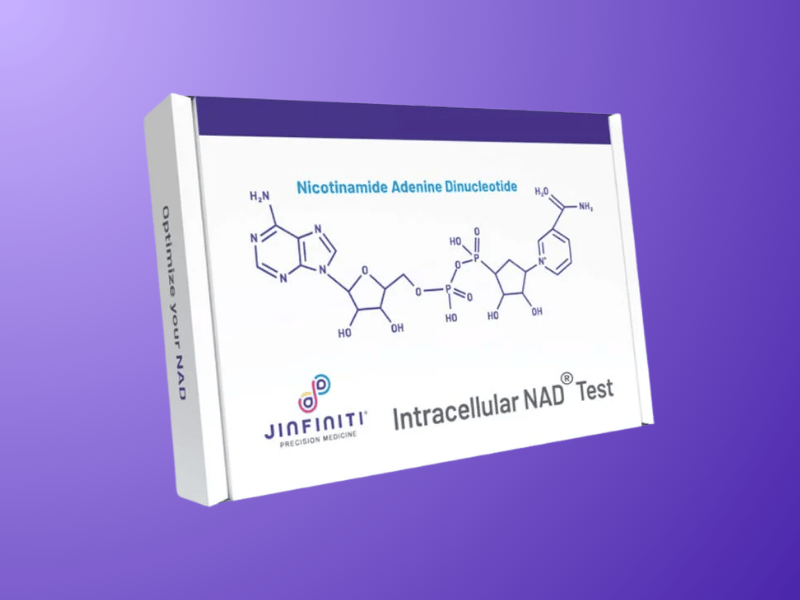
For the cellular energy piece, this is solvable. Jinfiniti’s Intracellular NAD® Test is an at-home finger-prick blood spot test that measures intracellular NAD+ levels with CLIA-certified accuracy. Results arrive within a week. Optimal range is 40–100 μM; most people presenting with fatigue and brain fog are measurably below it.
Testing before you start supplementing tells you exactly where your levels sit. Testing again at four to six weeks tells you whether the intervention worked and whether the dose needs adjusting.
As Dr. Jin-Xiong She, founder of Jinfiniti and the scientist behind the Vitality NAD+ Booster formula, explains: “Most people assume their NAD+ is fine because nothing in their standard panel flagged it. But intracellular NAD+ isn’t on a standard panel. The only way to know is to measure it — and the number changes how you interpret everything else.”
When to Retest and Adjust
If your four-week post-supplementation test shows levels in the optimal range (40–100 μM), your dose is working. If you’re still suboptimal, dose adjustment is likely needed. Some people require more than the standard serving to reach target levels, particularly when baseline levels were severely deficient. Retesting every three to four months while optimizing is a reasonable cadence.
RELATED READING
- What Is NAD and Why Do Your Cells Need It?
- Brain Fog After Eating: What It Means and What to Do About It
- Best Supplements for Inflammation: What the Evidence Shows
Frequently Asked Questions
What is the best supplement for menopause brain fog?
There’s no single best supplement. The most effective intervention depends on which root cause is driving the fog. For cellular energy deficiency, which is measurable via NAD+ testing, a multi-pathway NAD+ booster that includes creatine is the most targeted option. For sleep disruption amplifying cognitive symptoms, magnesium glycinate addresses a different part of the picture. A baseline test is the most efficient starting point before committing to a specific protocol.
Can NAD+ supplements help with menopause brain fog?
Research suggests that NAD+ precursors like NMN and NR may support cognitive function by restoring the cellular energy reserves that estrogen previously helped maintain in brain tissue. Human clinical data on brain-specific outcomes is still developing, but the mechanism is well-characterized and consistent with the broader evidence base on NAD+ and aging. Testing your baseline NAD+ levels before supplementing helps determine whether this is a meaningful factor for you.
Does creatine help with brain fog during perimenopause?
Evidence is growing. A 2023 meta-analysis found creatine supplementation improved memory in healthy adults, with the most pronounced effects in older age groups. The brain relies on phosphocreatine for high-demand cognitive tasks, and low stores correspond to the kind of processing lag many perimenopausal women describe. Creatine is also safe, well-studied, and among the more evidence-backed supplements available for cognitive support in midlife.
How long does it take for supplements to help with menopause brain fog?
It varies by supplement and by how depleted you are at baseline. For NAD+ precursors, Jinfiniti’s clinical trial found that 85% of participants reached optimal NAD+ levels within four weeks. Creatine loading protocols can produce measurable effects faster; maintenance dosing takes longer. Magnesium and vitamin D3 changes tend to become apparent over four to eight weeks. Testing at baseline and again after four to six weeks of consistent supplementation is the most reliable way to track actual progress.
Read More